


Long on pledges, short on funding details: Shujan
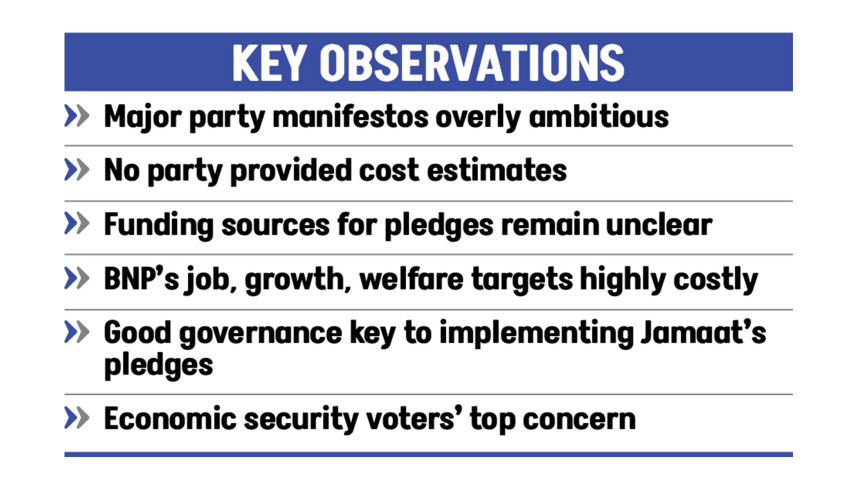
Reviewing the election manifestos of five political parties, Shushashoner Jonno Nagorik (Shujan) yesterday said the manifestos of the two major parties are excessively ambitious and that none of the parties has provided financial estimates for implementing their proposed programmes.
As a result, although the pledges may appear attractive in principle, questions remain among citizens about the economic capacity to carry them out, the organisation said.
 For all latest news, follow The Daily Star's Google News channel.
 “It is striking that no party has specified how much money will be required to implement their promises, or from which sources that money will be mobilised,” said Dilip Kumar Sarkar, chief coordinator of the organisation.
He made the remarks while presenting the keynote paper at a press conference at Jatiya National Press Club.
Referring to the BNP’s manifesto, Dilip said promises such as creating 10 million jobs, raising the economy to one trillion dollars by 2035, gradually bringing 40 million families under a family card system, and recruiting 100,000 health workers are extremely costly initiatives.
He said the scope of the proposed farmer card and the amount of subsidy promised under it are not clearly defined, making it difficult to determine how much public revenue would be required for the programme.
To increase the tax-to-GDP ratio, the tax net would have to be expanded severalfold, he said, adding that the BNP’s plan to bring wealthy citizens under the tax net may face resistance from affluent groups.
Commenting on Jamaat’s pledges, he said ensuring good governance would be the foremost prerequisite for implementing them.
“Unless corruption can be reduced to a tolerable level, it remains questionable whether plans to simultaneously lower tax rates and increase public spending can be realised in practice,” he said.
However, Shujan said that if the tax base can be significantly expanded, meritocracy established in government recruitment, investment and procurement, and losses in state-owned sectors reduced, then implementation of the manifesto may be possible.
The keynote paper said high inflation, unemployment and income inequality have shaped the main socio-economic context of the election, making economic security the most important issue for voters.
While all parties speak of development, their approaches differ, it said, noting that BNP advocates a market-based approach, NCP a citizen-centric economy, CPB state control, and Jamaat a modern, just, high-growth economy.
Regarding the implementation of the July National Charter, Shujan said it has emerged as a symbol of transparent elections, an accountable state and the restoration of citizens’ rights. Although all five parties have taken a positive stance on the charter, differences are evident in their interpretations.
“BNP and NCP see it as the foundation of a post-authoritarian transition, Islamic parties view it as an opportunity for moral governance, and CPB considers it a framework for state reform,” Dilip said.
Shujan secretary Badiul Alam Majumdar also spoke at the event.
Comments