


Prioritise rights, inclusion of persons with disabilities
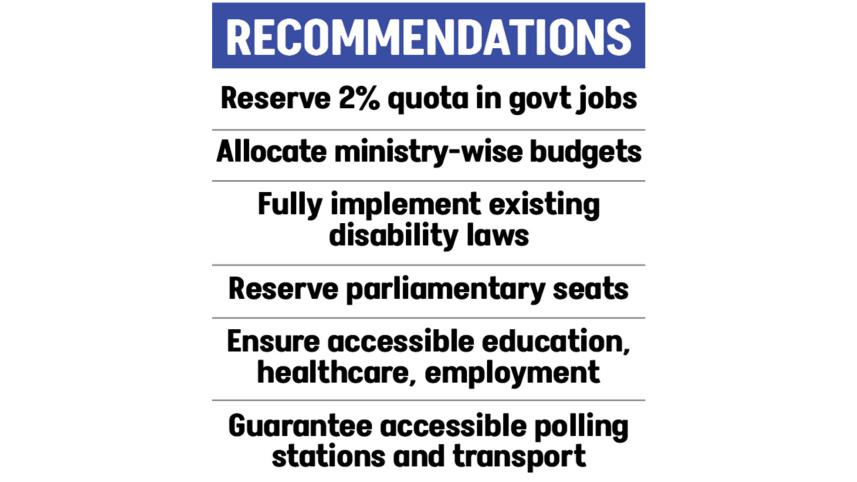
Ahead of the upcoming election, Disability Rights Watch and TIB have urged political parties to ensure the rights and inclusion of persons with disabilities by reserving a 2 percent quota in government jobs, allocating ministry-wise budgets, and fully implementing existing disability laws.
At a press conference in Dhaka yesterday, the organisations said despite Bangladesh ratifying the UN Convention on the Rights of Persons with Disabilities (CRPD) and enacting the Rights and Protection of Persons with Disabilities Act, 2013, implementation has largely stalled, depriving millions of people of basic services.
 For all latest news, follow The Daily Star's Google News channel.
 Citing World Health Organisation estimates, they said nearly 15 percent of Bangladesh’s population -- more than 20 million people -- live with disabilities.
Excluding such a large group, they said, makes inclusive development and democratic participation impossible.
The press briefing, titled “Expectations of persons with disabilities from mainstream political parties ahead of the 13th national election,” was organised by DRW with support from Transparency International Bangladesh at its Dhanmondi office.
Disability inclusion expert Dr Nafeesur Rahman said the National Action Plan on Disability, adopted in 2019, remains unimplemented and there is no dedicated budget for the sector. Coordination committees mandated by law rarely meet, while monitoring and reporting mechanisms remain weak.
He criticised the government’s Rules of Business for placing most disability-related responsibilities under the Ministry of Social Welfare, limiting the involvement of other ministries.
He called for structural reforms to engage the ministries of education, health, youth development, and women and children’s affairs.
Speakers also said Bangladesh has fallen behind in fulfilling its international commitments under the CRPD, urging legal and policy reforms, strengthening the national monitoring committee, and preparing a roadmap to submit pending reports.
They noted that disability-related data are largely absent from the Sustainable Development Goals framework, calling for the inclusion of disability indicators in national surveys and priority datasets.
The organisations proposed reserved seats for persons with disabilities in parliament and local government bodies, improved accessibility in education, health, employment and transport, increased disability allowances, and stronger support for grassroots disability organisations.
They also urged the Election Commission to run a public awareness campaign on facilities for voters with disabilities.
TIB Executive Director Dr Iftekharuzzaman said a fair election is impossible without equal voting access for all citizens, particularly marginalised groups and persons with disabilities.
“An election cannot be truly fair if some voters cannot exercise their rights on equal terms,” he said, stressing the need for safe transport and support for voters with disabilities.
“Even if postal or electronic voting is not possible, at a minimum, all voters with disabilities must be able to cast their ballots safely and independently.”
He added that all political actors must advance disability rights before, during and after the election through action plans aligned with national and international commitments.
Amrita Rejina Rozario, country director of Sightsavers Bangladesh, highlighted the need for accessible polling stations, safe transport for wheelchair users, protection for women from harassment, and continued disability inclusion beyond the election.
She urged the incoming government to address the lack of parliamentary representation for persons with disabilities and take concrete steps to ensure their participation in governance.
DRW member Md Jahangir Alam said there is still no clarity on whether registered voters with disabilities can vote through postal ballots or electronic means.
He raised concerns about accessibility at polling stations, including the use of assistive devices, caregivers and interpreters.
DRW President Monsur Ahmed Chowdhury, Member Secretary Khandaker Zahurul Alam, disability youth activist Md Abdullah, and Access Bangladesh Foundation Chairperson Mohua Paul also spoke at the event.
Comments