


Can Family Card reset our social protection system?

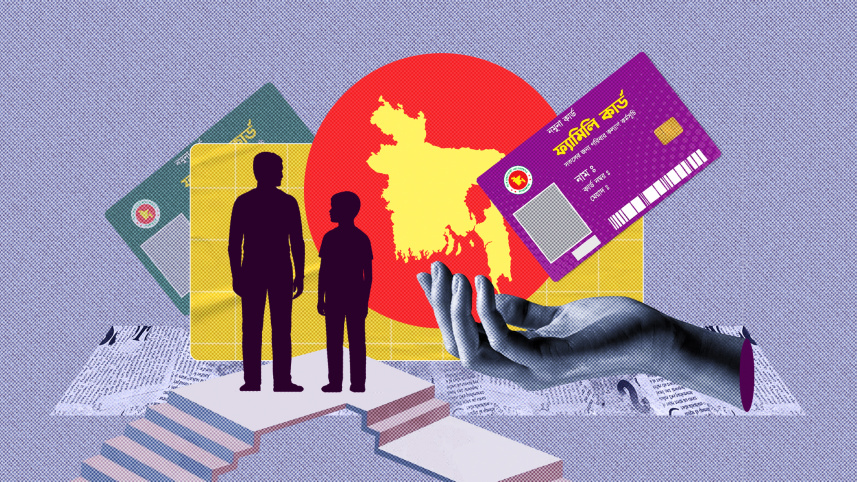
The social protection system in Bangladesh has always carried two truths together. On paper, it is large, diverse, and politically important. On the ground, it is often messy, fragmented, and sometimes unfair. The tension is back under the spotlight with the government’s new Family Card initiative, scheduled to begin as a four-month pilot from March 10, covering 6,500 families in 14 upazilas, each receiving Tk 2,500 per month through mobile wallets or bank accounts.
Supporters see it as a bold step, even historic. Critics fear it may simply become one bigger programme layered on top of an already crowded landscape. The real question is not whether the Family Card is good or bad in principle; it is whether the country can use this moment to address the deeper design and governance failures that have long held back social protection.

Two features make this initiative politically and economically significant. First, the scale being discussed is unprecedented. If the government eventually brings two crore families under monthly support, it would cost roughly Tk 5,000 crore per month, or around Tk 60,000 crore a year. It is a macro-level commitment that will shape fiscal choices for years.
Second, the architecture proposed goes beyond cash transfer. The draft guideline reportedly envisions a Dynamic Social Registry, integration of existing TCB cards, and a longer-term ambition of turning the Family Card into a universal social identity instrument by 2030, while pushing the social protection budget towards three percent of GDP by 2028. If that direction is real and implemented properly, it could address a core problem Bangladesh has struggled with for decades: a system that has grown in pieces rather than as a coherent whole.
Bangladesh currently runs more than 100 social safety net programmes across 25 ministries, with a budget allocation reported at roughly two percent of GDP. Too often, it produces duplication, inconsistent eligibility rules, administrative waste, and room for discretion at the local level. As a result, some households receive multiple benefits while similarly poor households receive none. While the draft guideline notes that 22-25 percent of the actual poor remain excluded, many studies indicate that the exclusion error could be more than twice this figure. When exclusion errors are that high, the moral argument for reform becomes as compelling as the technical one.
What the Family Card gets right
Three aspects deserve credit because they align with what serious reform requires.
First, using the household as the delivery unit. Many vulnerabilities are shared within the family: food insecurity, health shocks, rent pressure, and job loss. A family-based instrument can reduce the common problem of “one person, one benefit” designs, which miss the broader dependency structure.
Second, making women the primary recipients. The plan is to issue cards in the name of the mother or female head of household. This matters. There is strong global evidence that transfers routed to women more often translate into spending on food, health, and children’s needs, and it can strengthen bargaining power inside the household.
Third, attempting a data-driven selection mechanism. The proposed use of Proxy Means Test (PMT) scoring, door-to-door data collection, verification by social services staff, and QR-coded cards signals an intention to limit patronage. But design intentions do not automatically become delivery outcomes. That is where the real test begins.
Three biggest risks, and how to reduce them
First are targeting risks. PMT is not magic. It can be useful, but it can also misclassify households, especially in urban areas where incomes are irregular and assets are shared informally. Bangladesh’s urban poor are often “working poor” who do not look poor on paper, yet remain one illness away from disaster. The pilot locations include major urban slums in Dhaka and other areas, which is good because it forces the system to confront real urban complexity early. What should be non-negotiable is a strong grievance and appeals mechanism, plus routine recertification. If the poor cannot contest exclusion, the registry will turn into another instrument of unfairness.
Second are fragmentation risks. A new programme can worsen the mess. If the Family Card simply adds a large cash transfer without consolidating older schemes, more duplication may emerge. The promise of integrating TCB cards into the Family Card registry is, therefore, pivotal. The reform opportunity here is clear: use the Family Card as the “front door” to social protection, while gradually rationalising overlapping benefits behind it. That requires political courage, because consolidation always creates losers among intermediaries, not among the poor.
Third are fiscal risks: Tk 60,000 crore per year must be financed properly. Large social spending can be good economics if it is well-targeted, predictable, and linked to human development. It can stabilise consumption, protect nutrition, and prevent distress sales of assets. Yet, it can also become a fiscal trap if it expands faster than revenue capacity. To be sustainable, the rollout must include a clear budget plan detailing the balance between redirected funds, new revenue, and savings gained from streamlining the system. Without that, the programme risks being scaled back in a messy way, which would hurt the very families it aims to protect.
The country’s National Social Security Strategy (NSSS) is built around a lifecycle approach: support should respond to different risks at different stages of life, from early childhood nutrition to old age security. A single card is a strong tool for aid, but the government must ensure that popular cash handouts do not drain the funding and attention needed for high-impact services like nutrition and disability support.
Therefore, the best use of the Family Card is as infrastructure, not as the entire building. Build the registry, strengthen payment rails, improve verification, and then layer programmes in a coherent way: nutrition and maternal health where needed, education stipends where school dropout is high, climate-responsive support where disasters hit, and portable benefits for migrant workers.
If Bangladesh wants the Family Card to become a genuine reform lever, five practical commitments could define success: 1) a single dynamic social registry that all ministries must use, with interoperable data systems and clear rules on data privacy and access; 2) consolidation milestones, announced early—which programmes will be merged, which will be phased out, and what safeguards will protect current beneficiaries during transition; 3) independent monitoring and public dashboards, including inclusion and exclusion error estimates, payment regularity, and grievance resolution performance; 4) urban portability, so families who move for work do not lose benefits because their address changed; and 5) a credible financing plan, tied to domestic resource mobilisation and expenditure reprioritisation, so the promise does not become an unfunded mandate.
Social protection is not charity. It is an economic policy. If done well, it increases resilience, raises human capital, and reduces inequality in a way that growth alone cannot. Done poorly, it becomes a leaky bucket and a political battleground. The Family Card initiative, in that sense, can become Bangladesh’s most serious attempt in years to move from fragmentation to an integrated system, anchored in a modern registry and cleaner delivery. Or it can become another large programme that inherits the old weaknesses: discretion, duplication, and distrust.
Dr Selim Raihan is professor of economics at Dhaka University and executive director at the South Asian Network on Economic Modeling (Sanem). He can be reached at selim.raihan@gmail.com.
Views expressed in this article are the author's own.
Follow The Daily Star Opinion on Facebook for the latest opinions, commentaries, and analyses by experts and professionals. To contribute your article or letter to The Daily Star Opinion, see our guidelines for submission.
 For all latest news, follow The Daily Star's Google News channel.
Comments