


Tk 60,000cr stimulus for private sector

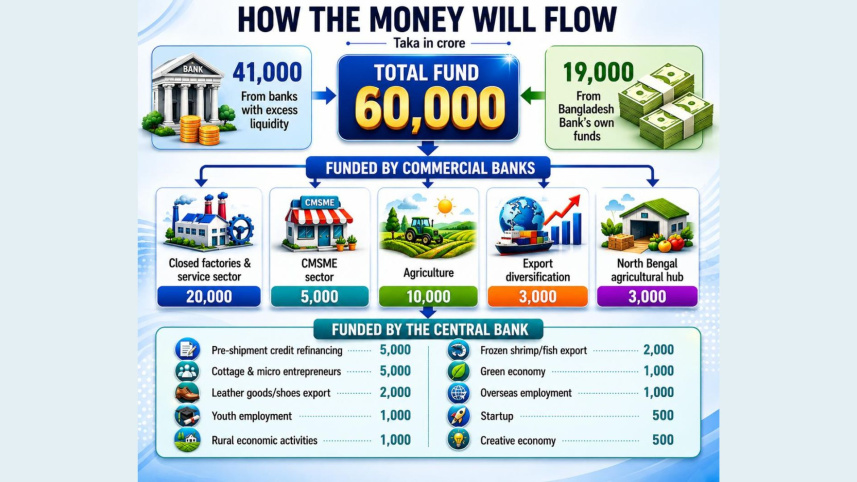
Bangladesh Bank yesterday announced a Tk 60,000 crore stimulus package aimed at reviving the struggling private sector amid slowing growth and persistent inflation concerns.
Announcing the package at a press briefing at the central bank headquarters, BB Governor Md Mostaqur Rahman said the initiative was designed to address industrial disruption and financial sector vulnerabilities while supporting employment generation.

The package has two main components.
The first is a Tk 41,000 crore refinancing fund to be mobilised from banks with surplus liquidity through long-term deposits of at least three years at a 10 percent interest rate. Under the arrangement, Bangladesh Bank will provide refinance at 4 percent interest, while the government will subsidise the remaining 6 percent.
The second component is a Tk 19,000 crore fund sourced directly from the central bank’s own resources with a government guarantee.
Under the overall scheme, large borrowers will be able to access loans at around 7 percent interest, while smaller loans may carry slightly higher rates because of administrative and operational costs. Detailed implementation guidelines will be issued through upcoming circulars, the central bank said.
A major portion of the refinancing fund -- Tk 20,000 crore -- has been allocated for reopening closed factories, making it the single largest allocation. Another Tk 10,000 crore has been earmarked for agriculture and rural economic activities.
The cottage, micro, small and medium enterprise (CMSME) sector will receive Tk 5,000 crore, while Tk 3,000 crore each has been allocated for export diversification and the North Bengal Agricultural Hub initiative.
The Tk 19,000 crore BB-funded portion will support 10 targeted schemes, including pre-shipment export financing, CMSME support, overseas employment financing, startup funding, and youth-focused employment programmes.
This is the largest stimulus package since the then government provided Tk 2,37,679 crore under 28 separate programmes to ensure a quick economic recovery from the fallout of the Covid-19 pandemic.
According to the governor, the latest package is expected to generate more than 25 lakh jobs across industries, SMEs, agriculture, exports, startups, and youth employment initiatives.
Mostaqur said Bangladesh’s GDP growth has slowed significantly over the past three years, falling from 5.8 percent to 4.2 percent and likely declining further to around 3.7 percent.
He attributed the slowdown to disruptions in industries including garments, textiles, steel, ceramics, information technology, and broader manufacturing.
He also pointed to mounting stress in the financial sector, including a sharp rise in classified loans, declining depositor confidence, and high borrowing costs that have discouraged SME expansion.
The governor further cited capital flight and alleged illicit financial outflows, saying financial irregularities had weakened the banking system and intensified liquidity pressures.
Despite the central bank’s optimism, bankers and economists have expressed concern over the package’s design, funding structure, implementation feasibility, and possible inflationary impact.
Mashrur Arefin, chairman of the Association of Bankers, Bangladesh (ABB), described the package as “an excellent plan” but said effective implementation would be crucial.
He questioned the sourcing of the fund, arguing that banks’ surplus liquidity is already largely invested in treasury bills and bonds. He also noted that banks need to maintain some idle funds for day-to-day operations, limiting their ability to participate.
Mashrur suggested that instead of relying solely on bank deposits, Bangladesh Bank could inject liquidity by lowering the repo rate against treasury bills and bonds or reducing the cash reserve ratio (CRR).
 For all latest news, follow The Daily Star's Google News channel.
 According to him, such measures would make the package more workable and allow banks to lend at the intended 4 percent spread.
He also acknowledged that the initiative could fuel inflation, but said boosting employment and economic activity was also necessary under current conditions.
Syed Mahbubur Rahman, managing director of Mutual Trust Bank, also supported the intent but warned that implementation would be difficult.
He said banks are unlikely to lend to closed or failed factories because of the high risks involved. Restarting such units would require operational restructuring, management changes, workforce rehiring, and resolution of underlying financial and operational problems.
If revival efforts fail, banks risk losing their funds entirely, he said.
Mahbubur said credit growth has slowed to around 4.7 percent not because of a liquidity shortage, but due to a lack of viable borrowers. He also cited structural bottlenecks -- including inadequate infrastructure, weak law enforcement, and energy shortages -- as major constraints on investment.
Even operational factories are struggling because of gas shortages and rising electricity and energy costs, he said, adding that unresolved Covid-era stimulus loans continue to burden the banking sector.
He warned that because Bangladesh Bank would eventually recover refinance funds from commercial banks when schemes mature, the package could add further pressure on lenders already grappling with high default rates.
Responding to journalists’ questions at the briefing, the governor clarified that the package does not involve printing new money, but rather reallocating idle liquidity already present within the banking system.
He said some banks have excess liquidity while others face shortages, and the objective is to channel idle funds into productive sectors through refinancing mechanisms.
Mostaqur also said Tk 6,000 crore from the Tk 19,000 crore central bank allocation had already been deployed from BB’s surplus funds. He said the central bank earns around Tk 20,000 crore annually in profit, allowing it to finance the initiative without triggering inflation through money creation.
The governor also acknowledged weaknesses in previous stimulus programmes, particularly during the Covid-19 period, when a small number of large business groups reportedly received a disproportionate share of funds.
He said stricter monitoring and safeguards would be introduced this time to prevent concentration of benefits and improve accountability.
Mostaqur further admitted the depth of the banking sector crisis, saying a significant amount of banking funds had been lost through irregularities, loan scams, and financial mismanagement.
Many of these bad loans, he said, were not traditional defaults caused by business failure, but funds siphoned off without adequate collateral.
As part of the overall package, Bangladesh Bank also announced a Tk 500 crore fund from corporate social responsibility (CSR) resources to support creative industries. Unlike the stimulus loans, this fund will not require repayment.
Economists, however, remained cautious.
Abdur Razzaque, chairman of Research and Policy Integration for Development (RAPID), said the package appeared well-intentioned but lacked sufficient evaluation and consideration of alternatives.
He argued that controlling inflation should remain the top priority and warned that such stimulus measures could intensify price pressures and increase public hardship.
He also noted that stimulus alone does not guarantee improvement in underperforming sectors and that global experience shows such measures can sometimes fuel inflation and create additional macroeconomic imbalances.
Zahid Hussain, former lead economist of the World Bank’s Dhaka office, described the package as a countercyclical measure typically suited to periods of weak demand and low inflation.
However, he said Bangladesh currently faces a more complicated situation, with slowing growth alongside persistently high inflation.
Under such conditions, he warned, additional stimulus may not necessarily increase output and could instead push prices up faster than production if supply-side constraints remain unresolved.
Comments