


‘We must boost climate negotiation capacity’
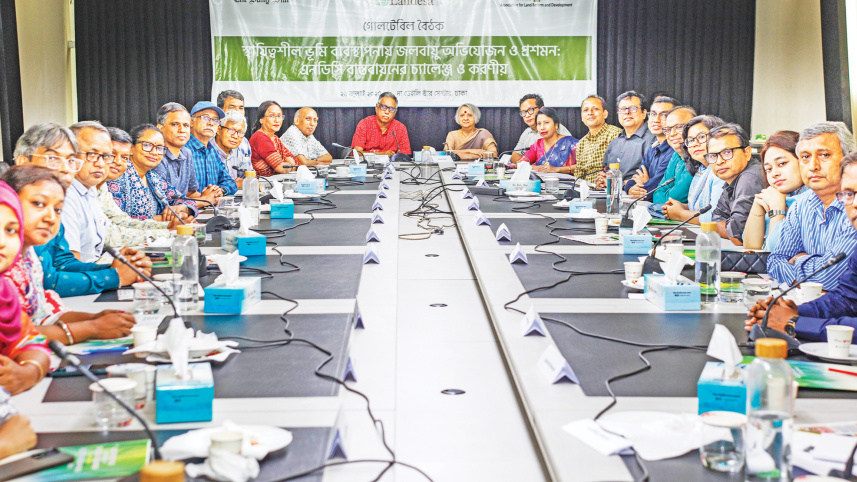
Bangladesh needs to enhance its capacity to negotiate climate change issues on global platforms like the Conference of Parties (COP), said speakers at a discussion yesterday.
They emphasised that achieving climate change mitigation targets as part of national preparedness could boost the country's confidence in demanding its fair share of global climate resources as an affected nation.
 For all latest news, follow The Daily Star's Google News channel.
 The roundtable, titled "NDC Implementation Challenges: Accelerating Mitigation and Adaptation through Sustainable Land Management", was jointly organised by the Association for Land Reform and Development (ALRD) and The Daily Star at The Daily Star Centre in the capital.
Speakers noted that although Bangladesh is not a major polluter, its role in mitigation will be discussed at the upcoming COP30, scheduled for November in Brazil.
To address climate change through mitigation, Bangladesh formulated the Nationally Determined Contribution (NDC) -- a policy document aligned with the Paris Agreement -- in 2015. COP30 will focus on implementing the NDC and revising targets for 2030, they added.
Climate change expert Prof Ainun Nishat said Bangladesh contributes only 0.48 percent of global greenhouse gas emissions, while countries like China, the US, India, and members of the European Union are the top emitters.
He said although a global fund to address climate change-induced challenges exists, it is not adequate. Bangladesh needs to strengthen its capacity to secure a share of this fund.
With the country set to graduate from Least Developed Country (LDC) status, it will need to align with forums such as the Like-Minded Developing Countries (LMDC) to effectively negotiate climate-change-related issues in the future, he added.
Prof Nishat also stressed the importance of youth raising their voices against major polluting nations, as climate change will impact younger generations the most.
Dwijen Mallick, research fellow at the Bangladesh Centre for Advanced Studies, said Bangladesh has received inadequate climate financing from both domestic and external sources, which poses a major obstacle to addressing its challenges.
He identified sectors such as agriculture, forestry and other land uses (AFOLU), along with waste management, as critical sectors where Bangladesh could make progress in climate mitigation.
Globally, around 35 percent of emission reductions could come from AFOLU and waste management, he noted.
Khushi Kabir, chairperson of ALRD and coordinator of Nijera Kori, highlighted the need to monitor greenhouse gas emissions from the agriculture sector.
ALRD Executive Director Shamsul Huda criticised large polluting countries for making lofty commitments at forums like COP but rarely following through.
Farida Perveen, director at the Department of Agricultural Extension, shared that drones are now being used to assess flood damage in the country.
Among others, Rowshan Jahan Moni, deputy executive director of ALRD, also spoke at the event. The discussion was moderated by Tanjim Ferdous, in-charge of NGOs and Foreign Missions at The Daily Star.




Comments