


Seat-sharing turmoil: Discontent in 11-party combine deepens


The seat-sharing discord within the 11-party alliance has intensified, with mistrust growing between Jamaat-e-Islami and other key partners, particularly Islami Andolan Bangladesh and Bangladesh Khelafat Majlis.
The crisis has cast doubt on whether a final understanding can be reached before the January 20 deadline for nomination withdrawal.

The rising uncertainty became more clear yesterday when the alliance abruptly postponed a pre-scheduled press conference meant to announce its final seat-sharing plan for the February 12 national election.
IAB leaders said they learned of the announcement through the media, while Jamaat later said the programme was deferred due to a lack of preparations.
IAB held back-to-back meetings -- one stretching late into Tuesday night at a madrasa in Rampura and another yesterday at its central office in Purana Paltan.
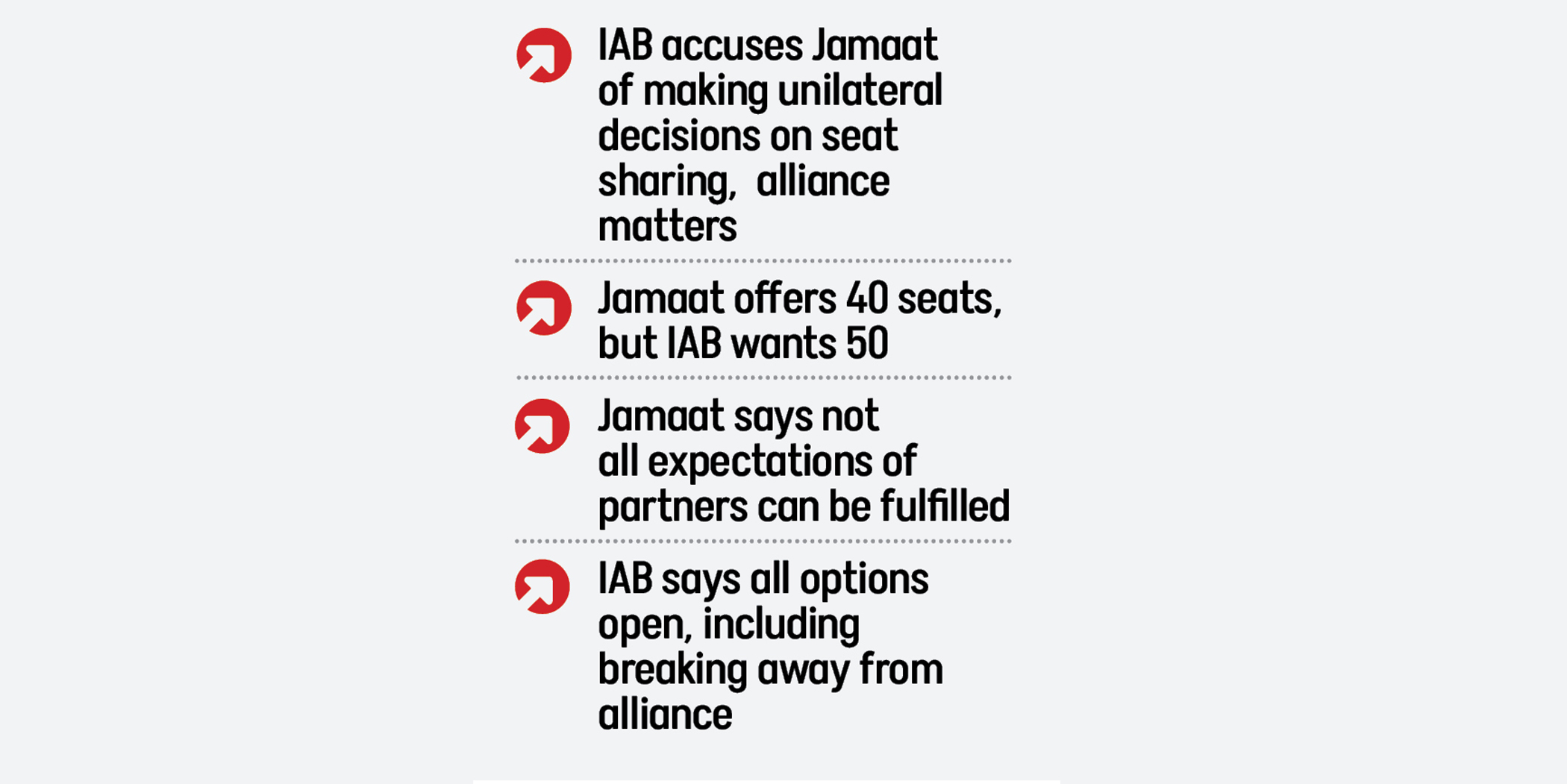
At both meetings chaired by IAB Ameer Syed Muhammad Rezaul Karim, leaders sharply criticised Jamaat for what they described as unilateral decisions that had eroded trust within the alliance.
Speaking to this newspaper, IAB Secretary General Yunus Ahmed said the dispute had raised a fundamental question over how much progress could still be made on seat sharing under the current circumstances.
He alleged that Jamaat had adopted a “go alone” approach, ignoring partners while taking key alliance decisions.
“To our utter surprise, we came to know about the matter from the media, which is really unexpected,” Yunus said, referring to Jamaat’s sudden announcement of the press conference.
After the meeting at the IAB central office, the party’s Joint Secretary General and spokesperson Gazi Ataur Rahman acknowledged the strain openly.
“There is no scope to deny that there are problems and crises in the alliance. We carry out our politics independently. So why should we be made to accept anything imposed on us by others?” he told journalists.
“If anyone does injustice to us, or insults or ignores us, we cannot take that lightly. Everyone has a sense of self-respect,” he said, adding that compromise could only work in an environment of mutual respect. “If such an environment existed, the issue of more or fewer seats would not be a major problem.”
Ataur also alleged that Jamaat candidates were campaigning in constituencies as if they were the sole nominees of the alliance. “If a party’s candidate or their local leaders engage in such falsehoods, then it becomes difficult to move forward together,” he said.
The IAB leader also hinted at the possibility of breaking away from the existing alliance and forging a new electoral arrangement with four like-minded Islamist parties.
“Anything can happen before the January 20 deadline for nomination withdrawal,” he said, adding that discussions were continuing with parties that maintained relations of respect with IAB.
Asked whether the party might contest the election on its own, Ataur said no final decision had yet been taken, as talks were still underway with several groups and the next steps would depend on an overall assessment of the situation.
At the same time, he said, the situation had not deteriorated to a point where negotiations with Jamaat had completely collapsed.
Despite mounting dissatisfaction, IAB insiders said the party ameer has yet to take a final decision on whether to leave the alliance.
On its future, IAB Secretary General Yunus said, “Jamaat didn’t do justice with us. In that case, we will finalise our decision whether to remain in the alliance, after discussion with our like-minded parties within a day or two.”
IAB leaders said tensions grew after Jamaat allegedly held separate meetings with the National Citizen Party, Liberal Democratic Party and Amar Bangladesh Party to bring them into the seat-sharing arrangement without informing existing partners beforehand.
 For all latest news, follow The Daily Star's Google News channel.
 They also expressed resentment over Jamaat Ameer Shafiqur Rahman’s meeting with BNP Chairman Tarique Rahman, where he spoke in favour of forming a national government after the election. IAB leaders said they were not informed about the matter in advance.
IAB leaders recalled that the alliance talks began after the July mass uprising, when the party took the initiative to unite Islamist forces under a single banner and field single candidates in each constituency.
Bangladesh Khelafat Majlis, Khelafat Majlis, Bangladesh Khelafat Andolon and Bangladesh Nezam-e-Islam Party later joined the process, followed by Jamaat, and then Jatiya Ganatantrik Party and Bangladesh Development Party, as negotiations expanded.
From the outset, IAB sought to contest more than 100 constituencies under the alliance, later scaling down its demand to more than 50 seats.
Jamaat, however, has offered 40 seats, an offer many IAB leaders remain unwilling to accept.
Khelafat Majlis, meanwhile, has demanded 25 to 30 seats, while Jamaat is reportedly willing to allocate a maximum of 20. If no agreement is reached, the party wants to keep its candidates open in those constituencies.
Several leaders of Bangladesh Khelafat Majlis, led by Mamunul Haque, also voiced concern over the renewed uncertainty. Its Secretary General Ahmad Abdul Qader said, “I believe the unity will remain. But some seats may have to be left open. We have said this before as well.”
Multiple sources said Jamaat wants to retain around 190 to 200 seats for itself and negotiate with other parties for the remainder.
Responding to the allegations made by alliance partners, Jamaat Assistant Secretary General and alliance coordinator Hamidur Rahman Azad said, “Those who are making such allegations [regarding mistrust, division and conflict in the alliance] -- it is their own views.”
Without naming IAB, he added, “If someone expects a lot, not all expectations can be fulfilled. We have to move forward together, taking everything into account.”
On the postponed press conference, Azad said it would be held “soon”, adding that the seat-sharing issue would also be finalised “very soon”.
Comments