


The fear and the future: what the emergence of AI can mean for our youth

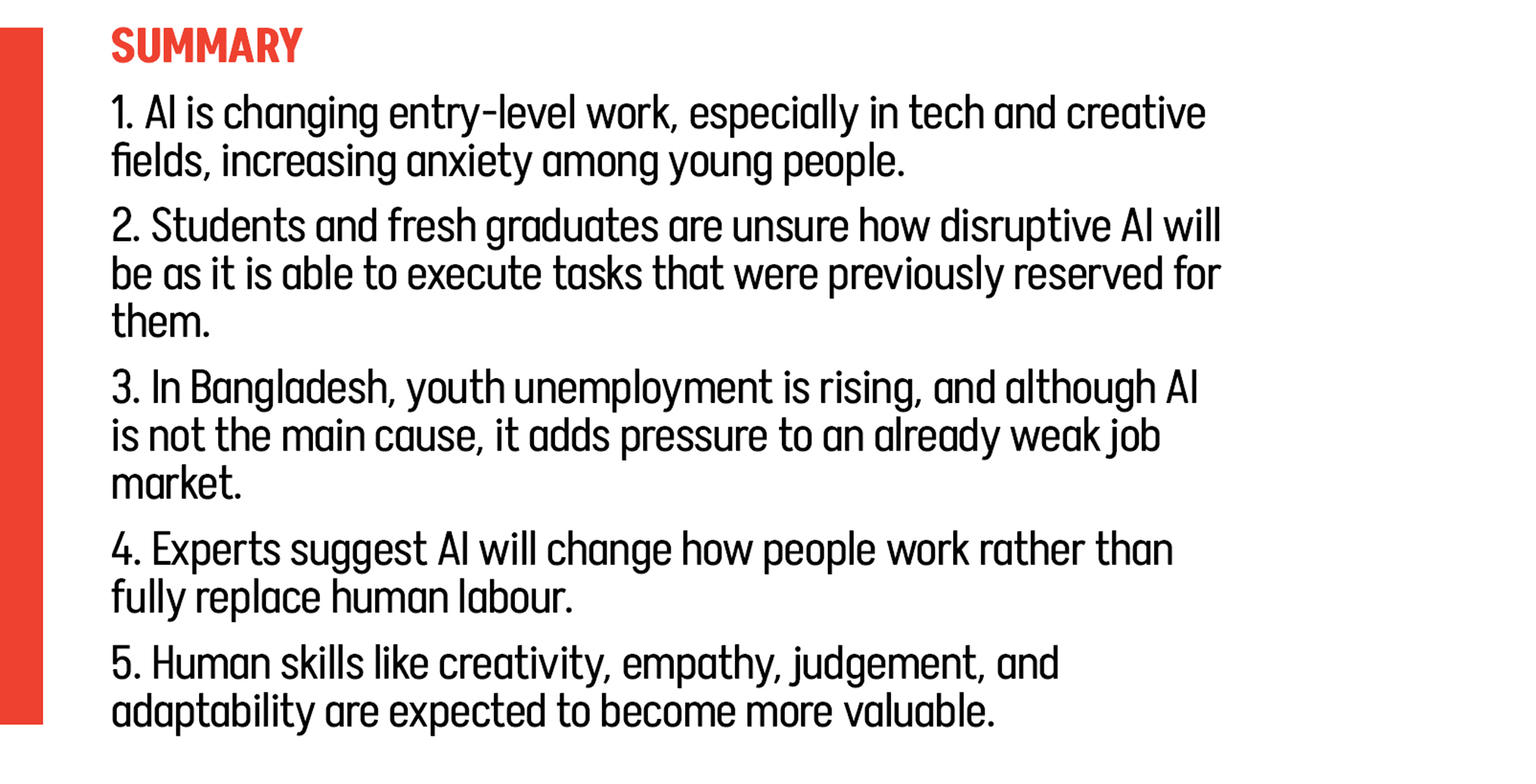
The notion that artificial intelligence (AI) is going to rewire the basis of our understanding of many entities, even at this point in time, seems a little far-fetched. Yet, what it does have the potential to do is lead us into new territory. As things stand, though, most users are still trying to figure out its limitations, while those who develop it seek to shatter them. In between the swinging tides stand the youth. Left in limbo, the young demographic is left wondering precisely how disruptive artificial intelligence really is and what its development means for their future.
Zunayed Ahmed, a third-year software engineering student at Seneca Polytechnic in Canada and a software automation intern at Communications & Power Industries (CPI), explains how he thinks entry-level jobs in tech have been impacted due to the emergence of AI: “The bar has been raised. For example, let’s say you are writing an API—Application Programming Interface. What you’d previously have to do was go through the documentation, read it, understand it, and then code. Now, it takes minutes to have a skeleton code. Because the workload is less tedious, you’re expected to know a lot more and do more as well.”

The development of generative AI has been meteoric. Most constraints that were conspicuous even a year ago have been rectified to various extents. Although new concerns have emerged, its integration into the professional realm has been evident. Even through AI’s limited capacity, it is able to execute tasks that are typically reserved for entry-level workers, which is to say repetitive and often mundane tasks that are low-stakes. Such a prospect is understandably anxiety-inducing for fresh graduates as well as for those on the precipice of graduation and even those who are currently pursuing their education.
Anica Hossain, a graduate student of communications at University of Liberal Arts (ULAB), a graphic designer, and owner of art merchandise business Anico, discusses the shift she has observed: “The development of AI has impacted the industry a bit. A lot of employers and brands tend not to hire graphic designers. They’re convinced that AI models can generate social media posts, write captions, and brainstorm ideas. But output that’s churned out by models distinctly looks like it was made by AI. Not everyone wants that kind of work. People still look for the human touch in the design. So, I don’t feel super threatened yet.”
Image: Google Deepmind
“Each artist and designer has their own distinct style, which I don’t think AI models can replicate yet. As an artist, I am unsettled that the work we create is used to train these models. In the future, these tools might create output that can emulate artists’ distinct styles. Right now, however, you still need designers to refine work generated by AI,” Hossain adds.
Having spent their formative years pursuing a qualification, only for it to be deemed inadequate, is discouraging. The purpose of entry-level jobs has been to help young graduates transition from the classroom to the professional realm. It is a period of training, one that isn’t just meant to teach and enhance the skills of fresh graduates but also allows them to figure out what kind of work they want to do. For such a crucial part of the process to become seemingly obsolete is disruptive in more than one way. In Bangladesh, particularly, this can amplify an already existing problem.
In a report by the World Bank, it was stated that unemployment in Bangladesh amongst tertiary-educated youth has increased significantly, with university-educated youth making up 27.8 percent of the total unemployment in 2022. An alarming rise from 9.7 percent in 2013. The rise in employment cannot be attributed to the rise of generative AI, though. However, with job creation stagnating and AI’s rapid improvement following in tandem, the state of the job market hangs in the balance.
Salma Begum, PhD, an associate professor at the Department of Economics and Social Sciences at BRAC University and a labour economist, analyses the dynamics of the current Bangladeshi workforce: “If we look at the research, it shows that the Bangladeshi labour market is at a low exposure level. Our exposure is well below the regional average when comparing neighbouring countries. This is because we depend more on agriculture and have informal services, which have not seen much automation so far. Digital inequality, in terms of access to digital literacy and relevant education, is another contributing factor.”
“AI models learn from data, and our country’s availability of good-quality, reliable data is low. This is a problem because while AI will eventually affect our market, our low exposure currently indicates our low preparedness for it,” she adds.
According to a report by the World Economic Forum (WEF), AI and information processing are projected to displace 9 million jobs, while creating 11 million new ones. It is expected that automation alone will cause 5 million jobs to be displaced. It must, however, be noted that the net disruption in the job market will be positive, with more jobs being created than displaced. What will be subject to change, though, is how people work, with the dynamic between humans and machines expected to alter.
“It is important to know and learn what AI tools can be leveraged to your benefit. This is something I do myself, and it does make working easier. I also think the ability to use AI tools might become a requirement in the future,” emphasises Hossain.
“Using AI in my workplace is encouraged. My employers have seen how powerful a tool it is. In fact, we have a proprietary AI model that employees are expected to use. In my workflow, I use it for debugging, and sometimes to find fixes as well. I will also use it to generate snippets of code that may be considered repetitive, low-risk, and not complicated. Lastly, I use it to write documentation whenever I am finishing up work on a big file, which is supposed to guide the next person who is going to work on it,” Ahmed affirmed.

Image: Immo Wegmann/ Unsplash
A point of contention still remains, of course. WEF asks that if AI and algorithms are contributing to a larger proportion of output and income, then where does that leave people? It, thus, becomes imperative that the significance of human-machine collaboration is reinforced when these inquiries are made.
Whether such considerations are going to be made remains to be seen. Based on findings from the World Bank, 1.2 billion young people in emerging economies will become working-age adults. In contrast, the job market is projected to only create 420 million jobs, leaving almost 800 million people in a precarious employment position. To tackle an issue of this magnitude, employers across the globe are emphasising the need to reskill and upskill.
“No technology is inherently good or bad. We can harness it for productivity and efficiency increases, which is how we utilise the benefits. But we can also not be prepared for it, for which we may pay a price in terms of lost employment and opportunities,” Salma Begum explains.
The conversation surrounding the impact of AI tends to devolve quickly into one of paranoia, where the most plausible outcome is envisioned to be the complete substitution of human labour. While these fears are by no means unfounded, what they do require us to do is take a step back, which can be difficult due to the uncertainty that has cloaked the entire situation. Nonetheless, the need to do so remains integral.
Though Ahmed finds the mechanism, even the scale and engineering, behind AI tools to be fascinating, he doesn’t think it is reliable enough to replace humans. “I have seen how AI models deal with complex tasks. Each one has a context window, which can be a limiting feature as it can forget vital information. You can’t replace humans with a tool that forgets or is unable to reason on its own. So, I just don’t see how software engineers and developers can be replaced, at least not with the technology we currently have.”
 For all latest news, follow The Daily Star's Google News channel.
 In a research paper by Isabeela Loaiza and Roberto Rigobon from the Massachusetts Institute of Technology (MIT) - Sloan School of Management, the authors introduced the EPOCH framework to understand how human capabilities have the capacity to complement, rather than compete with AI. The EPOCH framework identified five groups of human capabilities that allow work in areas where machines are limited. These include Empathy, Presence, Opinion, Creativity, and Hope.
Findings from the paper suggest that US workers are shifting towards tasks that “emphasise the human-intensive capabilities”. In fact, the results state that “new tasks” that appeared for the first time in 2024 are more human-intensive. It is also worth noting that human-intensive occupations were reported to experience more employment growth, hiring, and better projections. Some major occupations that had high EPOCH scores included Emergency Management Directors, Human Resource Managers, Sociologists, Clinical Psychologists, and Environmental Economists, amongst others.
Salma Begum reiterates that traditional career paths could take on a new form in the future, urging the young workforce to consider roles that bridge domains.
“Employers will want to hire people who are good learners, can solve problems, and work with new systems. Individuals who can navigate uncertainty and integrate new tools into their existing workflow are highly valued. Your ability to successfully adopt these systems in your workplace will matter more than your proficiency with any particular software,” she says.
When asked what students can do to adapt to the emergence of AI tools, Salma Begum emphasised the need to build a broad set of transferable skills along with proficiency in their core area, as boundaries between industries are being blurred.
There is little doubt that AI tools are a force of disruption, transforming and being integrated into workflows across sectors. What makes it a source of anxiety, however, is that we are still not sure just how disruptive it truly is. Given the rate at which it is progressing, the limits that previously defined the question are withering away; constantly expanding its range. While we don’t know the answer to this question, what it unravels is very human. As people, we are sceptical of the unknown. It is this instinct that forces us to ask questions, reason, and be critical. And this ability will determine not just how we understand AI tools but how we can use them to maximise their potential.
Abir Hossain is a sub-editor at Campus, Rising Stars, and Star Youth.
Comments