


The lure of natural dyes in sustainable fashion

If there is one buzzword that aptly summarises the initiatives and undertakings of the last few decades, it is sustainability. This is especially important in the textile industry, where water use and the disastrous effects of artificial dyes on water bodies have been perennially criticised. Some manufacturers have turned back full circle, employing the use of natural dyes as an eco-friendly alternative to synthetics.
Why natural dyes are returning to fashion

Derived from plants, fruits, and other natural materials, many of which can be easily found in local markets or even at home, natural dyes do not involve the use of petrochemicals in their processes and produce far less harmful waste. They do more than just add colours to fabrics; they offer a more sustainable option that significantly reduces the environmental and health impacts associated with chemicals.
In several parts of the world, traditional dyeing practices continue to be a crucial part of cultural heritage, with skilled artisans producing dyes on a small scale, preserving age-old techniques and supporting local economies. The process of creating these dyes is often cost-effective, as many sources, such as marigold, olive, and pomegranate peels, are everyday items that are both affordable and accessible to the community.

“We cultivate our own indigo in environmentally safe areas, such as alongside roads and embankments, to create sustainable dyes,” reveals Nazra Sabet, Chief Executive Officer of Friendship Colours of the Chars. The social purpose organisation also has a strong sourcing team that brings in items such as catechu, pomegranate peels, and olives to make into colourants.
Many of these natural dyes possess additional beneficial properties. For instance, certain dyes, like Acacia catechu (khair/katha) and Rubia cordifolia (madder), are equipped with bacterial and mould-resistant qualities. Others, such as pomegranate peels, are able to inherently repel insects, providing a natural way to enhance the functionality of textile products. Additionally, many natural dyes are effective in deodorising fabrics, thanks to their resistance to odour-causing bacteria.

However, despite their many advantages, natural dyes also present some challenges. Unlike synthetic dyes, which are known for their vibrant and colourfast nature, natural dyes can fade when exposed to sunlight or strong light sources. They often require the use of heat or steam to fix the colour and maintain colourfastness.
The challenges of colourfastness and consistency
According to Sabet, washing instructions play a big role in holding on to the longevity of these colours. “Proper care, including the use of mild soaps instead of harsh detergents, helps maintain the original colours for a longer period of time,” she shares. Achieving certain hues, especially vibrant shades like orange and yellow, may require multiple dyeing sessions.
The chemical structure of natural dyes can also lead to variability in colour; this means that the same dye molecule might produce different shades depending on its environment, making it less predictable than synthetic alternatives.
Shorder Mohammad Brinto, a designer for Colours of the Char, feels that the weather plays a very important part in the process of sustainable dyes. “In sustainable and natural dyeing, the biggest challenge is nature itself,” he shares.

As the designers and dyers work in rural regions, the source of water changes from season to season.
“Depending on the time of year, we might dye with river water, pond water, rainwater, or water from deep tubewells. Naturally, each type of water contains different minerals, and those minerals react differently with natural dyes.”
Brinto further shares how weather conditions can affect the process. If the environment is humid or dry, it can change how the colour turns out. “Because we don’t work with computerised, controlled systems, and every step is done by hand, the final result often does not match what we imagined. Whatever the outcome is, every time it brings a new kind of magic.”
Craft, care, and the rise of conscious dyeing
In recent years, the movement toward sustainable fashion has led to renewed interest in natural dyes. Many designers and brands are consciously seeking to incorporate these into their collections, promoting not only beautiful aesthetics but also ethical production practices.
According to Komal Kumar Malakar, a master artisan, the processes for dyeing include crushing raw materials in the machine, boiling them to achieve the desired colour and consistency and then making use of fitkari (alum) or iron to ensure that colours do not bleed.
 For all latest news, follow The Daily Star's Google News channel.
 The procedure is simple, uses less water, and does not involve the use of chemicals anywhere. The runoffs, too, are recyclable, supporting the ecosystem overall.
Komal Malakar particularly enjoys working with hortoki, a fruit that produces dark shades of grey and works particularly well on silk sarees, pomegranate peels, manjit (madder, producing a Roman shade of red), shikorae (or shillicorai for purple) and indigo.
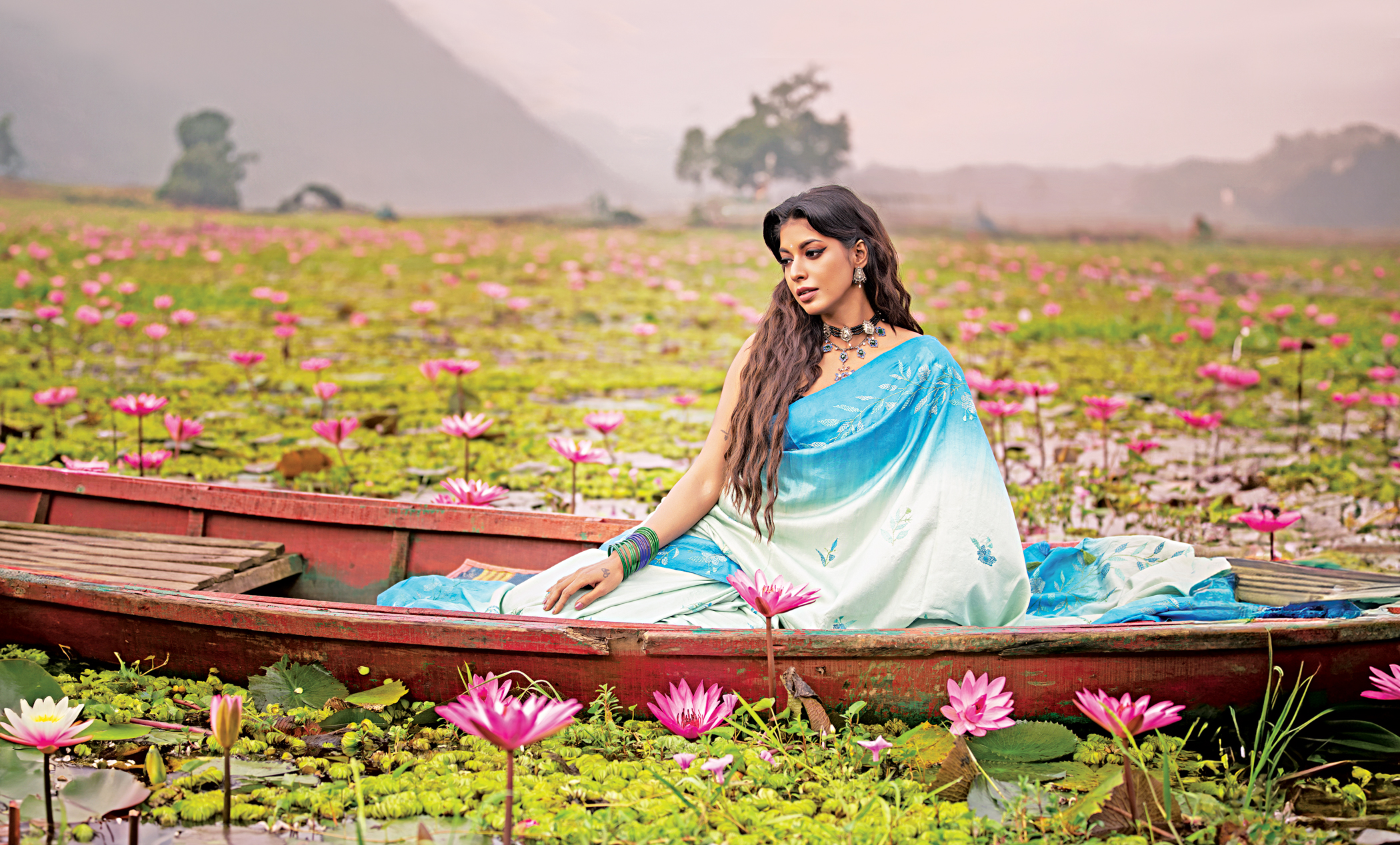
“All our dyes are derived from fruits, plants, roots and barks found in nature, and these are biodegradable. This is particularly why dyers like me enjoy working with natural products over chemical ones.” He particularly notes the importance of ingredients such as indigo, which is one of the oldest colourants. Grown by themselves and used extensively in their designs, indigo holds a special significance in producing rich, deep shades of blue, straight from the lap of nature.
Tradition, design, and the limits of scaling sustainably
Industry professionals reveal a growing trend among artisans and designers who are committed to reviving traditional dye techniques while innovating new applications.
“When it comes to balancing sustainable dye with aesthetics, we always choose concepts that stay connected to nature or to our heritage and traditions, like the waves of river water, or Panam City, and translate those details into our designs,” informs Brinto. “We continue to explore concepts where sustainable dye and design aesthetics come together.”
Despite the apparent advantages and visible efforts to increase the reach and acceptance, the harsh reality is that natural dyes are nowhere near as popular as chemical dyes, and with due reason.
“Colours derived from nature are not always very vibrant,” shares Nazra. “This is why we have a relatively smaller client base, and one that both comes and stays for the ethics behind it.” These colours, according to her, would not attract everyone.

Scalability is another factor affecting the popularity of natural colours. More labour-intensive and costlier than industrial dyes, the process is difficult to produce for the masses and time-consuming too. Many of those, like Nazra Sabet, who work with natural dyes or slow fashion, know that they produce for a niche market. There are a precious few who would pay a relatively higher price for slow, laborious work, although those who do keep coming back for it.
For natural dyes to become even partially competitive with their more toxic synthetic counterparts, significant innovation is needed, especially in the areas of extraction, processing, and overall production efficiency.
Strengthening the sourcing and supply chain can involve using waste streams from industrial and agricultural sectors, turning what would otherwise be disposal challenges into valuable raw materials. Regenerative farming practices can further ensure a steady supply of dye plants while improving soil health and avoiding competition with food crops. With these advancements, natural dyes can move closer to becoming a truly scalable and sustainable alternative for the industry.
While it is up to each individual buyer to make informed choices between vibrancy and simplicity, and/or slow handiwork and higher prices versus machine-made strength and cheaper rates, it is worth knowing that the journey of embracing natural dyes is as much about celebrating nature’s palette as it is about promoting sustainability and the livelihoods of those who keep these traditions alive. By supporting sustainable dyeing practices, consumers can contribute to the preservation of these traditions while also making conscientious and nature-friendly fashion choices.
Photo: Friendship Colours of the Chars
Comments