


Young voters will decide the winner
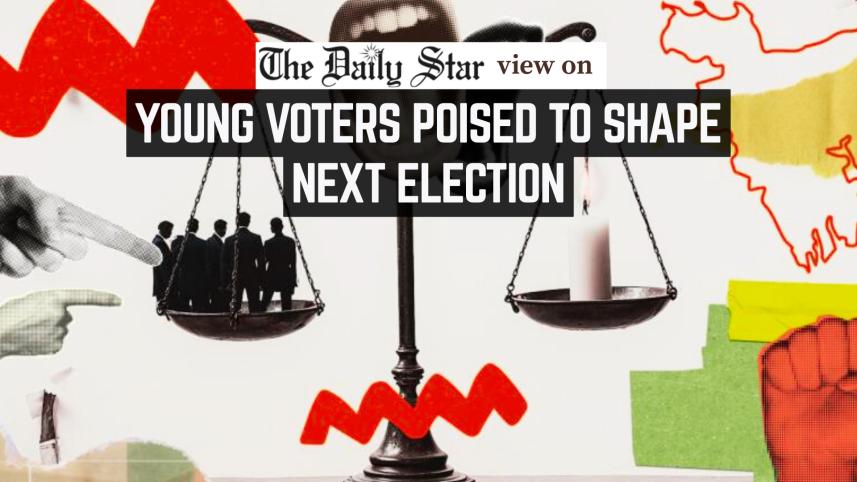
There is little doubt that young voters are a decisive demographic force, particularly in the context of the upcoming general election that people expect to be free and fair. With 5.56 crore out of 12.76 crore voters—about 44 percent—being between 18 and 37 years of age, young people make up nearly half of the electorate. They could, therefore, end up deciding the outcome of the February 12 election, making it all the more crucial for political parties to connect with their thought processes and expectations from a future government.
Unlike the last three elections, widely regarded as farcical or non-competitive, this election follows the youth-led uprising of July 2024 and will be conducted under a non-political interim government committed to reform, justice for crimes committed under the Awami League regime, and credible polls. Having been denied meaningful voting opportunities in 2014, 2018, and 2024 due to intimidation and rigging, young voters are participating seriously for the first time in many years. The apathy of the past has been transformed into a determination to reclaim their right to vote, as recent surveys have also demonstrated. One survey by the Bangladesh Youth Leadership Centre found that 97 percent of respondents aged 18 to 35 intend to vote. Another survey, conducted by the International Republican Institute, found that 89 percent of respondents were likely or somewhat likely to vote.

Young voters link voting to real-life issues and concerns, one of the most pressing being the number of jobless graduates. Bangladesh had nearly nine lakh unemployed graduates in 2024, according to the Labour Force Survey 2024 released by the Bangladesh Bureau of Statistics (BBS). Young voters want to know how the next government will tackle unemployment, improve the quality of education, reduce the cost of living, provide security to citizens, eliminate corruption, establish good governance and accountability, etc.
Political parties, therefore, must appeal to them with sincere and credible commitments. Universities are powerful spaces capable of shaping and influencing national politics. Recent student council elections in major universities have shown that youth groups who were able to connect meaningfully with the general students secured the largest victories. The BNP’s student wing, by contrast, suffered repeated defeats, indicating that the party needs to work harder to appeal to the youth. Young people want an end to the status quo in which the state remains unaccountable, ordinary citizens feel powerless, and corruption erodes basic rights. Young women, in particular, will vote for a safer Bangladesh, one in which they can participate fully in all aspects of public life. Political parties must align themselves with these aspirations.
We believe that the country’s democratic transition largely depends on youth turnout. With nearly half of the electorate being young, their participation will be the real test of whether Bangladesh is entering a new democratic phase. It will also determine whether, after years of erosion, public trust in elections can be restored.
 For all latest news, follow The Daily Star's Google News channel.
Comments