


Why North Korea is UN's Achilles Heel

The movement toward an individualised conception of security lies, first of all, in the evolution of the international society's consideration of rights of individuals in the face of potential threats from states and non-state actors. The most obvious foci of analysis here are the UN Charter, the UN Declaration of Human Rights (1948) and its associated covenants and conventions. Ironically, the United Nations today, especially its powerful organ the Security Council, seems to be failing in its primary duty – to protect people from the scourge of war and violent conflicts. The new threats are reinforcing the sense that this world body and its member-states are not organised to address the problems in an integrated way. The UN Charter, a quasi-global constitution, not only gives the Council primary responsibility for the maintenance of international peace and security that is capable of superseding the view of any state, but also stipulates in Article 103 that Charter provisions shall prevail over any other international agreement. It is therefore up to the UN Security Council to decide what actions are required for the maintenance or restoration of international peace and security, or for the advancement of human rights and fundamental freedoms that might be linked to security.
 For all latest news, follow The Daily Star's Google News channel.
 UN Inconsistent to Offenders
The comparison of the Libyan and Syrian cases makes very clear that the Security Council's record on human rights matters is not as consistent as most conscientious people might like. In fact, some observers think that the Council has displayed little consistency in applying humanitarian standards to its decisions and actions. As the Council grappled with a variety of situations involving human rights considerations, its record has been inconsistent despite a number of options available at its disposal. In fact, human rights concerns have become more sensitive in recent years. But the UN has not been able to impose punishment on the offending government or state. In recent years, Myanmar, Syria, Egypt, Iran are among the top ten offenders of human rights, surpassed by a paranoid state of North Korea that tops the list and has become the UN's Achilles heel.
North Korea – Worst Offender
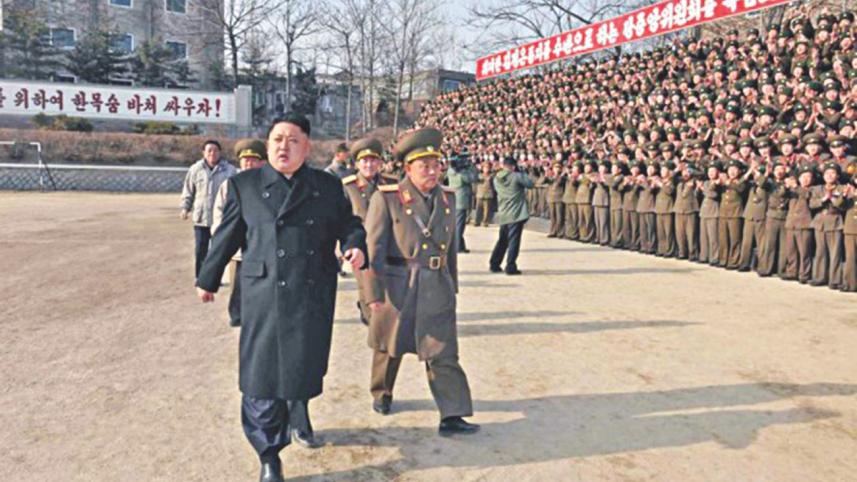
In fact, the Kim Jong-un regime is notorious in its record on human rights abuses that includes secretive state extrajudicial killings, disappearances, arbitrary detention, and torture of political prisoners. Indeed, Kim Jong-un's provocative attitude and use of state institutions transformed North Korea into a 'rogue' state and a threatening nuclear power while a huge number of people continued to starve for want of food and were denied basic human rights and dignity. The United States and its allies have for years been unable to find a solution, except for applying sanctions and appealing to China on this issue. Obviously, the recommendations of the UN Commission of Enquiry remain as a moral force.
In February 2014, the UN-mandated Commission of Inquiry (COI) found that the nature, scale, and gravity of the long-standing and ongoing systematic and widespread human rights violations in North Korea "reveal a state that does not have any parallel in the contemporary world." The Commission of Inquiry report detailed wide-ranging abuses in North Korea including prison camps, systematic torture, starvation and killings. Previously, the UN's concern of North Korea was limited to its nuclear weapons programme. The United Nations Security Council has adopted four major resolutions since 2006 that imposed and strengthened sanctions on North Korea for continuing to develop its nuclear weapons programme and called to dismantle it "in a complete, verifiable, and irreversible manner" and refrain from ballistic missile tests. To this date, the UN Security Council's resolutions have been largely unsuccessful in preventing North Korea from advancing its nuclear weapons and ballistic missile programmes, although the sanctions have slowed development in these areas. The UN continues to closely monitor these programmes. But the 193-member UN General Assembly in November this year has urged the Security Council to consider referring North Korea to the International Criminal Court. The UN General Assembly is currently finalising a resolution on the human rights situation in North Korea which, among other things, encourages the UN Security Council to continue its discussion of the country's human rights record. UN High Commissioner for Human Rights Zeid Ra'ad Al Hussein testified before the Security Council that the "abduction of foreign nationals, the enforced disappearances, the trafficking and the continued movement of refugees and asylum-seekers makes this point clearly. These, in addition to a litany of other gross human rights violations, have still not been halted or reversed by the Government of the DPRK,"
Dialogue and Enforcement of Mandate
North Korea has made a number of intriguing gestures recently on human rights. At the United Nations, its Foreign Minister announced his country's readiness to hold a "human rights dialogue with countries not hostile to it." The initiatives come on the eve of the introduction of a resolution on North Korea's human rights situation at the General Assembly by the European Union and Japan. The resolution is expected to mirror the one adopted in March by the 47-member Human Rights Council, which acknowledged for the first time the occurrence of "crimes against humanity" in North Korea and called for both a Security Council referral of the situation to an "international criminal justice mechanism" and the adoption of "targeted sanctions" against the ones "most responsible." Initially, North Korea denounced the report of the COI - upon which the resolution was based - and made inflammatory personal attacks against its chair, Australian Justice Michael Kirby. Now it offers dialogue, seemingly with the aim of weakening the text of the resolution and encouraging "no" votes or abstentions in the 193-member General Assembly. But whatever the reasons for the change in North Korea's position, dialogue must be viewed as a legitimate part of diplomatic discourse and not a vehicle to trade away other human rights goals - such as the wording of the General Assembly resolution, the position of the UN Special Rapporteur on Human Rights in North Korea or the UN office to be set up in Seoul.
It is time now to act decisively to initiate a result-oriented dialogue with the UN High Commissioner for Human Rights, and his office should be the focal point for such a dialogue with North Korea in line with UN resolutions and consensus reached at the General Assembly. The dialogue should seek to establish technical assistance programmes to help North Korea bring its laws into line with international standards, set up a national human rights commission, and identify the steps needed to carry out the recommendations of the UN treaty bodies and the COI report. The "human rights contact group," recommended by the COI, should be formed to promote a regionally focused longer-term dialogue. The political discriminatory system of Songbun, which lies at the root of so many human rights violations in North Korea, should also be discussed. North Korea has ratified the International Covenant on Civil and Political Rights, and – even though it often seems to forget that it is bound by this treaty – thus, should be held to its provisions. It is time for the recommendations of all the different UN bodies to be on the table. When debating security issues with human rights implications, the relevant UN officials should always be invited to address the Security Council. Finally, when enforcement action is approved, there needs to be a follow-on supervising committee to report back to the UN Security Council about commitment to and progress in implementing its mandate.
The writer is a former Professor of Dhaka University, and currently works as the Chairman of the Centre for Governance Studies and President of the Bangladesh Political Science Association.
Comments