


'Delayed compensation offers little relief to injured road crash victims'

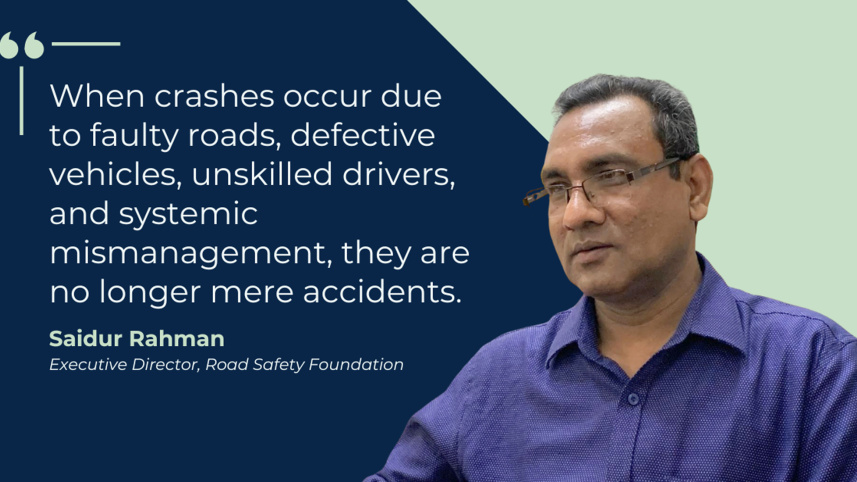
Saidur Rahman, executive director of Road Safety Foundation, speaks with Naznin Tithi of The Daily Star about the barriers faced by road crash victims and their families in receiving compensation, and how the mechanism can be made more effective, among other issues.
As in previous years, this Eid holiday has also seen a large number of people killed and injured in road crashes. Even though people are being killed and injured on the roads every day, we rarely see victims and their families receiving compensation. According to statistics from the Bangladesh Road Transport Authority (BRTA), only 14 percent of those killed have received compensation since the scheme was introduced. For the injured, the rate is even lower—just over two percent. Why so?

The main reason is that the government is not informing people about this issue. Those most affected by road crashes tend to come from disadvantaged, lower-income, or lower-middle-income groups and are often unaware of their rights. Many do not know about the government’s compensation fund, and it is the government’s responsibility to inform them. There has been little to no effective campaigning in the media, social media, or television. As a result, applications remain low. Furthermore, the application process is complex and needs simplification. That said, extending the application deadline to 90 days is a positive step.
The government claims that people are not applying. But the concern is whether the government could meet the demand if applications increased significantly. Around Tk 266 crore has accumulated in the compensation fund over several years, yet given the scale of annual road accidents, an estimated Tk 500-550 crore would be required. This raises the concern that a limited awareness campaign may, in part, be linked to funding constraints.
There are also several procedural barriers. In many cases, no general diary (GD) or case is filed with the police after a road crash. But applications for compensation are not accepted without the filing of a case. Ideally, a case should be filed immediately after a crash; if not, then within 15 days. However, police often do not cooperate. Moreover, support is often inadequate at district-level BRTA offices, too. Collecting hospital documents is also difficult for ordinary people, leading to frustration and demotivation.
Another major problem is that the fund does not support immediate medical needs. Compensation takes time—applications are followed by a 30-day investigation period. However, the injured require funds for immediate treatment, which the system fails to provide.
How can the compensation process be made more effective?
The government must take responsibility for road crashes, as many so-called “accidents” are actually structural killings. When crashes occur due to faulty roads, defective vehicles, unskilled drivers, and systemic mismanagement, they are no longer mere accidents. The government must ensure compensation for all victims and survivors and improve management to reduce crashes. The current fund, financed by fines and owner contributions among other sources, is insufficient. The government should allocate funds in the national budget. With adequate funding and public awareness, everyone could receive compensation. But currently, the fund is inadequate.
There are also allegations of bribery. How can transparency and accountability be ensured?
This is deeply concerning. To prevent such irregularities, a well-structured system must be established involving representatives from various segments of society—civil society members, government officials, academics, lawyers, and influential community figures. Oversight should be exercised through such a committee. Smaller committees are more prone to corruption, whereas larger bodies—comprising 15 to 20 members—can reduce such risks. However, in practice, these committees are often dominated by government officials, and allegations of corruption within public institutions persist. Accusations against the BRTA are also not unfounded. The institution has failed to ensure accountability, leading to declining public trust.
Community-level committees, with members including safety professionals, law enforcement representatives, and representatives from different social groups, can raise awareness, encourage people, and help ensure faster and more transparent compensation.
We have not seen effective implementation of the Road Transport Act, 2018 under any government, political or non-political. As a result, road accidents continue to rise. What are the key obstacles to its proper implementation?
Our road transport sector has never had proper governance. Where there is disorder, there is a greater opportunity for corruption and extortion. Some politically affiliated individuals, transport owners, worker leaders, and dishonest officials benefit from maintaining this disorder. The root problem is the lack of political will. Governments often confine themselves to forming committees and issuing recommendations, with little follow-through on implementation.
We need to develop a sustainable transport strategy and implement it in short-, medium-, and long-term phases. Dependence on road transport must be reduced by shifting people towards rail and waterways. Rail is one of the most sustainable modes of mass transport around the world, but it remains underdeveloped here. This imbalance places excessive pressure on roads, contributing to chaos. Institutions such as BRTA and the Dhaka Transport Coordination Authority (DTCA) must be made more accountable. Although a road transport law exists, a comprehensive road safety law is still absent. Moreover, there is no dedicated economic code or sufficient budget allocation for road safety. Investment in driver training, public awareness, and a culture of safe road use is also extremely limited. We are spending thousands of crores on building roads, but allocating almost nothing to ensure they are used safely.
What should the government do to build a disciplined public transport system?
Enforcement of the existing road transport law at the field level is weak. Approximately five lakh unfit or expired vehicles remain in operation on our roads, including around 75,000 buses and trucks. There has been no effective initiative to remove them. Whenever action is proposed, transport owner-worker groups call strikes, and the government backs down, worsening the situation.
The government must strengthen its own public transport capacity. The fleet and service quality of the Bangladesh Road Transport Corporation (BRTC) need significant improvement. Buses purchased for public service should not be leased; instead, they should serve passengers directly.
The management and structural frameworks of the BRTA, BRTC, and DTCA must be reformed to ensure institutional transparency and accountability. As these are technical bodies, their top positions should be filled by professionals with relevant expertise rather than members of the administration, so that they can deliver sustainable solutions to existing problems.
Finally, the absence of coordinated, sustainable planning in the transport sector is evident, which must not continue. Rail, road, and waterways should be integrated under a single ministry, which can be called the “Ministry of Transport and Communication.” This would improve coordination in policymaking and implementation, simplify decision-making, and help establish an efficient and disciplined public transport system.
 For all latest news, follow The Daily Star's Google News channel.
 Follow The Daily Star Opinion on Facebook for the latest opinions, commentaries, and analyses by experts and professionals. To contribute your article or letter to The Daily Star Opinion, see our guidelines for submission.
Comments