


How hoarding and panic buying are deepening the fuel crisis

There is a well-known concept in economics called the “tragedy of the commons.” To understand this, let’s imagine a village with a common well. Every family draws a little more than they need, reasoning that their extra bucket is too small to matter. Each family applies the same logic. The well runs dry. The tragedy is not that any one family was cruel or even particularly greedy. The tragedy is that individually rational behaviour produced a collectively catastrophic outcome, and nobody could stop it because there was no rule, no enforcement, and no shared understanding that the well belonged to everyone.
Walk into a filling station anywhere in Bangladesh these days, and you are standing at that well. The Middle East conflict that erupted in late February 2026 has disrupted global fuel supply chains. Bangladesh relies on imports for 95 percent of its fuel oil, making it highly vulnerable. But looking carefully at the numbers, a disturbing truth emerges: the shortage on the ground is not solely the consequence of the Middle East conflict. A significant part of it is due to our behaviour.

District administrations conducted 391 raids across 64 districts in 24 hours on March 31. They recovered 87,700 litres of illegally hoarded fuel, 191 cases were filed, and several people were sentenced. Meanwhile, the government’s reserve stands at 1,93,000 tonnes of fuel, enough for April, with fresh cargoes arriving and emergency purchases of 2,60,000 tonnes already approved. The well is not empty, but the queues stretch for hours because people in need often have to stand behind the people filling extra buckets.
At one filling station in Chattogram, daily octane sales have doubled since the conflict began, from a normal 2,500 to 3,000 litres to around 6,000 litres every day. Rural stations have seen demand surge fourfold. Pump attendants report customers rejoin the queue within hours of purchasing fuel. Tag officers stationed at pumps cannot track who has already filled up and who has not. Fuel is leaving the stations quicker than it arrives, leading to empty pumps. The official data suggests an adequate reserve. Both might be true with a single contradicting factor: “panic hoarding.”
It has already cost one life—a filling station manager in Narail was killed when a truck driver, unable to secure diesel, chased him down the highway and ran him over at 2am. The driver has been arrested, but a family has lost their breadwinner. This is how a “tragedy of the commons” unfolds in the middle of the night.
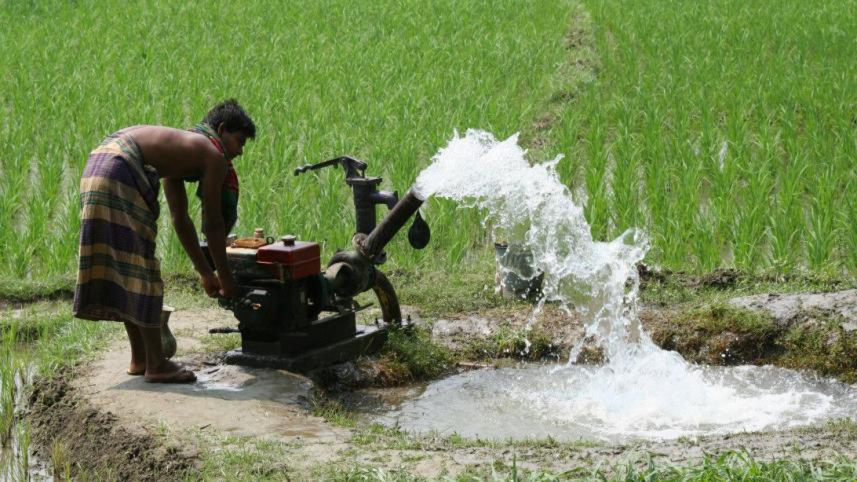
While many private vehicle owners in Dhaka are filling extra canisters, Mostak Ali in Lalmonirhat, who needs 13 litres of diesel every single day to irrigate his 33 bighas of Boro paddy, is allowed to get two litres under rationing. He travels 12 kilometres to get them. Boro rice accounts for 55 percent of Bangladesh’s total annual rice production. The cultivation target this season is 50.53 lakh hectares, and 62 to 65 percent of those fields depend on diesel-powered irrigation pumps. In the 16 northern and northwestern districts already reporting acute shortages, diesel is being sold in the open market at Tk 15 to Tk 20 above the government price. Farmers, unable to pay the premium, are left out. But the proper formation of paddy largely depends on irrigation. An expert suggests that the country could face a food crisis like the 1974 famine if Boro production falls by 20 percent.
At this point, 55 percent of our rice production sits in those fields and missing one irrigation cycle at this stage can cause major damage. The businessman storing over 5,000 litres in a warehouse in Meherpur is not thinking about Mostak Ali’s paddy. He is thinking about his margin. But in a connected economy, his buffer and Mostak Ali’s bankruptcy are the same transaction.
The enforcement drives are crucial but apparently insufficient. Fines such as Tk 9,35,070 collected across 64 districts on March 31 are not a deterrent to those who consider fuel as an asset appreciating faster than a bank deposit. The sentences are usually short and rare. The penalties need to reflect that hoarding is a high-risk activity, not a rational hedge against uncertainty.
More importantly, the distribution system must be restructured around a need-based rather than a first-come, first-served approach. There is no technical reason why diesel for irrigation cannot be distributed through a priority channel with a farmer-designated lane at every filling station during the Boro season. India has managed agricultural input subsidies through Aadhaar-linked systems for years. Bangladesh government’s own Farmer Card initiative is in the right direction, which should be implemented before the paddy crop reaches the flowering stage.
The transparency dimension is equally urgent. When the energy division spokesman says there is no national shortage, but farmers in 16 districts are paying more than the official price to irrigate their fields, the gap between official reassurance and ground reality breeds the fear that drives panic buying. Real-time, district-level fuel availability data published daily would allow people to make rational decisions instead of fear-driven ones.
Bangladesh’s fuel supply is under genuine pressure from a faraway conflict. But the queues stretching for kilometres, the midnight violence at filling stations, or a farmer travelling 12 kilometres for two litres are not all due to what is happening in the Gulf. These outcomes largely result from our collective actions. The well had enough for all, but it ran dry because we stopped being a community and started being competitors. We need effective governance to ensure that the farmer’s bucket is filled before any extra canisters are. We can’t afford a food crisis on top of an energy crisis.
Dr Sabbir Ahmad is a researcher and expert in project delivery and engineering. He can be reached at sabbir@ieee.org.
Views expressed in this article are the author's own.
Follow The Daily Star Opinion on Facebook for the latest opinions, commentaries, and analyses by experts and professionals. To contribute your article or letter to The Daily Star Opinion, see our guidelines for submission.
 For all latest news, follow The Daily Star's Google News channel.
Comments