


What's in a word? The battle for cultural authority in Bangladesh
The crisis in Bangladesh today is not only political. It is civilisational, linguistic, and epistemic. What we are witnessing after the collapse of a dominant political order is an open contest over cultural authority: who has the right to define the nation’s language, moral vocabulary, historical memory, and acceptable public speech.
For years, political domination was accompanied by an attempt to stabilise a particular cultural hegemony. This was not merely about elections, institutions, or the security apparatus. It was also about shaping the symbolic universe through which people interpreted themselves. In that order, certain ways of speaking were treated as refined, modern, progressive, and “authentic,” while other vocabularies were dismissed as backward, communal, vulgar, or alien. The point was not simply linguistic preference. The point was control over legitimacy.

This is why the present struggle cannot be reduced to a debate over a few words. The return of terms such as insaf, zulum, mazlum, faisala, inquilab, and zindabad in public speech is significant not because these are “new” words, but precisely because they are not. These words belong to older layers of Bangla’s history, shaped through long interaction with Persian and Arabic vocabularies before colonial language engineering and elite canon formation narrowed what counted as respectable Bangla in many institutional settings. Their renewed circulation today signals not linguistic decline, but political reopening. It reflects a wider struggle over who gets to speak for the nation and in what moral language.
A Foucauldian reading is especially useful here. Foucault teaches us that power does not operate only through visible coercion from the top. It also works through discourse, institutions, classification, and the production of “truth.” In this sense, the old power centres are not merely defending grammar; they are attempting to police the truth. They are trying to prevent ideational competition by preserving their authority to decide what is proper Bangla, what is civilised expression, and what forms of speech can enter the public sphere without stigma.
This is what makes the current contest so intense. It is not simply a contest between two political camps; it is a contest between competing regimes of truth. One regime seeks to maintain a monopoly over cultural legitimacy by presenting its historical preferences as neutral standards. The other seeks to reopen the field by restoring suppressed vocabularies and alternative moral idioms to public life. The language question, therefore, is also a question of power and knowledge: who names, who classifies, who excludes, and who is forced to defend their own tongue as if it were an intruder.
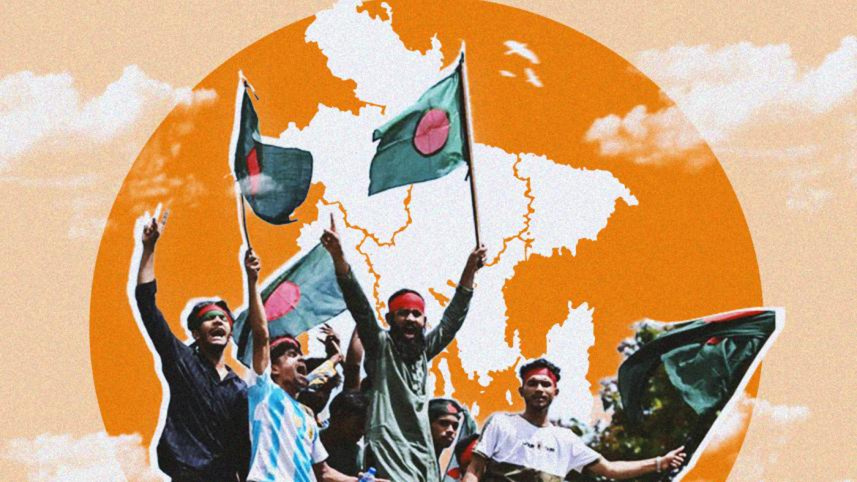
The July uprising made this contradiction impossible to hide. It was not a movement with a single centre, ideology, or social base. It was a multi-centred political eruption. Public university students mobilised over jobs, quota reform, and justice. Private university students stood in solidarity and amplified the call for accountability. BNP entered the moment with its own political equation. Jamaat and other Islamist actors dealt with it through different calculations. Left-leaning activists read the crisis through exploitation, repression, and the language of people’s rights. Liberals and conservatives alike opposed authoritarian domination for different reasons. The significance of this multiplicity is profound: a broad social coalition emerged not because it shared one worldview, but because it encountered a common structure of domination.
In Foucauldian terms, this was a biopolitical order under stress. The Hasina regime did not merely seek obedience; it sought to regulate life, aspiration, visibility, and the terms through which citizens could imagine justice. Students demanding jobs and reform, citizens demanding accountability, and groups demanding moral recognition were all confronting a system that had extended power across social life. Once that order fractured, the battle moved immediately to discourse. When the state-centred order weakens, the struggle over cultural authority intensifies.
That is why the current anxiety among old cultural elites is so revealing. If they now insist that the re-entry of Persianate/Arabic-inflected words will lead to “distortion” or “impurity” of Bangla, they are not making a neutral philological intervention. They are drawing a boundary around legitimacy. They are attempting to preserve a hierarchy of speech and, with it, a hierarchy of speakers. This is precisely where the language of “purity” becomes politically suspect. No living language is pure. They are layered, borrowed, adaptive, and contested. To demand purity is often to demand obedience to a cultural canon maintained by institutions of prestige.
The public debate around Professor Tariq Manzoor’s statement that Bangla is being “deliberately distorted” has become emblematic of this wider struggle. Whether one agrees with him or not, the political significance of such interventions lies in their timing and function: they emerge at a moment when previously marginalised vocabularies are re-entering mainstream political speech. The issue is therefore not only language quality; it is cultural gatekeeping in a transitional period.
Bangladesh is now in a period where the long-standing political authority has been destabilised, but cultural authority has not yet been democratised. That is why the language question feels so charged. It condenses a larger conflict over memory, class, ideology, religion, and national identity. The central issue is not whether Bangla will remain “pure”—no language is. The central issue is whether Bangladesh can move towards a more plural public culture in which no single elite bloc can monopolise the right to define the nation’s speech, history, and truth.
Ahmed Ashfaque Shahbaz is a PhD candidate in political economy at the University of Exeter in the United Kingdom. He can be reached at aashahbaz9@gmail.com.
Views expressed in this article are the author's own.
Follow The Daily Star Opinion on Facebook for the latest opinions, commentaries, and analyses by experts and professionals. To contribute your article or letter to The Daily Star Opinion, see our guidelines for submission.
 For all latest news, follow The Daily Star's Google News channel.
Comments