


Austerity and the crisis of fuel, confidence and coordination

Last week, while buying vegetables from an open market, I could not help feeling dissatisfied over the hiked price of every item. “It seems you are still in a moon-sighting mode,” I said, to which the seller responded nonchalantly, “What can I do? There is not enough supply after Eid.” The market had yet to resume its usual motion. This was the week when we were supposed to recalibrate, when offices returned to their routine, factories picked up their rhythm, and transport networks started wheeling. But the flight to regularity was stalled by both geo- and domestic political concerns, leading to increased uncertainty and anxiety among businesses and consumers alike.
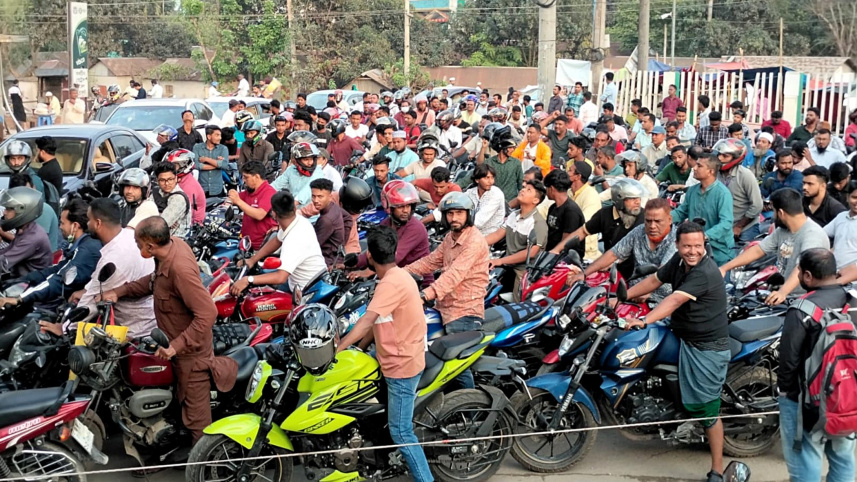
The proverbial flap of butterflies—understatement intended—in the Gulf straits has caused a tsunami in the rest of the world. The queues at the refilling stations extend beyond miles; altercations among punters stretch beyond their patience limits as we muse over the tit-for-tat missions in Tehran and Tel Aviv. Even though we are listed among the few privileged countries whose ships are allowed through the Strait of Hormuz, the fear of fuel shortages remains high. UK-based newspaper The Independent has marked Bangladesh as “the country that could be the first to run out of fuel due to the US-Iran war.” Although the government sources cited in the report vehemently deny any such possibility, recent austerity measures make the warning quite likely.

Attempts like fuel price passes, temporary rationing, and directives on “economical use” highlight our structural vulnerability. We import roughly 95 percent of our primary energy requirement, making us susceptible to global price shocks and foreign exchange pressures. In theory, the call for austerity is pragmatic demand management, but its timing could not have been worse. The decision comes when the economy has just begun to restart from a prolonged festive shutdown. Then there are the fun-seekers who are already eyeing another long weekend by manoeuvring the Bangla New Year holiday next week. Even under normal conditions, the post-holiday economic recovery phase produces friction. With austerity overlaying this moment, when fuel becomes pricier and less available, the friction can deepen further. On top of that, there are some mixed administrative signals: rationing of fuel, school openings on alternate days, and a plan to allow tax-free EV buses for educational institutions.
Then there is this divide between public and private sectors. The private sector does not have the luxury of getting a salary from a national exchequer. It must maintain its cash flow despite different shutdowns. Export-oriented industries—particularly RMG—operate under rigid delivery schedules dictated by global buyers. The deadlines do not get obliterated; they simply get compressed. Just when these sectors need extended hours for economic recovery, they are faced with a logistical freeze. The authorities have shortened banking hours, hampering coordination with customs, transport, and utilities. Real economic loss is likely to result from these austerity measures.
Ironically, many of these administrative decisions stem from the public sector that has a different temporal logic. The system often normalises shorter hours and extended holidays. The performance metrics of bureaucracy frequently fail to align with the urgent needs of private-sector recovery. This creates a structural asymmetry that hinders effective governance and intensifies economic challenges, especially during periods of crisis when rapid action is essential to facilitate recovery efforts. This is where austerity begins to feel less like policy and more like imbalance.
To be clear, Bangladesh’s current measures are not austerity in the classical deflationary sense. The situation is not akin to the European context marked by wholesale fiscal contraction. Instead, the approach is a hybrid model where automatic fuel pricing shifts global cost fluctuations onto the consumers in smaller increments. The administrative controls are imposed to manage demand as well as to signal discipline. But the underlying logic is not free from familiar risks.
First, let us consider the question of distribution. The austerity measures have created a sensation that prices may go up, leading scrupulous traders to hoard essentials, including fuel. If the government is forced to adjust fuel prices, the charges will cascade through transport costs into food prices and eventually affect every household, particularly the low-income ones. The initial attempt at rationing encouraged informal markets to thrive and led to selective enforcement.
Second, there is the question of perception. Austerity is not only about economic adjustment but also about legitimacy. Households implicitly question whether they share the burden when asked to conserve energy, limit consumption, and absorb the rising costs. Are elites equally constrained? The SUVs with hooters are still roaming the streets while ride-sharing bikers are forced to spend one-third of their shifts collecting fuel. Is discipline being demanded only downward?
This brings us to the third point: the question of governance style. The formation of monitoring cells must entail transparency, grievance mechanisms, and participatory communication. Tools of enforcement can poke deeper tension: austerity can stabilise an economy, but it can also destabilise trust. The post-holiday moment magnifies this tension because it exposes the lived experience of policy. A garment worker returning to Dhaka does not encounter “automatic pricing mechanisms”; they encounter higher transport fares. A factory manager does not see “demand management”; they see delayed shipments and rising input costs. Small traders perceive fuel directives as a limitation rather than as a sign of macroeconomic caution. And yet, alternatives exist—not in abandoning austerity, but in recalibrating it.
We expect the government to make burden-sharing visible. If fuel prices are adjusted, there should be targeted protections for those most affected. Demand management should prioritise transparency over coercion. Temporary limits can work, but they must be accompanied by clear communication of stock levels, timelines, and grievance channels. Otherwise, rationing becomes a theatre of control rather than a tool of stability. Above all, the public sector must sync its tempo with the private economy during recovery periods.
Austerity, in other words, must be intelligent. The danger is not austerity itself, but austerity that is poorly timed and distributed, which can lead to increased social unrest and economic instability if not managed effectively. The government must demonstrate its sincerity in addressing structural asymmetries while urging citizens to conserve, endure, and adapt. Any administrative imposition must have narrative coherence. The ongoing energy crisis is real, as are its fiscal constraints. But crises do not only test economies; they test political imagination. The question is not whether we conserve energy but how we conserve legitimacy. At this moment, we must fuel our economy with trust, not abstinence, to return to our rhythm.
Dr Shamsad Mortuza is vice-chancellor at the University of Liberal Arts Bangladesh (ULAB).
Views expressed in this article are the author's own.
Follow The Daily Star Opinion on Facebook for the latest opinions, commentaries, and analyses by experts and professionals. To contribute your article or letter to The Daily Star Opinion, see our guidelines for submission.
 For all latest news, follow The Daily Star's Google News channel.
Comments