


Depoliticise institutions, not ideas

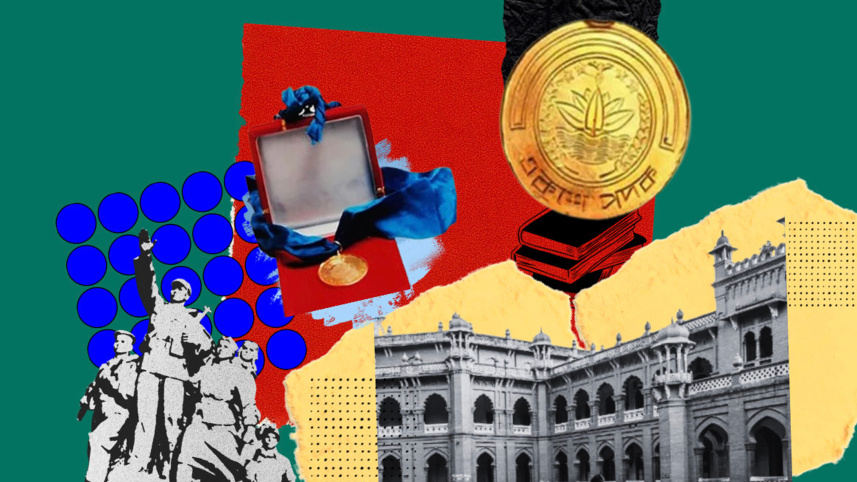
Not often do you hear a politician saying that “politicising education, research, and the practice of arts and literature is never a mark of a civilised society.” There is a lot to unpack in Prime Minister Tarique Rahman’s speech made at the Ekushey Padak 2026 award distribution ceremony on Thursday.
Ekushey, by design, is a political space. It is an archive of ideologically driven sacrifice leading to the formation of a nation-state. The award ceremony named after Ekushey celebrates dignity and intellectual freedom that is not devoid of politics. But when the prime minister labels “politicising” as an “anti-civilisational” marker, we need to ask: what does it mean to “depoliticise” education and the arts? The answer is far from simple.

It is impossible to sweep politics out of universities or academies of arts and culture. The transformative agenda of education is political in its noblest sense. When we design our curriculum to decide how we want to shape our citizens, to give them the knowledge and consciousness to question power and distinguish right from wrong, we embrace politics as a civilising agenda. The same goes for art. It is more than aesthetics that entertains. Arts teaches us to critique injustice and to push the boundary of our imagination by challenging established order. Politics does not threaten civilisation; it shows that it is alive and functional.
The real problem is not politics. It is the partisan attitude with which parties capture power. The Ekushey Padak to a certain individual was given and then stalled this year. The merit of the prize conflicted with the award-giving politics. Since the announcement of the resignation of Dhaka University’s vice-chancellor, speculations have been running high. A short list of candidates is available, but ironically all these senior teachers are being identified by their party loyalty and affiliations. Having worked with some of them in close quarters, I know of their high academic acumen and strong scholarly aptitudes. Yet, media tends to focus on their contribution to the political party alone.
As we have transitioned from an unelected interim government to a political one, we expect lessons to be learnt from the previous malpractices that corroded the system from within and gave politics a bad name. As a nation, we have inherited a proud legacy of politics synonymous with civic courage; moments of rupture, such as 1952, 1969, 1971, 1990 and 2024, erupted into the political scene, ushering in significant changes in our national life. One atrophy in such frequent brushes with politics is a culture of partisan affiliation. It started with student organisations, which acted as extensions of national parties. Then other professional bodies joined the bandwagon. We are living in a culture that demands political loyalty.
It is in this context that Tarique Rahman’s comment makes sense. It is the duty of the state to give weightage to these words. Gaps between what is said and what is practised will render this statement mere rhetoric. We need a system that promotes education and culture as spaces to nurture excellence in thought. We need a system that does not necessarily equate success with proximity to power. That system has to start with our educational institutions and academies. Our graduates must not internalise political patronage as normal before they enter the bureaucracy, the media, the judiciary—the job sector. Politicians must stop thinking of campuses as recruitment grounds. Over the years, we have created a culture that mobilises youthful energy for state control and electoral machinery. Curriculum has also been symbolically controlled to advance a convenient cultural narrative that supports party politics. Translating the prime minister’s words into action will require independence as a prerequisite for our research ecosystems.
Partisan politics often narrows the scope of knowledge production. For instance, while towing party ideologies, many scholars, especially in the arts and social sciences, will have to avoid controversial topics. Their preference for safe research questions will not add any new solid contributions to existing knowledge. A politicised research culture does not simply produce biased answers—it produces fewer questions. Frustrated by conservatism, brain drains can accelerate. For a developing country aspiring to move up in the global indexes, we need aggressive pursuits of innovation and technology. To uphold the value of our civilisation, we must protect the arts from symbolic appropriation. Already, we have seen how the issues of Bauls, Qawali, Mazars, Pahela Baishakh, and Probhat Feri have been scrutinised for ideological leanings. When cultural institutions or festivals feel pressured to align with partisan narratives, we realise the importance of the depoliticisation that the premier talked about. Since art depends on patronage from both state and non-state agencies, the depolitical paradigm must take the tension between power and imagination responsible for its creation into consideration.
There is a popular saying: everything is political. While it is true to a great extent, not everything needs to be partisan. We need to create an academic culture that knows the difference between political consciousness and party allegiance. The call for depoliticisation at the institutional level requires the establishment of civic rules and the safeguarding of democratic norms. A weak system devoid of rules allows partisan agents to thrive. The answer is transparency and accountability. We need to select academic and administrative leaders using clearly published criteria and independent search committees.
If the political leadership desires, they can decouple their student wings on campuses. Elected, non-partisan student unions may serve democracy better than formally or informally party-affiliated bodies. For a non-political system to thrive, there has to be an inbuilt grievance redress mechanism. If I understand the spirit of Tarique Rahman’s statement correctly, “politicising” as an anathema to civilisation means freedom of consciousness. Can a teacher or a student question authority without calculating risk? Can researchers publish uncomfortable data without consequence? Can artists stage dissent without fearing cancellation? The answer is not devoid of politics. But it is where politics respects boundaries.
Dr Shamsad Mortuza is vice-chancellor at the University of Liberal Arts Bangladesh (ULAB).
Views expressed in this article are the author's own.
Follow The Daily Star Opinion on Facebook for the latest opinions, commentaries, and analyses by experts and professionals. To contribute your article or letter to The Daily Star Opinion, see our guidelines for submission.
 For all latest news, follow The Daily Star's Google News channel.
Comments