


The surcharge of Eid-time tragedies

In Samuel Beckett’s play Waiting for Godot, a character with supposed authority intensifies the absurdity by quantifying emotion. Pozzo philosophises, “The tears of the world are a constant quantity. For each one who begins to weep, somewhere else another stops. The same is true of the laugh.” The inseparability and cyclical nature of joy and sorrow is found in the folkloric wisdom that we learnt at school, “The more the laughter, the more the tears—so said Ram Shonna.” We are taught to accept the fact that joy is never permanent, and happiness carries within it the seed of its fading.
Call me a pessimist, but reports of accident-related deaths that marred our Eid celebrations have a sobering effect. As if nature had its own mechanism to warn us against joy and force us to recognise a type of emotional symmetry that posits laughter and tears not as polar opposites but as necessary neighbours, like yin and yang.

It was almost surreal to see a bus plunging into the Padma River from the pontoon attached to a ferry boat at Daulatdia ghat in Rajbari. A ferry hit the pontoon, causing the bus to lose control and roll over straight into the river with passengers inside. As of Thursday night, 26 bodies have been recovered, with some passengers escaping through the windows and locals pulling them ashore. The absurdity is further solidified when you get to hear that the driver was allegedly having tea at a nearby stall and the helper was behind the steering wheel. Whatever the situation might have been, we are dealing with deaths caused by callousness. The passengers did not follow the protocol of getting off the bus before boarding the ferry. The guardrail was not sturdy enough to prevent such accidents. The pontoons and the ferry were aligned in a dangerous curve. The constant river erosion doesn’t allow the administration to prepare a proper dockyard, which exacerbates the risk of accidents.
My newsfeed is filled with anecdotal references to some of the deceased. Colleagues from my previous workplace are showering praise on a former debater and campus livewire, Raihan, who was among the victims. I have friends who had family members in that ill-fated bus. I cannot just brush away the incident as a distant accident. It could have been any one of us.
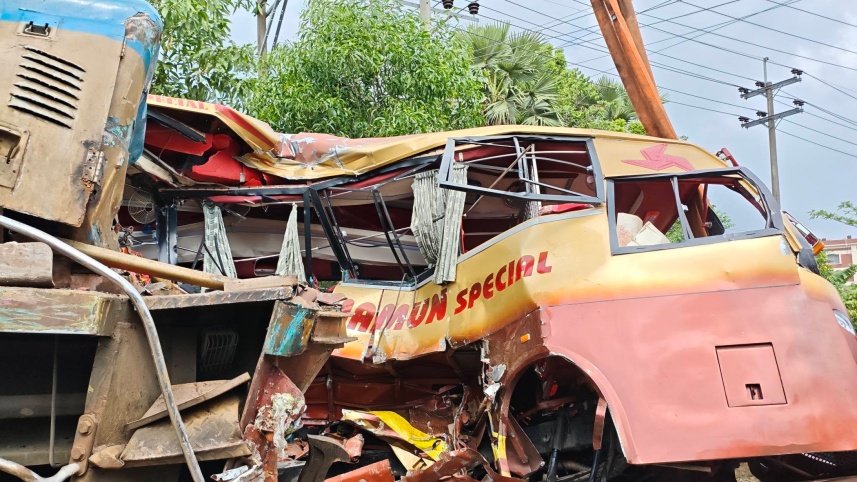
Every year, during Eid holidays, lives are claimed by road crashes. The Daulatdia ferry ghat accident will be a footnote in this year’s road crash report, just like the report of a bus ramming into a train on March 22 at a level crossing in Cumilla’s Paduar Bazar. Twelve passengers died with at least 15-20 injured in that incident. Add to that the crash in Burichang when a bus rear-ended a private car, killing all four members of a family as well as the driver.
There is no short supply of accident news during Eid holidays. You cannot blame the authority because they have done their part by issuing multiple directives. Yet, we continue to have tragic incidents like the one in Burichang. During such times, we often find ourselves lamenting our fate. The pull of compulsory homecoming over the Eid holidays imposes a heavy surcharge on the people. Eid-time mobility is affected by bad roads, poor driving, high pressure on the highways, lack of monitoring, and the absence of enforceable working-hour rules for long-distance drivers, resulting in a heavy toll on passengers, pedestrians, and families who face the harsh reality of risky journeys while yearning to be near their loved ones during the holiday season.
Behind each number of casualties, there is a human face. Imagine the trauma of the eight-year-old who was pushed out of the window as the bus was plummeting into the deep water of Padma; he will always blame himself for not being able to help his mother in her final moments. Should he consider his life a gift from his mother? Like many of us, should he simply blame “reckless drivers” and move on? What about fatigue, long hours, and a lack of defined limits for drivers? Whose profit-mongering allowed these drivers to be reckless? Why didn’t the guards at the ferry terminal insist on the offboarding of passengers? Once we start asking these questions, we plunge into a void of moral choices. A system designed to compete with rivals and maximise profits for its owners compromises the drivers’ agency. The passenger is but a commodity. But the “workers” must return to the city to serve others.
The amount of joy associated with Eid is in complete alignment with the amount of sorrow that Eid-time deaths entail. Eid is a social obligation. We celebrate to remember, to return to our group, our clan, and our families. The Eid journey is part of a ritual that involves visiting our roots and renewing our bonds. When this celebration becomes a dangerous duty, we need to go beyond asking, “Why are our roads unsafe?” and start asking, “Why do we accept unsafe roads as normal at the very moment we claim to value family most?”
We can philosophise the Eid casualties as a seasonal fate. But there are pragmatic steps that can make Eid joy constant. This will require ferry terminals with adequate barriers, level crossings with efficient safety devices, drivers following labour rights and safety policies, and unfit vehicles being removed from service. Above all, the process will require action plans based on the investigation reports. We need to learn from every accident and stop burying the investigation reports along with the deceased.
As for the victims, the winds raged last night with their monsoon moods, and I listened to a favourite song of mine by Sting, “On and on, the rain will fall/ Like tears from a star, like tears from a star/ On and on, the rain will say, /How fragile we are, how fragile we are.”
Dr Shamsad Mortuza is vice-chancellor at the University of Liberal Arts Bangladesh (ULAB).
Views expressed in this article are the author's own.
Follow The Daily Star Opinion on Facebook for the latest opinions, commentaries, and analyses by experts and professionals. To contribute your article or letter to The Daily Star Opinion, see our guidelines for submission.
 For all latest news, follow The Daily Star's Google News channel.
Comments