


Building ‘strategic capacity’ in fossil fuels isn't the answer to our energy crisis

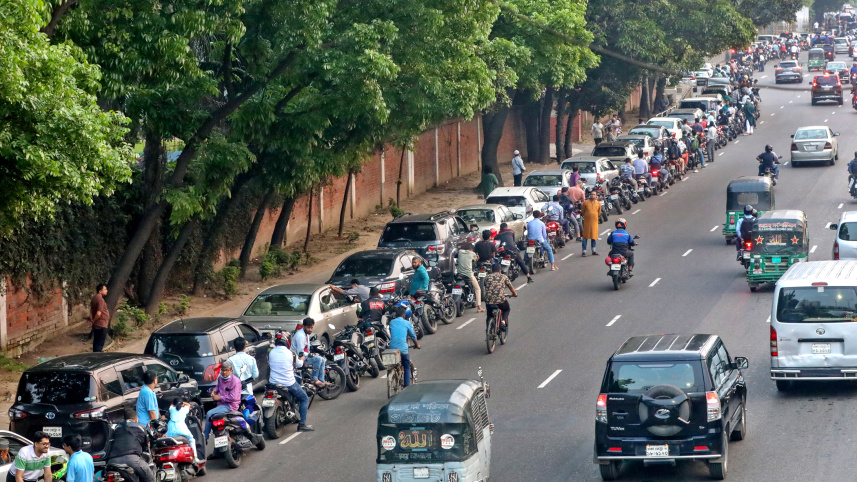
Bangladesh has been entrapped in medium-term energy challenges because of the US-Israel war against Iran and its consequent impact on crude oil infrastructure and supply chains based around the Strait of Hormuz. The government has so far maintained a roll-out plan by rationing energy supply. However, with the expected demand for air-cooling systems and the need for electricity and diesel for irrigation for Boro rice cultivation, energy requirements are likely to increase further from April. The coming month(s) will also require fertiliser supply for Boro cultivation, which the government is trying to manage through imports.
Meanwhile, industrial production, both in export-oriented and domestic markets, has started to decline. Rising energy prices are likely to increase the shipment costs of imported products, which could push food inflation further. Therefore, addressing challenges from a prolonged energy crisis would require medium- to long-term strategies.

The government’s top priority must be to establish a structured system of energy and electricity rationing, ensuring that limited resources are directed towards vital economic activities such as production, job creation, and export industries. Several think tanks, academics, and policy analysts have offered suggestions for building strategic capacity in fossil fuels, particularly diesel and LNG, to address emergency requirements. Some are enthusiastic about using imported coal or exploring domestic coal as a strategic option for energy security. Such initiatives would wrongly mix short-term strategies with long-term priorities.
It should be noted that borrowing to import LNG, developing additional LNG and diesel infrastructure based on interest-bearing long-term loans, and importing or mining coal from local mines using foreign loans and public funds will further deepen the indebtedness of the Ministry of Power, Energy and Mineral Resources, and severely damage the sector’s long-term energy transition plan under the Renewable Energy Policy 2025.
As part of a transition towards clean energy, a more cost-effective solution would be to explore domestic natural gas from “probable” wells. The government should immediately expedite drilling works in Srikail Deep-1, Mobarakpur Deep-1, and Fenchuganj South-1. It should also allocate additional funds to explore natural gas in other “probable” and “possible” onshore sites. Besides, foreign companies currently involved in onshore gas exploration must be pushed to update their operations regularly. The Tengratilla Gas Field (Chhatak West) is now out of international dispute and ready for re-exploration. The chances of discovering new reserves there are high. As a long-term strategy, the government must take bold steps to explore offshore gas blocks. Petrobangla must learn from earlier failures and proceed with re-tendering based on feedback from international oil and gas companies.
The government should also emphasise replacing diesel-based irrigation with solar-based systems soon. Approximately 13 lakh irrigation pumps annually use 10 lakh tonnes of diesel, about 15 percent of total diesel imports, costing about $1 billion each year. A rapid shift to solar irrigation could significantly reduce import dependency and save foreign currency. Moreover, solar irrigation with net metering could generate additional income for farmers and installers during the off-season from power distribution companies. Hence, the ministry needs to boldly act to accelerate net-metering connections through distribution companies such as the Bangladesh Rural Electrification Board (BREB).
Diesel and LNG use in industrial units can be reduced by 15-20 percent if rooftop solar power generation is expedited. Access to low-cost financing for installing solar panels on industrial rooftops in the Export Processing Zones or specialised industrial parks through local commercial banks, international financial institutions, and development banks could make this possible. Bangladesh Bank’s Sustainable Refinance Scheme needs to be expanded and simplified for interested companies. Additionally, multilateral development banks and international financial institutions should introduce credit-guarantee schemes to support the government and reputable commercial banks in financing renewable energy projects, thereby de-risking these opportunities.
Meanwhile, the transport sector is the largest consumer of total diesel imports. The transition from diesel-operated to battery-operated vehicles, or EVs, has been delayed due to many reasons, including vested interests. The government should introduce fiscal and budgetary incentives to promote EVs, charging stations, and related maintenance facilities across the country. Bangladesh’s bilateral trade agreements with countries that promote diesel, petrol, or LNG-based transport need to be revisited. The ministries of transport, power and energy, finance, and planning must work together to develop nationwide infrastructure for EV-based transport as soon as possible.
The power and energy ministry should also forge ahead with its renewable energy initiatives—the National Rooftop Solar Programme 2025 and utility-scale solar power plants through public procurement. Successful implementation of these programmes could generate about 8,000 MW of electricity in a short period and reduce dependence on gas, LNG, and coal-based power generation, thereby lowering reliance on imported fossil fuels, which cost about $7 billion annually.
The regional power grid for renewable energy trading—already operating at a limited scale between Bangladesh, India, and Nepal—needs further expansion. Extending the grid through India to Nepal and Bhutan could enable Bangladesh to access more low-cost renewable electricity, reducing dependence on costlier LNG-based generation. It would also allow Bangladesh to export surplus electricity to regional markets. Such measures could further reduce reliance on high-cost fossil fuel-based power generation.
Bangladesh’s strategic reserves should not be directed towards expanding LNG, diesel, and coal infrastructure or increasing imports using scarce foreign exchange at a time of tightened reserves. Instead, the country’s strategic focus should be on gradually implementing cost-effective and sustainable renewable energy solutions across power generation, irrigation, and industry and household use. This transition would significantly reduce demand for imported fossil fuels—diesel, crude oil, LNG and LPG—in later years. There is no need for new investments in fossil fuel infrastructure that would burden the country with long-term debt for 20-25 years. Bangladesh is not in a position to bear that burden.
Ultimately, energy security and sustainability will depend not on diesel, LNG, coal, or LPG, but on solar, wind, hydro and waste-to-energy systems for power generation, transmission, and distribution.
Dr Khondaker Golam Moazzem is research director at the Centre for Policy Dialogue (CPD).
Views expressed in this article are the author's own.
Follow The Daily Star Opinion on Facebook for the latest opinions, commentaries, and analyses by experts and professionals. To contribute your article or letter to The Daily Star Opinion, see our guidelines for submission.
 For all latest news, follow The Daily Star's Google News channel.
Comments