


Fixing a broken education system

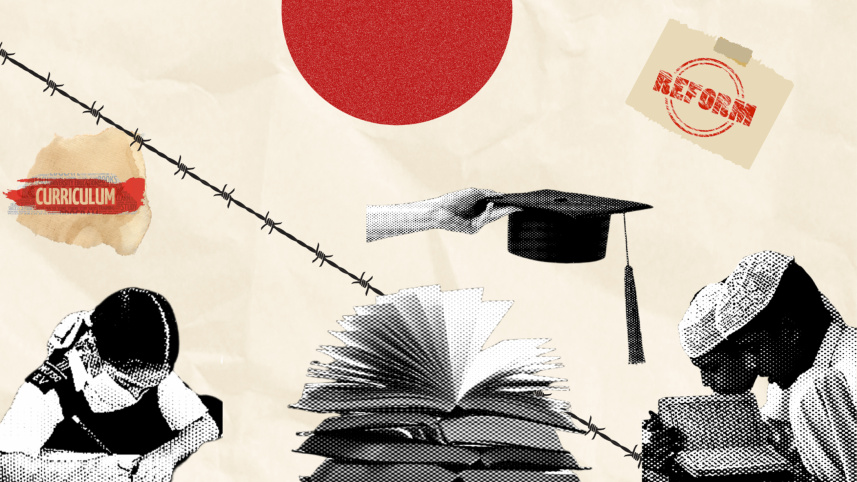
As well as a moral duty to provide a decent education to its children, Bangladesh faces an urgent economic imperative to do so. The nation currently enjoys a “demographic dividend”—a large working-age population relative to dependents—creating a window for economic growth. But with falling fertility and mortality rates, that window is about to close. Unless education reform is placed centre stage, within a decade, Bangladesh will be locked in with a woefully undereducated workforce for years to come.
Last week saw the publication of a report on education reform that, if implemented, could transform the future of Bangladesh. Chaired by Abed Chaudhury and commissioned by the education adviser, the drafting committee included Mushtaque Khan, Erum Mariam, Sabina Yasmin, Ananta Neelim, and others.

An excellent presentation outlined the report. But in the ensuing discussion, almost to a person, the 50-odd attendees focused on matters such as curriculum content, teachers’ conditions, textbooks, and so on, apparently failing to grasp the significance of the report. I presume that the 50-odd attendees from government and civil society had not had the benefit, as I had had, of reading the report in advance. Without an advance copy, it is quite possible I too would have failed to appreciate fully that such matters as curriculum content were not at all the focus of the committee’s work.
A metaphor is useful here to draw the distinction between what this remarkable report is about and what it is not about.
In choosing a car, we might look at the size of its engine, the colour, whether it has automatic or manual transmission, whether it has powered steering, whether it is a saloon or an SUV, and so on. This is an apt metaphor if we think of education as the car, we acquire at the outset of this, the journey of our lives. After all, it determines the speed and distance we can travel and underwrites our resilience when we navigate difficult terrain. The attributes of a car may be likened to curriculum content, or class size, or teacher training, all the things that the attendees wanted to discuss.
But the report was not so much about the attributes of a car as it was about how to make a good car manufacturing plant.
By taking this approach, the committee was able to identify the fundamental shortfalls of the education system and why they persist. Moreover, the report sets out how to assess any reform proposal, how to implement it, and, where a reform delivers, how to make it stick.
The substance of their approach is grounded in the powerful field of systems analysis. Rather than serving a menu of policy initiatives, the committee examines the systems-failure of educational governance. Rather than itemising every detail of a new curriculum, the committee explains how reform has invariably been thwarted by adverse incentives or signals within the system and the responses to those signals.
To elucidate this idea, consider exams and what the report identifies as the catastrophic failure of exams to prioritise competence or mastery over formal coverage of curriculum. Independent learning assessments show a widening gap between exam performance and actual competence. Achieving good grades in exams has ceased to signal mastery of skills. Students progress from one year without having acquired the necessary skills for achieving competence in the next.
In a systems failure, venality and incompetence are not the issue. A teacher is doing exactly what the system signals are telling the teacher to do. Exam results are the signal and the teacher’s mode of teaching is the response. Teachers teach to curriculum coverage and not mastery.
In fact, the response from every level of governance has all too often been to lower standards so as to maintain an illusion that mastery is being achieved.
In place of mastery of primary skills, such as linguistic and mathematical skills, Bangladesh’s secondary education system has prioritised things inimical to mastery, such as rote learning. Never in the history of homo sapiens has memorisation been the means of acquiring a skill.
A curriculum bloated by layers and layers of material, piled on by numerous actors without co-ordination, has undermined focus on mastery. But the issue with the curriculum is not so much excessive breadth as a “mismatch between expected learning outcomes, available instructional time, pacing assumptions embedded in curriculum documents and textbooks, and assessment signals that prioritise coverage over mastery.”
The committee based its emphasis on a very strong research-backed trend favouring depth and mastery over breadth and coverage at the secondary level. That emphasis must be reflected in Bangladesh’s education system.
Reform will be painful and while some reforms may be phased in, the committee stresses that others must be instituted more quickly. When exams properly assess pupil competence, grades act as a critical signalling function in every quarter of the education system. Poor grades demand reform of curriculum, teaching and textbooks.
The committee sets out several “non-negotiables,” conditions that must dominate all reform. For example, new initiatives may only be introduced where they “replace, consolidate, or retire existing activity.” The endless layering of initiatives must stop.
Perhaps chief among the non-negotiables is that everyone must know in advance who is responsible for each system signal. The proliferation of burdensome and interminable pilot programmes, for instance, will continue so long as ownership of response is not clear.
While generally refraining from prescription of curriculum content, the committee does identify two subjects as crucial to any curriculum. (In my view, a third subject is omitted. I will come to that.) The first subject is Bangla language learning, the importance of which is self-evident. The second is mathematics.
Mathematical education has been central to any notion of a decent education for centuries, even when education was the province of the idle aristocracy. Today, throughout the world, secondary school students learn about quadratic equations and trigonometric identities, when virtually none of them will ever return to such things once they leave school. But there is a good reason so many children in so many societies and for so long are required to study such things.
I am embarrassingly fond of saying that mathematics is an education in thinking without the encumbrance of facts, something said to me by a court of appeal judge in England, upon hearing that I, like him, had studied mathematics as an undergraduate. No other subject offers as efficient a way to help young people learn how to reason. Every other subject involves learning a lot of facts before reasoning can get a look in.
 For all latest news, follow The Daily Star's Google News channel.
 Here, the tendency towards rote learning is most visibly destructive. Examinations that test for a pupil’s knowledge of the quadratic formula reward rote learning. But the pupil who merely memorises the formula has gained nothing that the pupil who has learned how to reason and derive the formula has gained. The latter has learned how to think, even if she forgets what a quadratic equation is in years to come.
I come now to the subject that the committee omitted to identify as a priority.
A few years ago, I visited Amsterdam. I arrived at the city’s airport, jumped in a cab and asked the driver, “I’m sorry, I don’t speak Dutch, but do you speak English?”
The driver flashed me a vicious scowl before answering my question.
Later that day, I mentioned the episode to friends, who offered a fascinating explanation of that scowl. Asking the driver if he spoke English, they said, could be viewed as asking if he was illiterate or of the lowest class. Almost everyone spoke English.
After World War II, when the Netherlands was occupied by Germany, this small country, surrounded by neighbours speaking languages other than Dutch, decided that children would learn two other languages. The same holds for most of Northern Europe.
The academic literature is clear: in the young, learning another language has distinct cognitive benefits going beyond the acquisition of another language, improving even spatial reasoning.
The economic benefit is plain. One language is the currency of business and that language, above all others, is also the repository of what we collectively as a species have learned. The modern economy is all about that knowledge.
I suspect the committee refrained from stating that English should be a priority for fear of arousing linguistic nationalism and jeopardising reception of the whole report. For historical, understandable but unhelpful reasons, a monster of emotions is aroused by any discussion of language.
Bangladeshi elites, with their money, have liberated themselves from the inadequacies of the state’s secondary schooling system. Since elites largely determine policy agendas, reform of public education has taken a back seat for years.
What becomes of this outstanding report depends on the next government, civil society, and the people. It is hard to be optimistic whenever reliance on government or civil society seems necessary. Some hope might yet be derived from the fact that the July uprising showed that the people still wield some power.
Zia Haider Rahman, a former international human rights lawyer and head of research at Transparency International Bangladesh (TIB), is the author of the novel ‘In the Light of What We Know.’
Views expressed in this article are the author's own.
Follow The Daily Star Opinion on Facebook for the latest opinions, commentaries, and analyses by experts and professionals. To contribute your article or letter to The Daily Star Opinion, see our guidelines for submission.
Comments