


The referendum mandate is real, but reform must return to the constitution

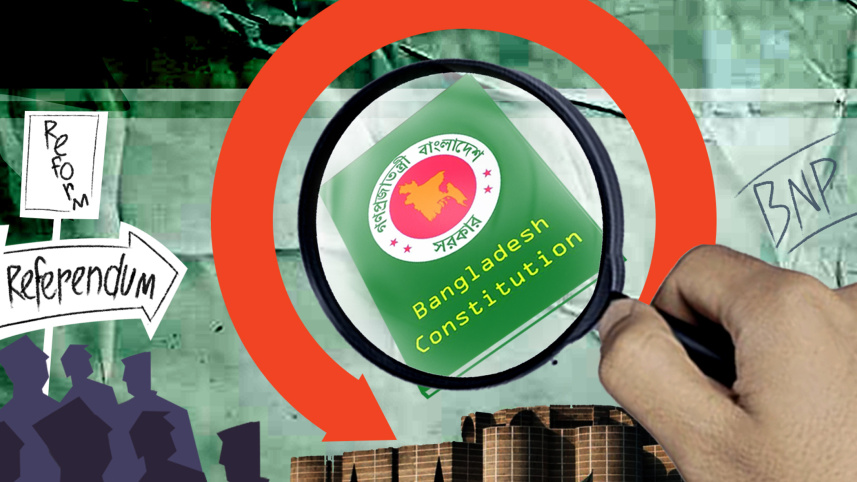
Bangladesh has just staged a rare democratic exercise: a parliamentary election and a referendum on constitutional reform on the same day. The Election Commission has gazetted the referendum result, with 68.59 percent of valid votes backing “Yes” on a turnout a little above 60 percent. The referendum was framed as consent to implement 48 constitutional reform measures under the July National Charter. Yet, within hours of the new parliament’s first oath-taking, the reform roadmap began to unravel, largely because the reform process was built on a legally brittle shortcut.
The fault line sits inside the July National Charter (Constitutional Reform) Implementation Order, 2025. The ballot asked voters to consent to the order and to a bundled set of constitutional reform proposals. In case of a “Yes” win, the order says a Constitution Reform Assembly will be constituted, comprising the elected representatives, who will “serve concurrently” as the members of parliament and assembly members, and the assembly will have “full authority” to carry out constitutional reforms within a fixed period. It even declares that reforms adopted by the assembly are “deemed final” without further approval.

To activate that machinery, the order requires a second oath. After taking the parliamentary oath, MPs were meant to take, in the same ceremony, an oath as members of the assembly. BNP MPs refused that second oath. Salahuddin Ahmed’s public reasoning was blunt: none of them were elected as assembly members and steps could be taken only after the assembly was “constitutionally adopted” in parliament. MPs of the Jamaat-led alliance, by contrast, proceeded with the assembly oath.
BNP’s legal point is not nonsense. An oath is not a slogan; it is a constitutional device that signals where authority comes from and what binds office-holders. If a new constitutional body is to be created, the orthodox route is to amend the constitution first, define that body’s powers, and then prescribe any oath within the constitution’s own schedules and procedures. Forcing a second oath through an executive order, and treating refusal as defiance of “the people,” collapses law into politics. The implementation order itself tries to pre-empt this debate by dressing the assembly in parliamentary “privileges and immunities,” but that is not how constitutional legitimacy is built.
Still, BNP’s posture cannot be romanticised. A party that enjoys a decisive parliamentary majority can cite constitutional purity today and dilute reforms tomorrow. BNP says it remains committed to implementing the July charter. But a referendum “Yes” vote was, at minimum, a demand for constraints on the executive and for institutional guardrails. To treat that demand as optional parliamentary discretion is to turn popular consent into a blank cheque for the next supermajority. That is precisely the logic that has repeatedly converted constitutional amendments into instruments of partisan entrenchment.
The more uncomfortable truth is that the interim government’s design made this collision almost inevitable. The implementation order is framed in the language of revolutionary legitimacy, invoking the “sovereign will” expressed through the July mass uprising as its authority. That may be emotionally resonant, but constitution-making by proclamation rarely produces durable constitutionalism. Predictably, litigation has already begun. A writ petition has already been filed with the High Court challenging the legality of the referendum and seeking cancellation of its results. Once courts are invited into a transition’s political design, the timeline stops being controlled by reformers and starts being controlled by litigation.
This is happening in a legal environment already crowded with sub-judice constitutional questions. The High Court previously declared unconstitutional key parts of the 15th Amendment, including the abolition of the caretaker government system, and it also reinstated the referendum requirement for constitutional amendments, with the hearing on the appeals adjourned till March 5. Separately, the Appellate Division in November 2025 reversed the 2011 verdict that had struck down the 13th Amendment, restoring the caretaker system prospectively from the next election cycle. In short, Bangladesh is trying to “implement” constitutional changes while the constitution’s recent past is still being litigated.
The caretaker government issue illustrates why shortcut constitutional engineering is dangerous. The abolition of the caretaker government system, justified politically by a court verdict and then entrenched legislatively, became the gateway to elections that large parts of the country did not accept. Now the system is notionally revived, but parties still dispute what an acceptable caretaker government structure should look like. If this debate becomes just another winner-takes-all bargaining match, the country risks repeating the same crisis one election later, only with new actors and the same temptations.
There is a solution, but it requires abandoning two comforting myths. The first myth is that a referendum can replace constitutional procedure. It cannot. The second myth is that parliamentary supremacy alone guarantees democratic legitimacy. It does not, especially in a polity where parliamentary supermajorities have historically been used to harden executive dominance. The only workable path, then, is to fuse the referendum’s political mandate with constitutionally orthodox, parliament-led lawmaking that can survive judicial review and future transfers of power.
That means the new parliament should initiate a transparent reform process that treats the July charter as a public draft, not as a sacred text and not as a menu. If BNP is sincere, it can table constitutional amendment bills in discrete packages, send them to an all-party committee, hold public hearings, publish draft clauses, and adopt a credible method for caretaker government selection and election-time administration that does not depend on the goodwill of the incumbent. If it wants to preserve the reform assembly concept, it should first amend the constitution to define the assembly’s status, powers, relationship with the amendment article, and the oath’s place in the constitution. Then the second oath would be law, not a political test of loyalty.
Just as importantly, the reform agenda should not be held hostage to the most contentious constitutional redesigns. Many governance reforms can be pursued through ordinary laws and institutional practice while constitutional questions are debated in the open. An overview of the July charter process captures both the ambition and the dissent that make genuine implementation harder than slogans suggest. Early, concrete improvements in election administration, policing, judicial appointments, and anti-corruption enforcement would help rebuild public trust and reduce the cynicism that grows when elites spend months arguing over procedure while everyday impunity continues.
The referendum result is not the end of the reform debate. It is the beginning of a constitutional test. Bangladesh can either treat law as a tool to rationalise political power, or treat law as the discipline that keeps power from devouring the republic. The difference will not be decided by who took which oath on day one. It will be decided by whether the winners choose constitutional restraint when restraint is against their immediate interest.
Barrister Khan Khalid Adnan is advocate at the Supreme Court of Bangladesh, fellow at the Chartered Institute of Arbitrators, and head of the chamber at Khan Saifur Rahman and Associates in Dhaka.
Views expressed in this article are the author's own.
Follow The Daily Star Opinion on Facebook for the latest opinions, commentaries, and analyses by experts and professionals. To contribute your article or letter to The Daily Star Opinion, see our guidelines for submission.
 For all latest news, follow The Daily Star's Google News channel.
Comments