


Tourism and roads won’t solve CHT’s deeper wounds

In July 2024, a student-led movement demanding quota reform evolved into the mass uprising against authoritarianism, bringing an end to over fifteen years of increasingly centralised and coercive rule. What followed was an interim government and then Bangladesh’s first genuinely competitive election in decades, won by the BNP. Since then, the country has been gripped by a mix of hope, excitement, anxiety, and speculation. From farmers in rural areas to political elites in Dhaka, and from indigenous communities in the hills to people in the plains, Bangladeshis are looking ahead to how the BNP will shape the nation’s political future.
This energy has also reached the most historically marginalised regions of the country. In the Chittagong Hill Tracts (CHT) and indigenous villages in the plains, election banners lined the roads, and political processions were a regular sight during the election campaign period. Yet among hill communities, this moment was marked as much by scepticism as by anticipation. A common concern was that no matter which party came to power, life in the hills would remain unchanged. This belief has deep roots, shaped by decades of unfulfilled promises, stalled agreements, and systemic neglect. Whether the BNP will prove different remains to be seen.

The CHT occupies a distinct place in Bangladesh’s political imagination. Its geography, cultural diversity, Indigenous identities, and history of conflict and marginalisation set it apart from the rest of the country. Internationally recognised standards, including the UN Declaration on the Rights of Indigenous Peoples (UNDRIP), affirm that Indigenous peoples have the right to self-determination, to maintain their distinct political, social, and cultural institutions, and to participate meaningfully in decisions affecting their lives. Any serious democratic project must therefore address the specific realities of the CHT rather than subsume them under generic development narratives. In this context, it is worth examining how Bangladesh’s major political parties addressed—or failed to address—the concerns of hill communities in their manifestos for the election.
At present, political discourse largely revolves around the BNP, Jamaat-e-Islami, and National Citizen Party (NCP). A review of these parties’ manifestos revealed some encouraging language. Commitments to a truth and healing commission, constitutional rights, protection of Indigenous languages and cultures, strengthening the Hill District Councils and the Regional Council, and reforming the Chittagong Hill Tracts Accord all featured prominently. These commitments resonated with UNDRIP’s emphasis on redress for historical injustices, cultural protection, and Indigenous participation in governance. However, beyond these broad pledges lies a troubling consensus: all three parties primarily frame the CHT as a site for eco-tourism and infrastructure development.
This narrow understanding of “development” overlooks the core political and historical issues that define the hill tracts. Roads, resorts, and tourist facilities cannot substitute for constitutional recognition, land rights, demilitarisation, justice for past atrocities, protection from communal violence, and the full implementation of the CHT Accord. UNDRIP clearly recognises Indigenous peoples’ rights to their traditionally owned or occupied lands and requires that development projects proceed only with their free, prior, and informed consent. Treating infrastructure as a cure-all risks depoliticising deep-rooted injustices and reinforcing existing inequalities.
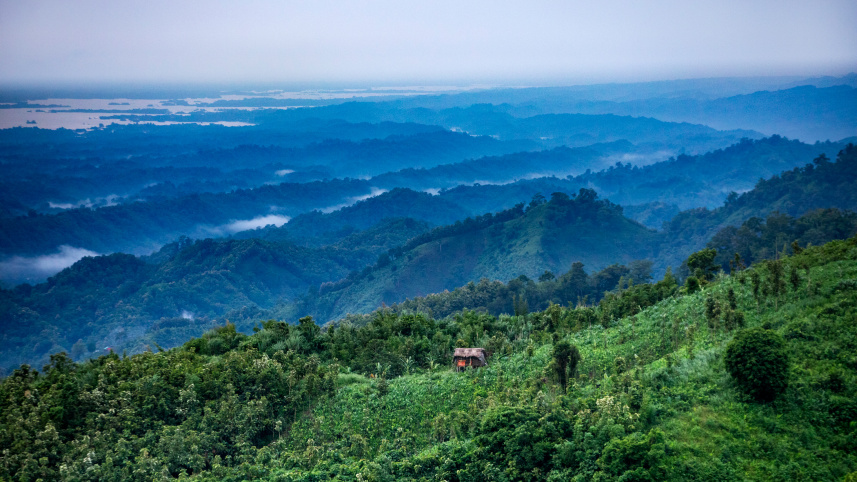
Tourism in the CHT has increasingly become synonymous with Sajek Valley. Yet during the summer months, residents of Sajek Valley struggle to access safe drinking water. While new roads have improved connectivity, quality schools, trained teachers, and higher education opportunities remain scarce. There are very few university students from the valley. Bandarban offers a similar paradox. Celebrated as a premier tourist destination, it continues to have one of the lowest literacy rates in Bangladesh. These contradictions reveal the limits of a development model that prioritises visibility over lived realities and fails to uphold Indigenous peoples’ rights to education, health, and social well-being.
Particularly noteworthy is the BNP’s assertion that everyone in both the hills and the plains should be defined by a single identity: “Bangladeshi.” While shared citizenship is essential, conflating nationality with ethnic identity risks erasing the distinct Indigenous identities of hill communities. UNDRIP affirms that Indigenous peoples have the right to maintain their distinct identities while fully participating in the political life of the state. A democratic society should be capable of accommodating plural identities within a shared political framework. Unity does not require uniformity.
If this election and the subsequent democratic transition are to represent a genuine break from the past, BNP must move beyond symbolic recognition and cosmetic development. The people of CHT are not asking for charity or tourist branding. They are demanding justice, recognition, meaningful participation in decision-making, and the fulfillment of long-standing political commitments. Until these demands are addressed with sincerity and courage, the hope that “this time will be different” will remain fragile, not only in the hills but across Bangladesh.
Kurnikova Chakma is student at University of Dhaka (DU).
Joya Dewan is student at DU.
Dr Muhammad Asadullah is associate professor of justice studies at the University of Regina, Canada.
Views expressed in this article are the author's own.
Follow The Daily Star Opinion on Facebook for the latest opinions, commentaries, and analyses by experts and professionals. To contribute your article or letter to The Daily Star Opinion, see our guidelines for submission.
 For all latest news, follow The Daily Star's Google News channel.
Comments