


Virus eradicated, humans too
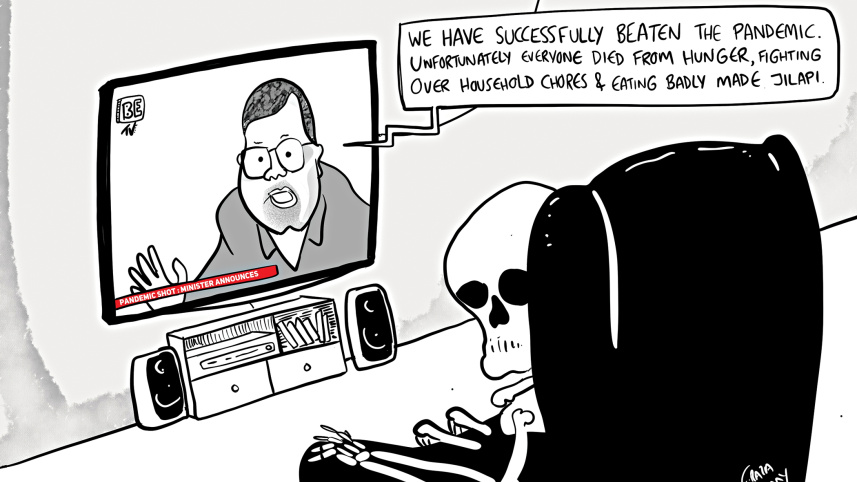
Chapasthan has apparently stopped the spread of the deadly morosnavirus, and they have supposedly done so a fair while ago. There has been radio silence from the country for the last six months as the world descended further into the war against the Morbid-19 disease and there was little time to look at news that was not about a given nation's own troubles.
But news trickled through that something utterly strange was afoot in Chapasthan when a migrant worker from that country returned to it via sea from his adopted country of Iwalked last month.

After reaching Chapasthan, he communicated with our agency over the satellite phone he had carried, which was a stroke of luck as all telecommunication in the country was down. The government had years back started to roll out a passenger-pigeon communication service fearing the spread of rumours on digital media.
This correspondent then too travelled went to Chapasthan to see if the migrant worker's horrific account of an empty ghost town, recounted over his satellite phone was anywhere close to true.
It was.
After three days searching most restaurants, hundreds of tea-stalls and all other popular hangout spots, no survivors were spotted. The virus had been defeated, but that was because there seemed to be no hosts left.
However, upon scouring newspapers that were piled up in big columns in front of a building, it was apparent that the massive human cost was not because a particularly deadly strain of morosnavirus had attacked Chapasthan. Reports dating back a year showed that Chapasthan was taking the same measures that most of the world had adopted back then -- social distancing, nationwide shutdown and testing as many as possible for Morbid-19.
About a month and a half later, people became restless just as the outbreak was approaching its peak. As an underdeveloped nation, Chapasthan could ill afford to keep their economy closed for long periods and particularly, forego export orders of their number one export -- buttons -- worth billions. So, the government had decided to open up factories, restaurants and other small businesses on a "limited scale". Only people who lived in Chapasthan's capital would be allowed to join work while others would remain "safe" in their village homes. Curiously enough, the newspaper did not define the "limitations". They said social distancing guidelines must be followed, but the newspaper pages were filled with people cramming together to buy fish, climb foot overbridges, provide donations, go for Dryday excursions donned in new clothes and all.
A month after the opening up on a limited scale, both the infection rate and death rate spiked. The government was roundly criticised for delaying approval of testing kits made by local companies. They could have followed the example of European nation Kartaka's example and started contact tracing and testing for antibodies to identify who might be immune, therefore could go back to work and keep the economy chugging along, said an op-ed writer, whose obituary appeared on the next day's paper.
Chapasthan had self-identified as an autodemocracy -- a system of government where democracy happened automatically -- and so, the government, under increasing pressure, promised to show the world that they were far ahead of their more developed counterparts and would stop the disease dead in its tracks.
According to a news published three months ago, the Chapasthan government declared martial law and ordered institutional quarantine of all 170 million people.
Newspapers came out for about a month after that, and carried news of how a half-baked research led to a ridiculous figure of the minimum income to be doled out to disadvantaged families and had left them starving, how domestic violence and murder had increased when abusive families were cooped up and of course, people dying at home without treatment with morosnavirus-like symptoms.
There was also news of how some rich people made it out by giving the law enforcers guarding their mansions, their mansions. But not much was heard about them afterwards.
The last official bit of info came from the information minister, who was in charge of sitting at home and enforcing the Insecurity Act, so had no contact with the outside world for six months. He was also the supposed last survivor.
"Everything is fine, no one is spreading rumours, my screen is blank. Sometimes I watch news of the good old days of bumper cucumber harvest on VTV and it makes me feel even more hopeful for the future. As part of my job, I am glad to announce we have beaten Morbid-19 well before any of the richer nations have," he had said.
 For all latest news, follow The Daily Star's Google News channel.
Comments