The water we wear: Why “No Shopping Day” matters
Imagine this for a moment. You open your wardrobe in the morning and pick your favourite jeans. It feels like any other day, simple, ordinary, routine. You don’t think twice before wearing them. But without realising it, you are carrying something invisible, something that never appears on a price tag or clothing label. Almost 10,000 litres of water are tied to that one pair of jeans. Not in a bottle. Not in a tank you can see. But quietly embedded in every thread of the fabric.
Now shift your attention to a saree hanging beside it. Elegant, delicate, familiar. It too holds thousands of litres of water within its fibres. It sounds surprising at first, almost unbelievable. How can clothing carry water? But this is the reality of what we call virtual water the hidden water behind everything we use, wear, eat, and consume every single day.
At first, the idea may feel abstract, even distant. Water, after all, is something we associate with rivers, taps, rain, or bottles. We rarely connect it to the objects around us. But virtual water is not imaginary. It is very real. It simply refers to the total amount of water used throughout the entire production process of a product, from growing raw materials to manufacturing, processing, dyeing, packaging, and finally delivering it into our hands.
Cotton farming, in particular, has placed enormous pressure on global water resources. One of the most striking examples is the shrinking of the Aral Sea in Central Asia. Once one of the largest lakes in the world, it has now dramatically reduced in size over decades. The main reason is massive water diversion for cotton irrigation. Rivers that once fed the sea were redirected to agricultural fields, leaving behind a dry, cracked landscape where water once flowed freely. Fishing communities disappeared. Ecosystems collapsed. Entire ways of life were lost.
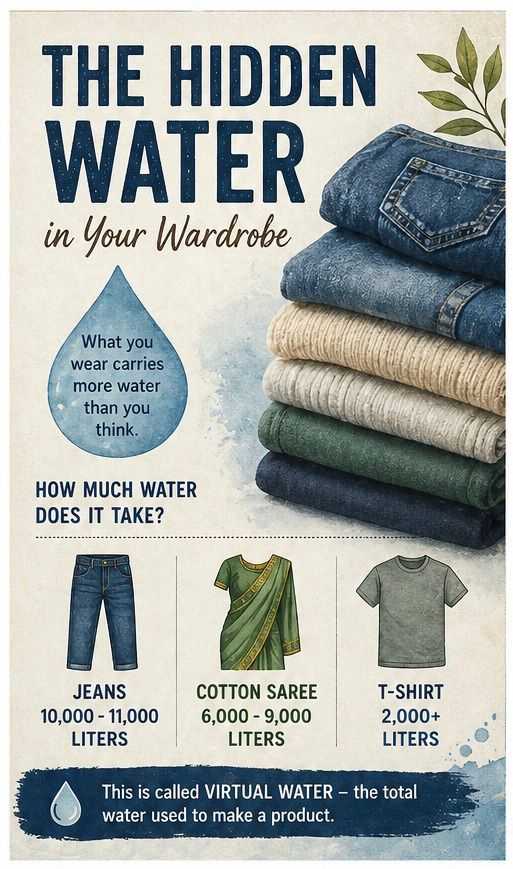
Take clothing as an example. A single pair of jeans can require around 10,000 to 11,000 litres of water to produce. A cotton saree may use anywhere between 6,000 to 9,000 litres, depending on its design, thickness, and finishing. Even a simple cotton T-shirt can take more than 2,000 litres of water before it reaches a store. These numbers are not random; they represent countless stages of water use that we never see.
Cotton farming alone is one of the biggest contributors to this invisible water footprint. Cotton is a thirsty crop. It needs large amounts of irrigation, especially in regions where rainfall is not enough. Water is drawn from rivers, groundwater, and lakes to keep cotton fields alive. After harvesting, even more water is used in processing, bleaching, dyeing, and finishing the fabric.
But the story of virtual water is not just about numbers. It is also about consequences.
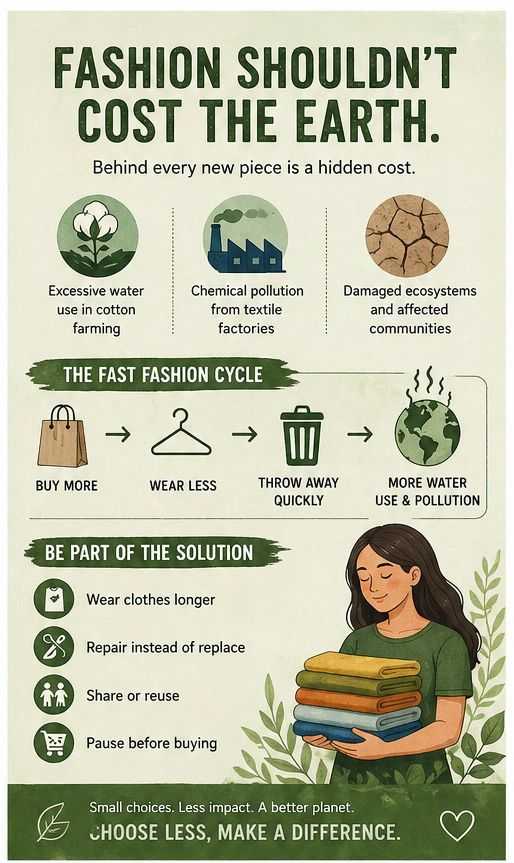
Most people assume that the water we use daily at home, brushing teeth, cooking, bathing, is the main concern when it comes to water scarcity. In reality, the majority of freshwater consumption happens far away from our sight, within agriculture and industrial production. The clothes we wear, the food we eat, and the goods we use are all part of this hidden system.
Cotton farming, in particular, has placed enormous pressure on global water resources. One of the most striking examples is the shrinking of the Aral Sea in Central Asia. Once one of the largest lakes in the world, it has now dramatically reduced in size over decades. The main reason is massive water diversion for cotton irrigation. Rivers that once fed the sea were redirected to agricultural fields, leaving behind a dry, cracked landscape where water once flowed freely. Fishing communities disappeared. Ecosystems collapsed. Entire ways of life were lost.
Yet despite all of this, our consumption habits continue almost unchanged. Fast fashion has reshaped how we view clothing. Trends change quickly. Prices are low. Choices are endless. Buying has become easier than ever before. And in this cycle of constant consumption, clothes are often worn a few times and then forgotten. They are replaced not because they are worn out, but because they are no longer “new.”
Take clothing as an example. A single pair of jeans can require around 10,000 to 11,000 litres of water to produce. A cotton saree may use anywhere between 6,000 to 9,000 litres, depending on its design, thickness, and finishing. Even a simple cotton T-shirt can take more than 2,000 litres of water before it reaches a store. These numbers are not random; they represent countless stages of water use that we never see.
What we rarely pause to consider is that every new purchase carries a hidden environmental cost. When demand increases, production increases. When production increases, more water is used, more chemicals are released, and more pressure is placed on already stressed ecosystems.
This is why even small actions, like a “No Shopping Day”, especially on occasions like Earth Day, carry meaning beyond symbolism. It is not about stopping consumption forever. It is about interrupting the cycle, even briefly. It is about stepping outside the automatic habit of buying and asking a simple question: do I really need this?
Skipping a single purchase may not feel powerful in isolation. But when multiplied across millions of people, the impact becomes significant. Less demand leads to reduced production. Reduced production means lower water use, fewer chemicals released into rivers, and less strain on natural ecosystems. It creates space for reflection in a system that rarely pauses.
This is not a message about restriction. It is not about giving up comfort, or fashion, or personal expression. It is about awareness. It is about recognising that every product we own has a history that begins long before it reaches us. And within that history lies water, often thousands of litres of it.
There are also simple but meaningful choices we can make in our daily lives: wearing clothes for longer instead of discarding them quickly, repairing instead of replacing, sharing or exchanging clothing with others, and choosing quality over quantity. These actions may seem small, but they gradually shift the culture of consumption from excess to mindfulness.
Virtual water teaches us something deeply important: what we see is never the full story. A clean shirt is not just fabric. A glass of juice is not just fruit. A book, a phone, a meal all carry invisible resources shaped by human effort and environmental cost.
And once we begin to see this hidden layer, our relationship with everyday objects starts to change. We begin to understand that consumption is not just a personal act; it is part of a much larger global system connecting water, land, labour, and life.
This Earth Day, perhaps the question is not only what more we can do for the planet.
Maybe it is also about what less we can take from it.
Because sometimes, the most meaningful action is not addition but restraint. Not more consumption but more awareness. Not another purchase but the decision to pause.
And in that pause, we may begin to see something we often miss: that even the smallest choices we make can travel far beyond us through water, through land, and through time.
Israt Jahan is the Operation Director of Ignite Global Foundation. She can be reached at israt@ignite.org.bd.
Send your articles for Slow Reads to slowreads@thedailystar.net. Check out our submission guidelines for details.
How Bangladesh can stop the next data breach
Salinity and the unseen health burden in coastal Bangladesh
Dhaka: How a city was planned to drown
Can Bangladesh’s 250 million tree pledge succeed?
Bonolata Sen's Natore: A topographic reading
When rain turns Dhaka's commute into a second job
Why Bangladesh’s children are in school but not learning

Why Bangladesh is still failing to protect children from infectious diseases

Why Bangladesh’s new data protection law may fail to protect your data