Celebrating Eid: Thousand years of history in three embraces
As the crescent moon marks the end of Ramadan every year, more than two billion Muslims worldwide convene with grace. Households fill with the scent of roasted meat and vermicelli, we wear our finest panjabi and salwar kameez, and the city empties in a matter of days as millions rush home to their villages.
These rituals feel deeply familiar, almost instinctive. Yet few who celebrate, pause to ask where they truly come from.
The practices that turned into our customs have travelled a thousand years to reach us. The very essence of how Eid is observed in Bangladesh has undoubtedly been hewed by the courts of Baghdad, Cairo, Córdoba, and Constantinople.
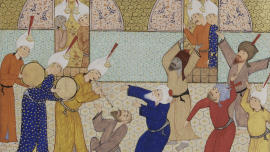
When the Abbasid Caliphate reached its height under Harun al-Rashid in late 8th-century Baghdad, Iraq, Eid was already a grand, state-sponsored spectacle. The court celebrated with large marches, grandiose public feasts, and the deliberate distribution of gifts to the poor.
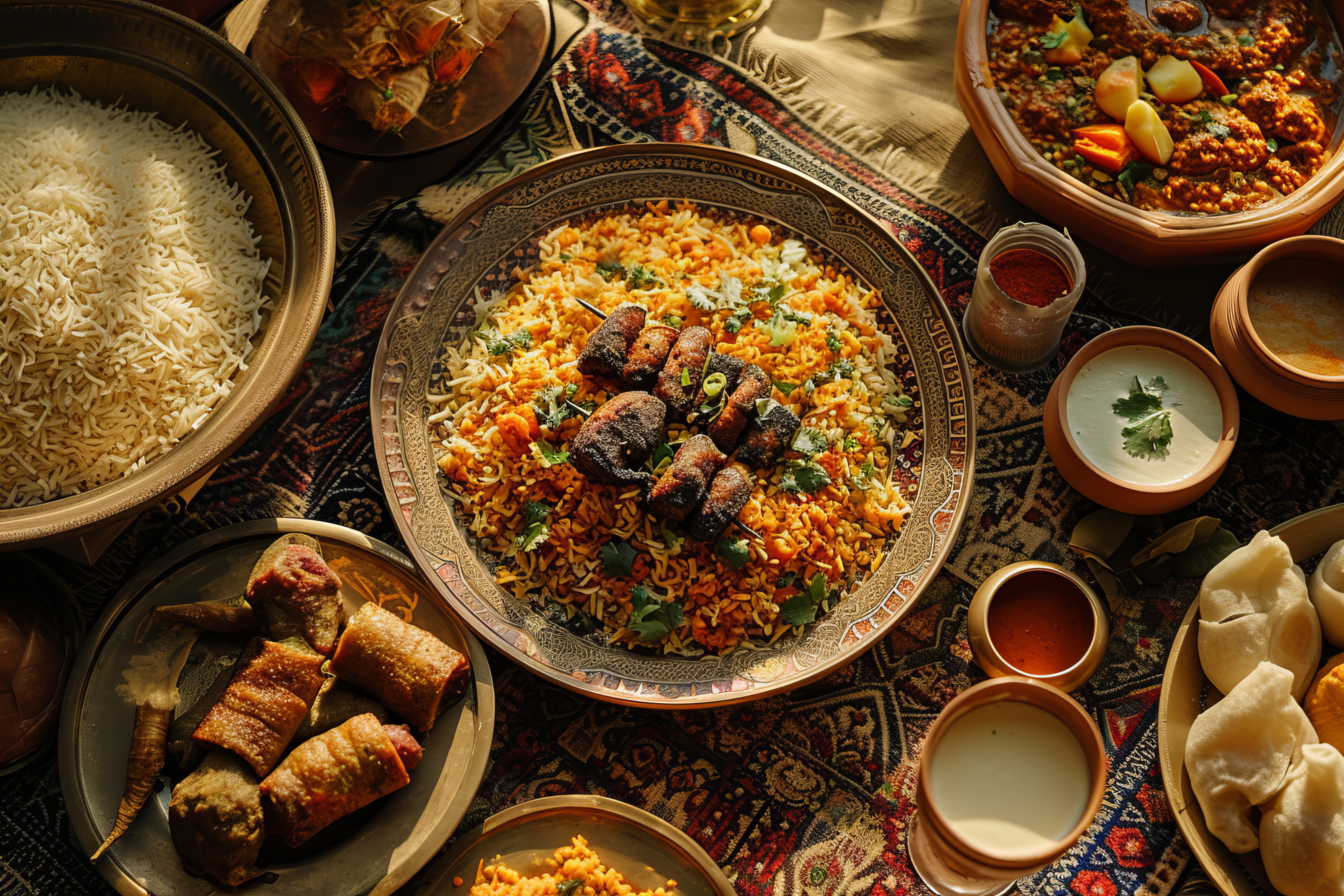
Sweets made from semolina, honey, vermicelli (semai), and rosewater—great ancestors of basbousa and mamounia—closely resemble Bangladeshi firni. They were distributed freely among households and at the courts of viziers.
But beneath the pageantry, two customs endured the test of time: charitable giving as a prerequisite to celebration, and the communal nature of the Eid meal.
The Fatimid Caliphate in Egypt ruled from the 10th to the 12th centuries, having refined this festive culture further. Fatimid garb was closely documented through descriptions of their ceremonial processions. Historians often describe royal marchers as being enrobed in dignified garments, a display meant to maintain the morale of a prosperous sultanate. Taking white and green as their dynastic colours, which connoted the glad tidings of the heavens and symbolised purity. This tradition of wearing white or new, fine clothing for Eid prayer has endured ever since.
Zakat al-Fitr, the obligatory charity given before the prayer, was institutionalised precisely to ensure that no community member observed Eid in hunger. This marked a redistributive impulse, as the courts understood that a visible, well-fed populace celebrating Eid was, put simply, a statement of caliphal legitimacy.
As trade routes carried Islamic culture westward into Al-Andalus (modern-day Andalusia, Spain) and northward toward Byzantine (Mediterranean) territories, Eid traditions were absorbed in equal measure. In Spain, the Caliphate of Córdoba surpassed Constantinople (Istanbul) as Europe's largest multicultural city, blending Catalan, Berber (North African indigenous), and Levantine customs into its fiestas.
Byzantine Rome maintained commercial contact with the Islamic world throughout this period, and accounts from both civilisations document the mutual exchange of festival foods and textiles. Gift exchanges between Byzantium and the Islamic Near East (Persia and Mesopotamia) were used as promotional items to increase demand for the item in question.
Items seen gifted between the two courts were effectively a ploy to make luxury goods a tool of statecraft, in contrast to the democratised markets of today. The silk robes, ornate kaftans, embroidered silk thobes, and head garments thus crossed into our traditions through the emigrating Mughals half a millennium later.
In 1610, when the Mughal rulers declared Dhaka as the provincial capital, subedars (high officials) arrived to manage the administration. However, along with tantrums, they brought Biryani, Korma, Kebabs, Borhani, and most famously, saffron.
The recitation of naats and Sufi devotional poetry during Eid, arrived through Persian and Central Asian Sufi networks and entrenched its existence in the subcontinent. The use of henna (mehndi) as part of Eid cosmetics for women was common practice across Arab and North African cultures. And so is visiting ancestral graves on Eid, reflecting Sufi reverence in South Asia, distinct entirely from its Middle Eastern counterparts, where no such custom exists.
Finally, consider the crisp notes slipped into a child's palm on Eid morning — the ritual of Eidi. Its roots predate Islam itself. Originating in Persian Nowruz celebrations during the reign of the Sasanian King Hormoz II around 300 AD, the custom of giving coins became widespread in Persia. New coins symbolised renewal and fresh beginnings, a custom that bled into the following generations.
The Delhi Sultanate retained much of its Persianate and Ottoman influence in the subcontinent. Emperor Jahangir allocated lakhs of provisions to dervishes as well as the poor during Eid al-Fitr. Shah Jahan would disburse huge amounts to set a precedent of embellished imperial generosity, with robes of honour in richly decorated fabrics of muslin, silk, brocade, and velvet to royal ladies, princes, and nobles. He also distributed precious stones to his cosmopolitan political subordinates.
Though behind every year’s Eid lies a question that receives too little attention: how does one determine when Ramadan ends?
The crescent moon
The 9th-century Caliph al-Ma'mun established the House of Wisdom in Baghdad in 832, where mathematicians, scholars, and astronomers collaborated using star charts and sextants to bring scientific rigour to the Islamic lunar calendar. Under the Abbasids, astronomers built upon Greek and Indian knowledge to develop the most sophisticated celestial tools of the time.
Al-Khwarizmi, who produced the first major Muslim astronomical work, the Zij al-Sindhind, wrote tables for the movements of the sun, the moon, and the five known planets. Al-Farghani, a court astronomer, wrote Elements of Astronomy on the Celestial Motions, a work so comprehensive it became widely accepted in Europe, leading to the development of calculus. Meanwhile, Al-Battani, hailing from what is now Syria, calculated the solar year to within a few minutes and was later cited by Copernicus himself.
At the centre of all this, from timekeeping to determining the position of stars and the direction of Mecca, came the most crucial innovation - the Astrolabe. The Astrolabe was used to determine the moon phase.
One of the earliest scholars drawn to Andalusia was Abbas Ibn Firnas, who constructed a famous mechanised planetarium that simulated celestial phenomena, including thunder and lightning. His daughter Fatima continued the tradition, writing a significant treatise on the use of the Astrolabe.
This led scholars from across Christian lands to flock to translate Muslim or “Saracen” science, kickstarting the scientific awakening of Europe. The line from Ibn Firnas’ observatory to Galileo's telescope is not merely metaphorical, but inspired.
Today, Bangladesh uses a national moon-sighting committee and telescopic confirmation to officially declare Eid — a practice that is, in spirit, a continuation of Abbasid meritocratic governance.
There is something extraordinary about traditions that have stood the test of time. Any fears of cultural erosion with the advent of globalisation are quieted by the knowledge that Eid, the holiest of festivities, has always been a hodgepodge of cultures, customs, and rituals.
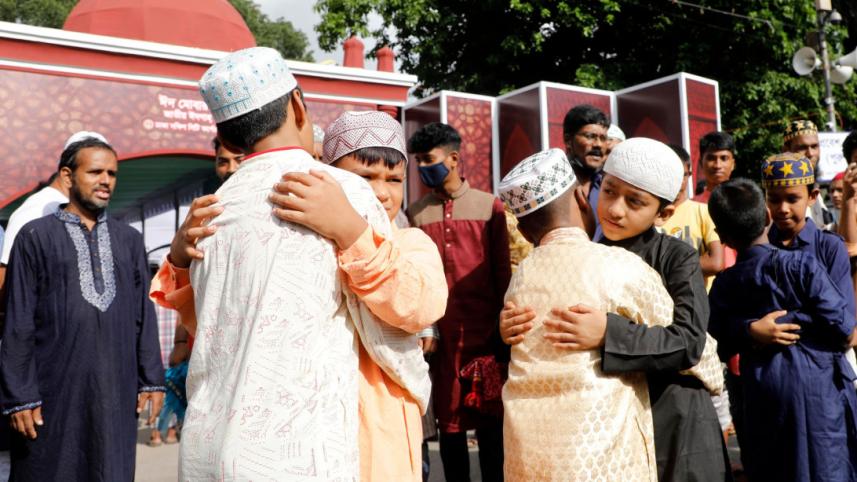
To celebrate Eid is to carry a thousand years of history in three embraces.
Shoumik Zubyer is a researcher of the soils of Mars at the Atomic Energy Commission and SERC, and a peripatetic. He can be reached at: shoumic.zubyer@gmail.com
Send your articles for Slow Reads to slowreads@thedailystar.net. Check out our submission guidelines for details.
The blind spots of Bangladesh studies
Rediscovering Santal history through Scandinavian archives
Asma Abbasi: The essence of orange
Tigers and the empire: A history of hunting, power and resistance
25th Death Anniversary / A life so full: Remembering Ahmed Sofa
Bengal's forgotten slave trade: Portuguese, Arakanese and Dutch trafficking networks
Mufazzal Haider Chaudhury and the idea of Bangladesh
The Tagore paradox: Why critique strengthens his legacy
What Sufism can teach us about the modern world