A new reading of Fakhruddin Mubarak Shah and Sonargaon’s independence
This occasion presented a favourable opportunity to Fakher Adden [Fakhruddin] the armour-bearer of Bhiram Khan, not only to assume the government of Sunergong without permission, but also to declare him an independent monarch, assuming the title of Sultan Sekunder.
.... Fakher Adden ... succeeded in regaining his authority, caused himself to be proclaimed sovereign of Bengal; and ordered the coin to be stamped, and all public papers were issued in his name.... Bengal remained for many years afterwards an independent and distinct Kingdom.
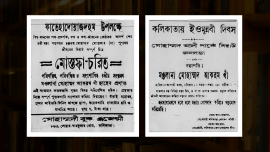
The above excerpt is taken from a two-century-old history book titled The History of Bengal (pp. 81–82), published in Calcutta, the then capital of the Bengal Province under colonial rule. The author of the book was Charles Stewart, an Indologist who served in the Bengal Army in his early career. Later, he became a professor of Arabic, Persian, and Hindustani at the East India College in Haileybury, England. This was the first history book in the English language that attempted to reconstruct the political profile of the Bengal Delta. One may have many critiques of this book, and we may not disagree with them. However, there is little doubt or disagreement that Fakhruddin Mubarak Shah was the first independent Sultan of Sonargaon—a land located in the centre of the delta and surrounded by riverine geography. Stewart wrote that Bhiram (Bahram) Khan died in 739 AH/1338 CE at Sonergong [Sonargaon]. At that time, Muhammad bin Tughlaq had conquered a vast area in the Deccan and was heavily engaged in transferring his capital to the newly established city of Daulatabad. Taking this as an opportune moment, Fakhruddin declared independence in Sonargaon. This argument was further developed by Edward Thomas in The Chronicles of the Pathan Kings of Delhi, Illustrated by Coins, Inscriptions, and Other Antiquarian Remains. Thomas suggested that the most suitable moment for Fakhruddin Mubarak Shah was 737 AH/1336 CE, based on his reading of the date on Fakhruddin’s coins as:
ضرب هذه السكه بحضرة سناركانو سنة سبع وثلثين و سبعماية
[Translation: This sikkah was issued from Hadrat Sonargaon in the year seven hundred thirty-seven.]
Henry Blochmann, another orientalist, also critically examined the available textual records and numismatic evidence. He suggested a correction to the reading of Thomas and commented that, in the absence of nuktah or diacritical signs in the Arabic script, the initial sin (س) and ta (ت) appear similar, as do the words saba and tisa. Therefore, the correct reading of the date would be 739 AH, and he proposed that Fakhruddin Mubarak Shah ruled for ‘ten years and some months’. On the basis of numismatic evidence, he concluded that Fakhruddin Mubarak Shah’s reign period was 739–750 AH. It is evident that the debate centres on the reading of the date.
In the 1960s, Sukhamaya Mukhapadhyaya, in his Banglar Itihaser Dusho Bachar: Swadhin Sultander Amal (1338–1538 AD), took the year of Fakhruddin’s independence as the starting point of his historical narrative and ended with the defeat of Ghiyasuddin Mahmud in 1538 CE.
My humble effort today is to revisit this historical narrative with the help of numismatic evidence discovered in the last three decades. It is almost proverbial that the world of sultanate coinage is a mystery. A new coin, or even a re-reading of an old coin, advances the established debate further.
Firoz Mahmud published a gold coin issued by Fakhruddin Mubarak Shah, discovered in Sylhet and preserved in the Bangladesh National Museum (BNM). The gold coin contains the date in the marginal section, written in words, which is quite readable, although the upper portion appears to be cut off. It was probably issued to commemorate the declaration of independence by Fakhruddin Mubarak Shah in 739 AH.
It is interesting to note that an expert numismatist like Abdul Karim accepted the reading of the gold coin. However, this coin also created an opportunity for historians to revisit the issue.
The historiography centred on Fakhruddin largely depends on Persian chronicles as primary sources written under the patronage of North Indian rulers. Two Tarikh-i-Firuzshahis are the only contemporary texts. Later works such as Tarikh-i-Mubarakshahi, Tabaqat-i-Akbari, and Tarikh-i-Firishta also contain important information on Fakhruddin and the affairs of Bengal. The eighteenth-century historical compilation by Golam Hussain Salim (Riyaz-us-Salatin) also includes a separate section on Fakhruddin. Except for the last, all the other texts were written outside Bengal, and none of the writers ever came here. The imperial lens is a salient feature of these works, which is reflected in their writings on Bengal. They approached the events of Bengal through an imperialist lens. As a result, some of these works describe Bengal as a land of traitors, disobedient subjects, and troublemakers.
Fakhruddin Mubarak Shah, being aware of the political condition of Muhammad bin Tughlaq, took full advantage of his location and the geographical setting and declared independence in Sonargaon. His reign period was sixteen years (734–750 AH), with a short interregnum. How short it was and when it occurred remains a debated issue.
As a result, the coins issued by the rulers of Bengal are a more reliable primary source for reconstructing the history of the aforementioned period. However, clipped margins, scarcity of specimens, and the clumsy, sprawling scripts of the coins have created controversy among historians and numismatists. The importance of placing all the available coins of a Sultan side by side and carefully reading the date portion cannot be ignored.
New coins issued by the rulers of Bengal have been discovered and published by researchers as well as coin collectors. I propose 205 years (1333 to 1538 CE) of the Independent Sultanate period instead of 200 years (1338–1538 CE) on the basis of these numismatic researches. In doing so, I would like to re-read the date portion of the only gold coin of Fakhruddin Mubarak Shah, now kept in the Bangladesh National Museum. My reading suggests that this ruler declared independence in 1333 CE, i.e. five years earlier than the prevailing date.
What was the force behind the rise of Fakhruddin Mubarak Shah? What facilitated his emergence as an independent authority? In attempting to answer these questions, I would venture to examine the multi-faceted settings—man-made and natural—that played the role of catalysts in the making of Sonargaon as the first independent geo-political entity in the trans-Meghna region.
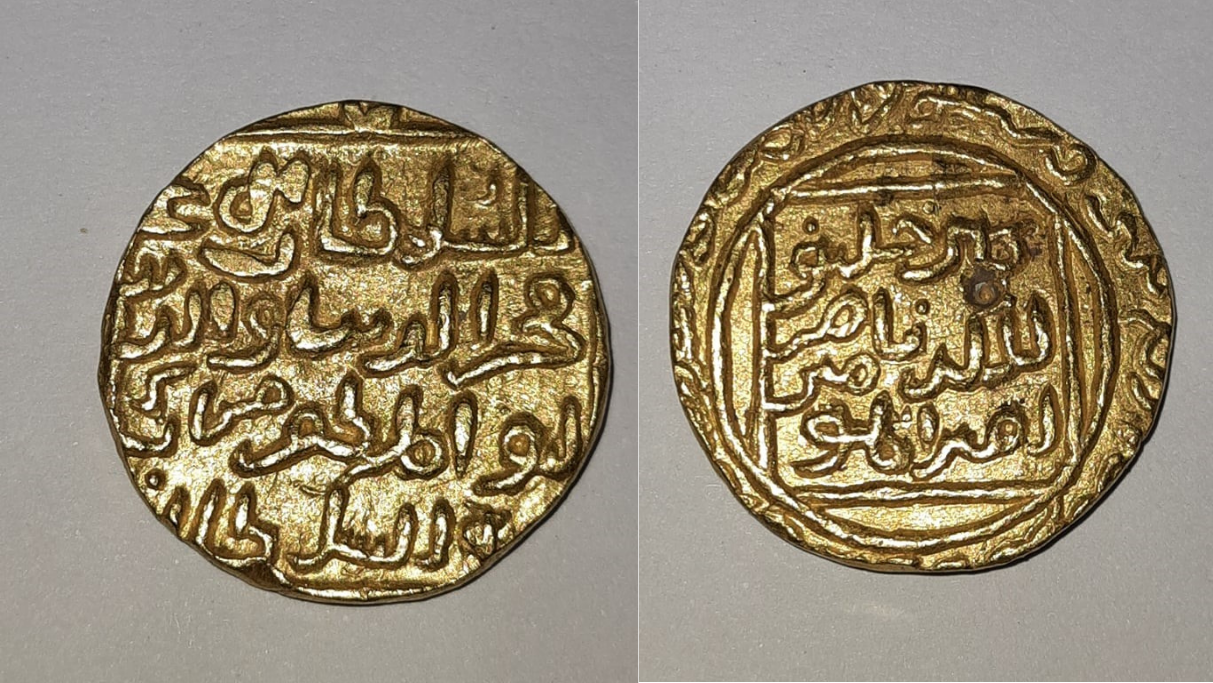
Stan Goron and G. P. Goenka published seven new coins of Fakhruddin in their catalogue. The gold coin published by Firoz Mahmud was placed first in their list and was dated to 739 AH by historians and numismatists. The second is a quarter tanka made of gold. Goron and Goenka proposed a new reading of the first coin (Picture 1), which is given below:
Obverse: alsultan al azam fakhr al-dunya wa’l din abul muzaffar mubarak shah
Reverse: yamin khalifat allah nasir amir al-muminin
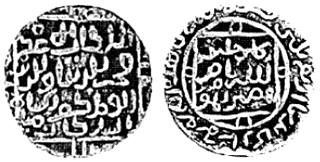
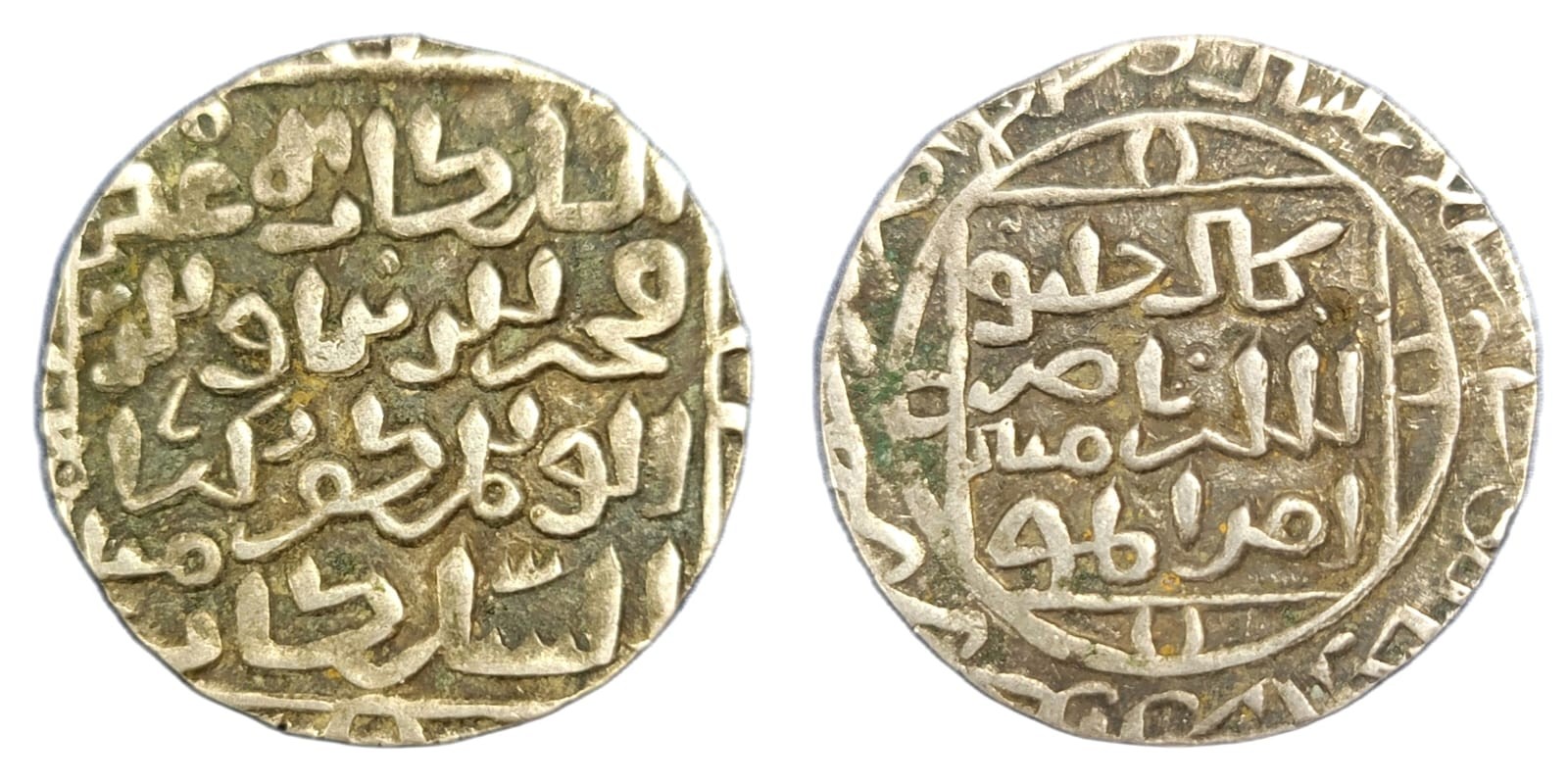
On the border, the date is read as 734 AH. They also mentioned a silver coin of Mubarak Shah that was not included in the catalogue. J. P. Goenka published a silver tanka (Picture 2) issued from Sonargaon and read it as follows:
Obverse: alsultan al azam/ fakhr al-dunya wa’l din/ abul muzaffar mubarak shah/alsultan
Reverse: yamin khalifat/ allah nasir/ amir al-muminin
On the reverse of the above coin, the epithet is placed within a square field bounded by a circular border. Each side of the square field contains an annulet at the centre, positioned between the square and the circle. The date and the mint name are placed outside the circle. On the coins of Fakhruddin, the mint name is usually prefixed with jalal, but here it is shahr. On the basis of this silver coin and the gold coin mentioned earlier, Goenka questioned the established narrative that Fakhruddin declared independence in 1338 and that, in the initial phase, his independence was short-lived. The coins of Fakhruddin dated 734, 737, 738, and 739 indicate his authority in the eastern region for several years.
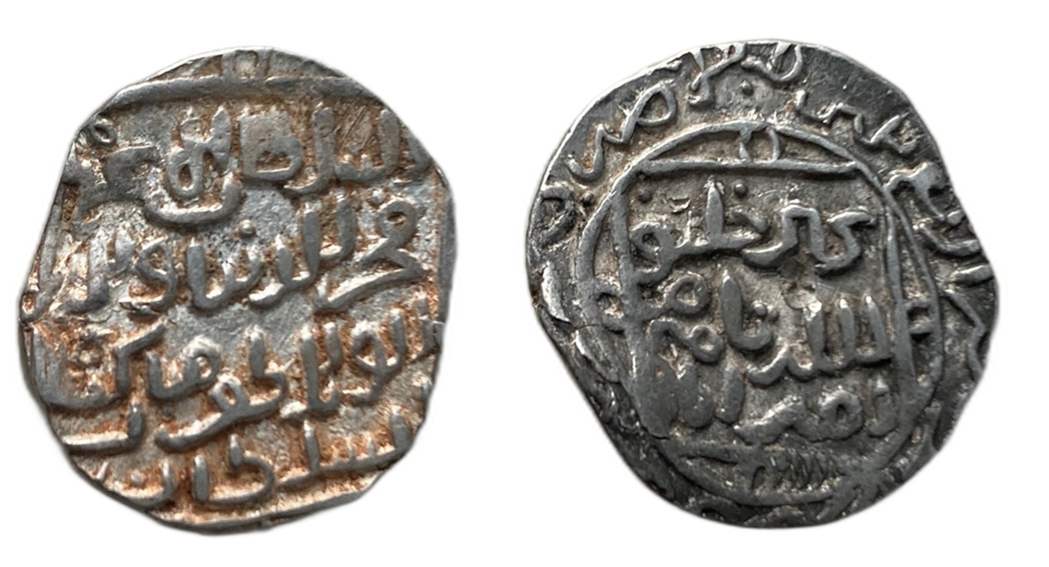
I have personally examined this gold coin and noticed that the last three alphabets—ra (ر), ba (ب), and ‘ain (ع)—are very clear. In the written form of Arabic numerals, only the word for four (arba‘) ends with these three letters. This further confirms the reading of the date as arba‘ salasin (34). There are at least three silver coins (Pictures 2, 3, and 4) of Fakhruddin Mubarak Shah dated 734 AH, i.e. 1333–34 CE.
On the basis of the above numismatic evidence, it can be inferred that Fakhruddin Mubarak Shah declared independence in Sonargaon in 734 AH/1333–34 CE. This sixteen-year sovereignty was interrupted for a short period. Accepting this chronology, a humble attempt may be made to revisit the historiography of Fakhruddin Mubarak Shah’s independence. In this venture, an analysis of both the circumstantial and spatial contexts is made, which led—or rather, inspired—Fakhruddin to revolt and declare independence against the mighty Tughlaqs.
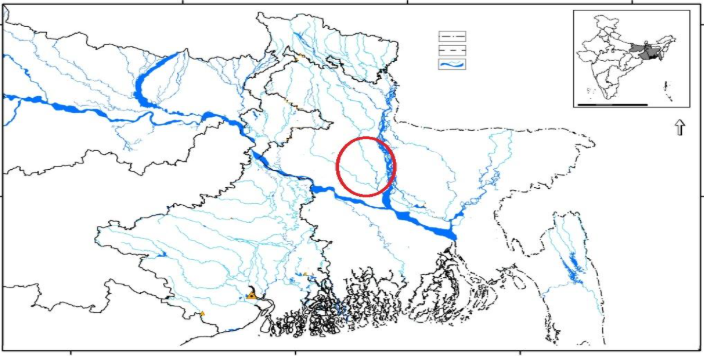
At present, Sonargaon is an upazila in Narayanganj district, about 27 miles north-east of Dhaka, and covers an area of 24 square miles. The earliest reference to Sonargaon is found as a mint town on the coins of Shamsuddin Firuz (705 AH/1305–06 CE). Major rivers and their tributaries played a dynamic role in the rise and development of Sonargaon as a capital city. The Old Brahmaputra created a natural defensive line on the northern side of Sonargaon. The River Sitalakhya flows through the west, while the Meghna passes through the east and south of the area (see Map 1). The northern boundary of Sonargaon was less definite, but three rivers—Sitalakhya, Dhaleshwari, and Meghna—provided a clear defensive perimeter around a triangular landmass in the southern part of Sonargaon. Menikhal, a watercourse that runs between the Sitalakhya and Meghna, created a second line of defence as well as an interconnection between the river routes. The river network around Sonargaon facilitated both the formation of a political entity and its economic prosperity. It was connected to the Bay of Bengal maritime zone through the southern river networks (Map 2).
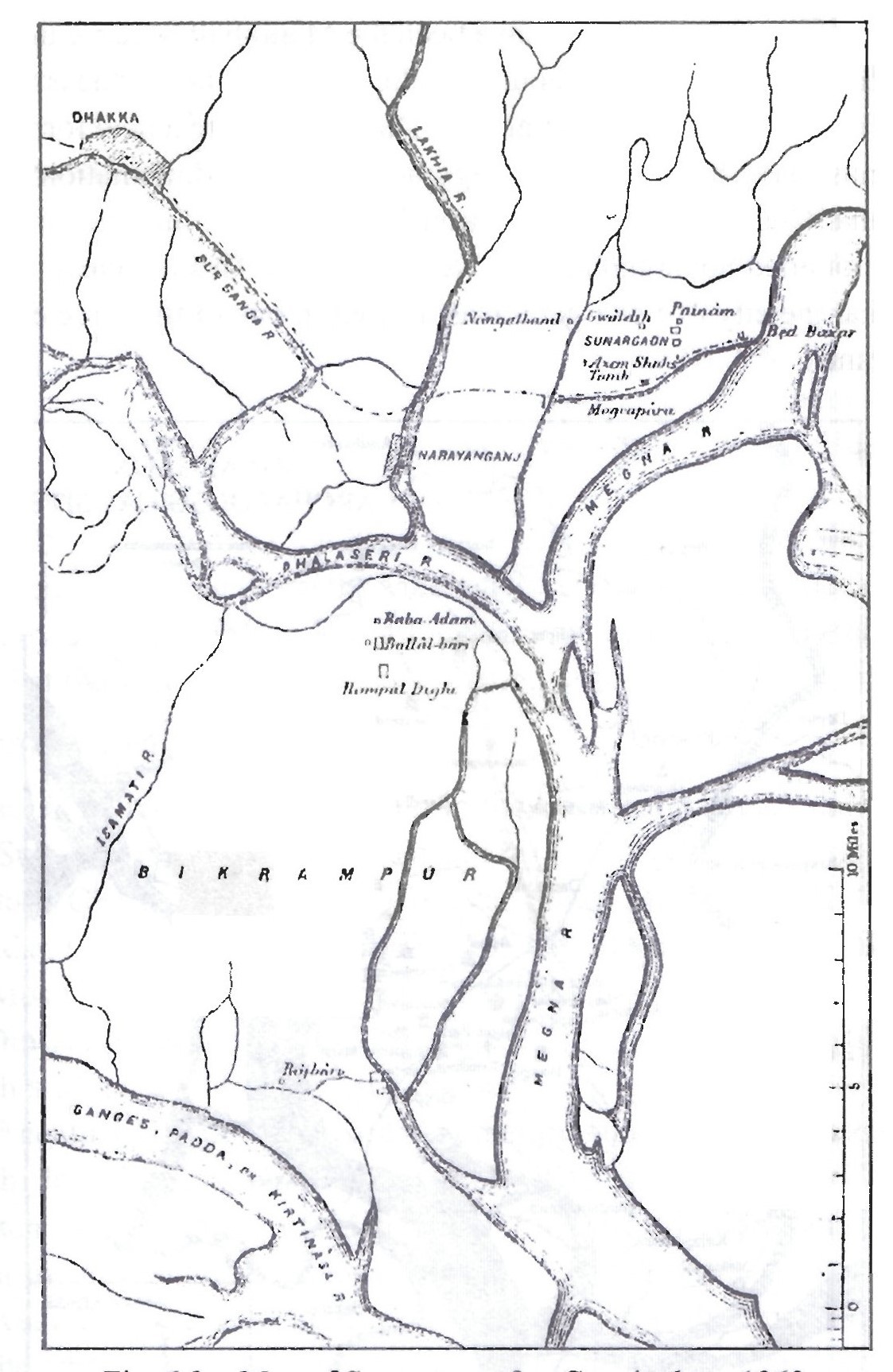
Mamtazur Rahman Tarafder identified the Sultanate capital city in the Mugrapara–Goaldi locality, which contains three Sultanate mosques, a few tombs, ruined monuments, and other relics of historical significance. Habiba Khatun, in her attempt to identify the present location of the capital Sonargaon, noticed that the mint Sonargaon and the iqlim Sonargaon were not the same administrative entity. The former had a limited spatial coverage, while the latter had a wider administrative and spatial significance. She concluded that settlements in Sonargaon in its early phase were centred on the banks of two rivers: (a) the western bank of the Brahmaputra and (b) the eastern bank of the Sitalakhya. With an analysis of the archaeological sites and place names, she commented, “Sultan Fakhruddin Mubarak Shah was the first Sultan of Sonargaon who minted coins from ‘Hazrat Jalal Sonargaon’. The place could be identified with the present village Hazratpur–Jalalpur.”
The geomorphology and spatial context created a favourable opportunity for Fakhruddin Mubarak Shah to establish a separate political entity in the eastern part of Bengal. The location, topography, and environs of Sonargaon were suitable for naval warfare, even in the rainy season, which acted as a natural barrier against the invading imperial army. Rivers around the area functioned both as boundary lines and as means of rapid movement. Fakhruddin was well acquainted with this area. One may raise the question: what is the basis of such a proposition? Is there any particular written text on Fakhruddin? The answer is negative. However, an analysis of Ibn Battuta’s travelogue and Tarikh-i-Mubarakshahi may support the conjecture. Sarhindi wrote that there was resentment among the soldiers of Qadar Khan in Sonargaon. At that time, Fakhruddin was hiding in a safe place on the opposite side of the river. He succeeded in establishing a rapport with the recalcitrant soldiers of the imperial army. At one stage, Qadar Khan was killed by his own soldiers. After that, Fakhruddin marched towards his capital to recapture it. He distributed the wealth of the khazana (treasury) to the imperial soldiers according to his promise made to gain their support. The situation described by Sarhindi indicates that Fakhruddin was hiding in a nearby place on the other side of a river which was flowing near the capital Sonargaon at that time. He was waiting for a favourable moment to regain his lost kingdom. Jadunath Sarkar also explained the situation in a similar tone. Heavy rain resulted in damp conditions, and the imperial soldiers were not accustomed to such a climate. Sarkar described the political scenario of Sonargaon in a striking manner. According to him, “like the ever-shifting course of the rivers, the political current in the eastern capital took bewildering turns.” The geographical setting of the area contributed to the defeat of Qadar Khan within a very short time.
The Tughlaq governors posted in eastern India jointly marched against the rebel Fakhruddin. None of the textual references indicate that any military assistance came from Delhi. Was this an indication of the negligence of Muhammad bin Tughlaq? As we know, Muhammad bin Tughlaq is famous for his ambitious projects. In 1327 CE, he began shifting his capital from Delhi to Daulatabad in the Deccan. This initiative caused him to lose a great amount of wealth and life. The elites of Delhi became deeply frustrated. In 1334, a revolt took place in Mewar. The Sultan himself fell ill due to a bubonic plague which originated in Bidar. The Karachil expedition in 1333 was also disastrous for him: more than one lakh soldiers were killed, and he had to retreat. A possible attack was looming on the northern frontier. All this shows that he was heavily preoccupied with wars, financial losses, and human casualties. His ambitious projects and the possibility of a Mongol attack kept him fully occupied. He was not in a position to keep a close eye on the affairs in Bengal. This created a perfect opportunity for Mubarak Shah. Located on the easternmost border of the empire, Sonargaon became independent.
Fakhruddin Mubarak Shah, being aware of the political condition of Muhammad bin Tughlaq, took full advantage of his location and the geographical setting and declared independence in Sonargaon. His reign period was sixteen years (734–750 AH), with a short interregnum. How short it was and when it occurred remains a debated issue. This long sixteen-year rule can be regarded as the first independent political reign in the eastern and south-eastern parts of Bengal in the fourteenth century. Sonargaon had a flourishing trading hub under its jurisdiction. As a result of these trading activities, Fakhruddin Mubarak Shah had to issue more coins. These coins bear testimony to his sovereign authority in the trans-Meghna region.
Dr Sahidul Hasan is an Associate Professor in the Department of History at the University of Dhaka.
Send your articles for Slow Reads to slowreads@thedailystar.net. Check out our submission guidelines for details.
APO 433: Dhaka’s forgotten post office of World War II
Dadabhai Naoroji: The man who exposed the economics of British colonialism

Untold stories of 1971 through private letters
The extraordinary journey of Atish Dipankar Srigyan

Forgotten story of Jeanette Van Tassel, the American woman who flew over Dhaka in 1892
Beyond 1947 / A personal essay
Abul Mansur Ahmad / A global quest in search of a nation

Chand Bibi and the forgotten history of Muslim women’s political resistance
Women’s voices in Nazrul’s Dhumketu