The Rabindranath we have not yet claimed

Today is the Pochishey Boishakh, Rabindranath Tagore's 165th birthday.
Over the past several years, through the noise of Bangladeshi public life, I've hit a note of frustration about what we do with Rabindranath. Or, more precisely, what we do to him. We make him a god, or we make him an enemy. We invoke him, denounce him, protect him, vandalise him. What we do rather less often is actually read him. Sit with what he was actually trying to say.
So today, on his birthday, I want to set aside the politics, just for the length of this essay, and ask a simpler question: what can Rabindranath mean to us? What can we actually learn from his work? And from that place, is there such a thing as a Bangladeshi Rabindranath?
I don't promise a definite answer, but I hope I can offer something to think about.
The strawman on both sides
The politics around Rabindranath in Bangladesh is not new, but it has acquired a particular intensity in recent years — one that I find, frankly, exhausting in its predictability.
On one side sits a devotional attachment: Rabindranath means Bengaliness, means 1971, means our national anthem. This attachment is genuine, even moving. But it tends to transform Rabindranath into a symbol, even a god, to be venerated rather than a thinker to be engaged with. After all, you do not read the people you worship. You do not argue with them, learn from them in the ordinary, difficult sense of that word, or allow them to unsettle you. You simply put them up on a pedestal.
On the other side sits a grievance that seeks to cancel him from public life: Rabindranath opposed the establishment of Dhaka University; he was a zamindar; he was a representative of a Hindu upper-caste cultural order that Bengali Muslims had reason to distrust. Too often, they do not actually engage with Rabindranath's work either — they construct a caricature and then, with considerable energy, proceed to demolish it.
Both sides use Rabindranath for their own political purposes. The irony is that Rabindranath himself was very critical of exactly this kind of instrumental nationalism. He wrote that nationalism is the organised self-interest of a people, a force that sets human beings against one another in competitive formations. To conscript him into the service of any nationalism, including Bengali cultural nationalism, is to work directly against his philosophy.
So what do we do instead? I want to suggest we go back — to East Bengal, to the Padma, to the monsoon, to the thirty-year-old man who arrived at Shilaidaha in 1891 and came back, year after year, changed.
The arrival
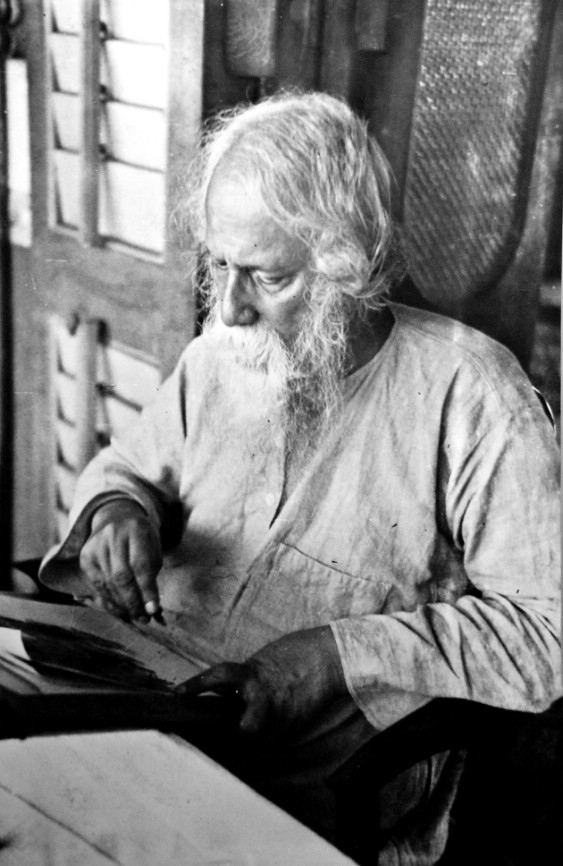
Debendranath Tagore sent Rabindranath, his youngest literary son, to manage the family zamindari in Shilaidaha, Shahjadpur, and Patisar. It was, from one angle, a practical administrative assignment. From another, it was the most consequential thing that ever happened to Rabindranath's art.
He had grown up inside the Tagore mansion in Jorasanko, Calcutta — a house of extraordinary cultural richness and equally extraordinary confinement. In Jibansmriti (My Reminiscences, 1912), he writes of a childhood spent looking out at the world from rooftops and windows, the outside always near yet somehow unreachable: the trees in the distance, the people on the street, the sense that the gap between himself and that world contained some inexhaustible mystery. Confinement, he tells us, produced in him a hunger for the open that never entirely left.
Then came East Bengal.
In the Chhinnapatra — the letters he wrote from this period, mostly to his niece Indira — we get the raw, unprocessed experience of that first encounter with the Padma. "Coming here," he writes in 1892, "I feel as though I have entered a new life. This vastness of the Padma, this solitude — it is as if something inside me is being unlocked." The letters are immediate in a way that poems and songs cannot be — they are the first breath of an experience before it has been shaped into art. Read alongside the compositions that followed, they reveal something important: East Bengal restructured him.
Baul
Lalon Fakir had died in 1890, just a year before Rabindranath arrived in Shilaidaha. The Baul and Fakiri traditions were a living, singing presence in the air. Rabindranath encountered them, absorbed them, and was changed by them in ways he himself acknowledged.
In Sangeetachinta (Thoughts on Music), he writes: "In the Baul's song I found a melody that lay outside scripture, one that came from the very interior of the human being. That melody told me — if you want to find God, you must go to the human being." It is, I would argue, the theological core of what later became his Puja (devotional) songs — the insistence that spirituality and humanity are not separate domains, that the transcendent is discovered not by turning away from the world but by going deeper into it.
This is the Baul lesson. And it is a lesson that has its roots — quite literally — in this soil, in the mixed spiritual traditions of what is now Bangladesh. When we sing Rabindranath's devotional songs, we are, in part, singing something that was given to him here.
The caged bird and the forest bird
In 1892, sitting in Shilaidaha, Rabindranath wrote a song that would later appear in his collection Sonar Tari (The Golden Boat) under the title "Duti Pakhi" — Two Birds, popularly known as "Khachar Pakhi chilo Shonar Khachatite."
The caged bird lived in its golden cage; the forest bird lived in the forest. One day, somehow, they met — what was in the Creator's mind? The forest bird said, "Caged bird, let us both go to the forest." The caged bird said, "Come, forest bird, let us stay quietly in the cage." The forest bird said, "No, I will not be held in chains." The caged bird said, "Alas, how shall I ever venture into the forest?"
It is tempting to read this as a straightforward romantic allegory or a mystical poem about the soul's longing for God—and it can sustain both readings. But I want to suggest that it is also something more immediate: a map of Rabindranath's own situation in East Bengal.
He came from the golden cage of Jorasanko. The forest — vast, uncontainable, indifferent to his categories — was the Padma, the monsoon sky, the lives of the people who worked his family's land. Two worlds pulled at each other, but neither could fully enter the other. The forest bird could not be caged. The caged bird could not simply fly free.
In Jibansmriti, written twenty years after the song, Rabindranath returns to this image of childhood confinement: "As a child, I would look out from the rooftop towards the outside world. That world was so close, and yet somehow just beyond reach. That feeling never went away." By 1912, the childhood rooftop and the banks of the 1892 Padma had collapsed into a single memory — different instances of the same unreachable outside, the same ache of a proximity that never becomes possession.
The tension between the cage and the forest, between the privileged observer and the life that escapes his observation, is what generated some of the most soul-searching work of his career.
What happens to the monsoon?
To understand what East Bengal did to Rabindranath's artistry, it helps to trace the monsoon across his compositions.
His first monsoon song, Shaon gogone ghor ghonghota (Dark clouds gathering in the Shravan sky), was written when he was sixteen, in 1877. It is cast in the mould of Vaishnava padabali, the classical tradition of devotional love poetry: here, the monsoon is the dramatic backdrop for Radha's longing. It is accomplished, even remarkable for a sixteen-year-old. But it is a borrowed vision: the monsoon seen through the eyes of a tradition, not through one's own.
A decade later, just before the East Bengal years, comes Emono dine tare bola jay (On such a day, one can say it, in such dense, dark rain) in 1888. The monsoon here is a romantic shelter, an excuse for intimacy, a reprieve from the world's noise. It is charming, carefully made, like a scene arranged for effect. The rain creates an enclosure within which feeling can be safely expressed. A classic romantic scene.
Then came the East Bengal years. And everything changes. Or so it appears to me.
Hridoyer e kul o kul du kul bhese jay was written in Shilaidaha in 1893. Both banks of the heart are swept away. The monsoon here is no longer a backdrop or an escape. It is the feeling itself. The flooding of the river and the flooding of the heart follow the same rhythm. Rabindranath had been watching the Padma overflow its banks. In that watching, he understood something about emotion that he had not previously been able to articulate: that certain forces do not observe limits, that the category of containment dissolves under sufficient pressure.
In Sangeetachinta, he writes about restraint in composition, about the importance of holding feeling within form. But in this song — baadh aar badhite nari, "I can no longer hold the dam" — he is confessing to the collapse of that restraint, and finding in that confession not shame but a kind of liberation. "Why has this happened to me in this youth of mine?" It is the question of an artist who feels himself being remade and is not yet sure what he is becoming.
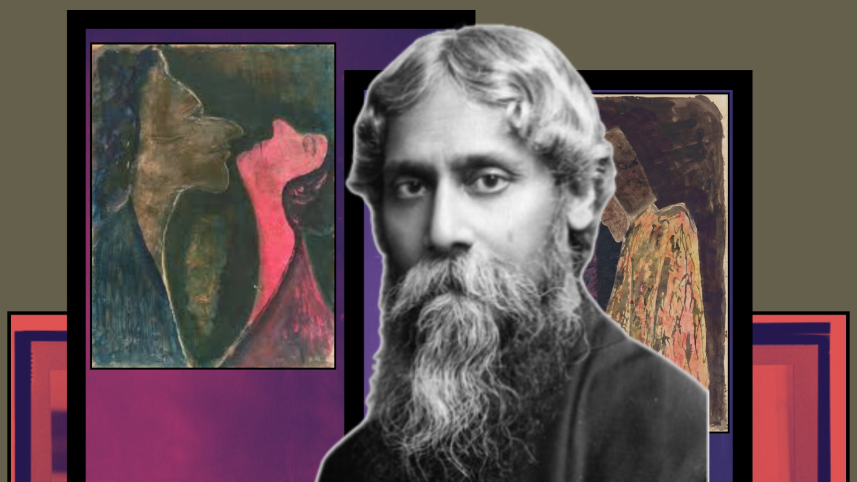
Two years later, in 1895: Jhorjhor borishe baridhara (The raindrops fall and fall). Now the camera tilts downward from the sky to the earth. Hay pothobasi, hay gotiheen, hay grihohara — O wanderer on the roads, O the immobile, O the houseless. The monsoon is no longer interior weather. It is flooding people's homes. In a letter from this period — one of the Chhinnapatra — he writes of a day when an old man came to him because his homestead had been submerged: "What can I do? There is something I can do as a zamindar. But inside, I keep wondering — do I really understand this man's suffering?" That question — do I really understand? — is the question that I think turned the landlord into a humanist.
Bangladeshi Rabindranath?
So when I speak of a Bangladeshi Rabindranath, I want to be careful about what I am and am not claiming. I am not claiming him as ours in a nationalist sense. What I am claiming is that the Rabindranath the world came to know — the one who won the Nobel Prize in 1913 for Gitanjali, the one whose devotional songs carry a quality of interior vastness that seems to belong to no single tradition — that Rabindranath was made, in significant part, in what is now Bangladesh. The theological shift, the humanist turn, the discovery that the divine is not separate from the human but is somehow folded within it: all of this crystallised along the banks of the Padma.
The Bangladeshi Rabindranath, then, is the one whom the Padma taught to overflow. The one whom Ratan, the little girl from his short story "Postmaster," taught to feel the weight of a distance he could not bridge. The one whom the Baul's melody taught that God, if there is a God, is found inside the ordinary human being rather than above it. These are the lessons that we forget, too, at our own peril.
Navine Murshid is an Associate Professor of Political Science at Colgate University.
Send your articles for Slow Reads to slowreads@thedailystar.net. Check out our submission guidelines for details.
APO 433: Dhaka’s forgotten post office of World War II
Dadabhai Naoroji: The man who exposed the economics of British colonialism

Untold stories of 1971 through private letters
The extraordinary journey of Atish Dipankar Srigyan
Forgotten story of Jeanette Van Tassel, the American woman who flew over Dhaka in 1892
Beyond 1947 / A personal essay
Abul Mansur Ahmad / A global quest in search of a nation

Chand Bibi and the forgotten history of Muslim women’s political resistance
Women’s voices in Nazrul’s Dhumketu