Witnessing a nation in the making: A journalist’s journey to Mujibnagar

It was a ceremony with tight security and strict secrecy. There was thrilling excitement in the Indian security establishments. The day was April 17, 1971. On this day, the largest and most significant international public relations event in the history of India and Bangladesh took place. Several anti-aircraft units were deployed to prevent a Pakistani Air Force attack. Foreign journalists staying in Kolkata to cover the civil war were asked to meet at the Kolkata Press Club at 4 a.m. to travel to an unknown but newsworthy destination in search of a scoop or breaking news.
60 cars were rented for 200 foreign journalists on that day. On the other hand, the US Consul General in Kolkata, George G.B. Gryphon, and the British Deputy High Commissioner were eager to learn what would happen amid the Pakistani civil war of 1971. In the process of organising the entire oath-taking ceremony on 17th April 1971, Sameer Bose of the Indian Border Security Force (BSF) and Colonel I. Rakshi of the Indian Army put in all their effort to accomplish an impossible task, which can be called a huge job or a Herculean task.
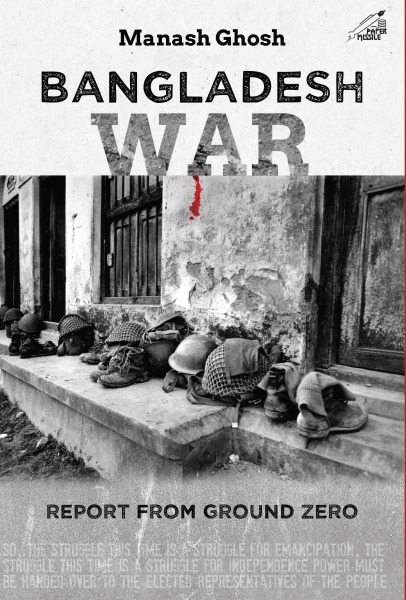
In 1971, this oath-taking event was highly sensitive for the newly elected Indira Gandhi government, which was navigating complex regional politics. A young journalist from Kolkata, based at the national newspaper The Statesman, closely observed the historical event amidst the tense atmosphere of the Bangladesh Liberation War. His detailed account, later published in his book Bangladesh War: Report from Ground Zero, provides invaluable insight into the event's political importance and the intense efforts to legitimise Bangladesh's independence movement.
In the first week of April 1971, Tajuddin Ahmed had two meetings with Indian Prime Minister Indira Gandhi and her high-level associates. The most important decision of the meetings was to hold the oath-taking ceremony of the Mujibnagar government before the international media. The policy makers of the Indira Gandhi government agreed that it was necessary to hold the government-in-exile oath on Bangladeshi soil to gain international support and create a legal basis for the Bengali liberation war. It is necessary to mention here that when Chuadanga district was initially selected for this oath on 14th April, Pakistan carried out air strikes to foil the ceremony. Then, the new place for the oath was selected as the mango grove in Baidyanathtala of Meherpur, which is very close to the Nadia district of West Bengal. The road communication was also good from Kolkata. One of the important factors in selecting the location for this oath ceremony was the journey of government-in-exile members and foreign journalists.
B.S.F. Chief Khusro Faramurz Rustamji and Regional Chief Golok Majumdar played a vital role in determining the place for the oath. India borders this mango grove in Meherpur from three sides. Given this strategic location, the risk of an air attack by Pakistan was low. Even then, anti-aircraft guns were installed a few hours before the oath-taking ceremony to prevent Pakistani aircraft from violating Indian airspace. Manash Ghosh writes, ‘Tawfiq-e-Elahi Chowdhury, SDO of Meherpur, reported that the determined resistance from the EBR, EPR and the mukti volunteers had halted the Pak Army's march towards Meherpur. The Pakis were still at a 'safe distance', but the risk of strafing by Pak fighters was high. Whatever was to be done had to be done in total secrecy, fast and, of course, with adequate safeguards. Rustamji and Golak swung into action instantly. The anti-aircraft guns of the army's air defence units were brought in and deployed around the mango grove only a few hours before the actual ceremony started, so as not to arouse suspicion.’ (Page:110, Bangladesh War: Report from ground zero)
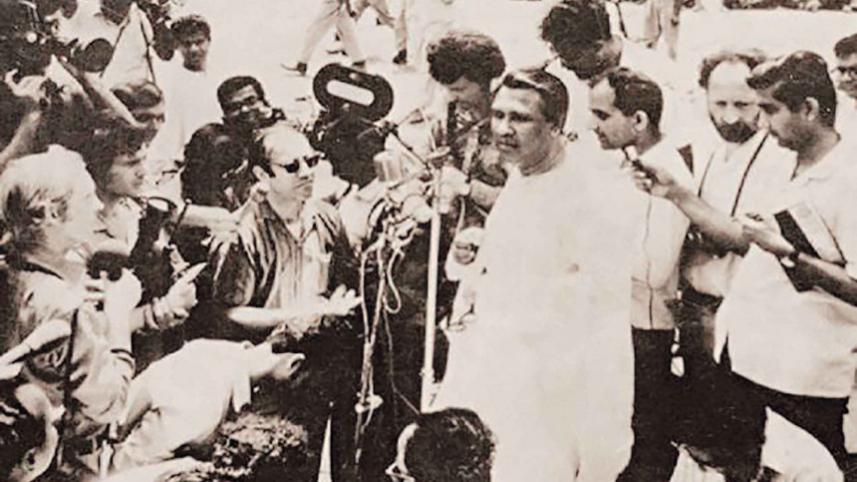
According to journalist Manash Ghosh, the largest number of foreign journalists were stationed in India to cover the Pakistan war in April 1971. Earlier, so few foreign journalists were stationed in India at the same time to cover the India-China war in 1962 or the India-Pakistan war in 1965. Managing those journalists properly was a difficult task. Again, the Indian government did not want to reveal the real story to anyone before the oath-taking ceremony for security reasons. Hence, there was tension and anxiety. When the foreign journalists arrived at the Kolkata Press Club in the early hours of April 17, 1971, no one knew where they were heading. Even Manash Ghosh, a journalist with the Kolkata-based national English newspaper The Statesman, did not know where they were being taken. Even the driver of the car did not know his destination. The drivers were instructed to follow the VVIP convoy, nothing else. Beyond that, no one knew much. On that day, the VVIP convoy of the cabinet members of the Mujibnagar government had tight security from Indian commandos. A convoy of journalists was following behind.
Manash Ghosh mentioned that after leaving Kolkata, when they reached the Kalyani area, they realised that the Indian security forces were taking them towards the Bangladesh border. Before that, he and the foreign journalists did not even know what was going to happen or where they were being taken. The convoy once stopped on the way from Kolkata to Baidyanathtala in Meherpur. At that time, Manash Ghosh saw that Tajuddin Ahmed's special assistant, Barrister Amir-ul-Islam, was reading a document very carefully and repeatedly. Later, he learned that it was the official proclamation of Bangladesh's Liberation War.
According to journalist Manash Ghosh, Khusru Formorj Rustomji and Golok Majumdar were looking after the overall affairs of the oath-taking ceremony of the Mujibnagar government. With the help of these two people, two more Bangladeshi diplomats were present at Baidyanathtala on the day of the oath-taking. They were Mr K.M. Shahabuddin, the Second Secretary of the Pakistan High Commission in Delhi, and Assistant Press Officer Amjadul Haque of the same office. After March 25, when they expressed their loyalty to the Bangladesh government, they were shamefully thrown out of the Pakistan Embassy in Delhi by Pakistani officials. Even their belongings were thrown on the road. After that, these two Bangladeshi officials contacted some senior Indian journalists and joined the Mujibnagar government.
The convoy carrying the VVIPs and journalists reached the mango grove of Baidyanathtala around 11 a.m. for the oath-taking. The BSF was under tight security, hidden under the dense mango grove. The anti-aircraft Ack Ack guns were also on high alert. Indian Air Force fighter jets were in the skies over Bangaon and Kalyani areas in West Bengal. There was a fear that Pakistani aircraft could attack at any time.
After a journey of about seven hours from Kolkata, even after reaching the mango orchard in Meherpur, the foreign journalists could not find out the reason for their long visit. Where is the scoop news, where is the breaking news? Naturally, they were very annoyed and frustrated. Some American journalists asked, with great annoyance, "Did you bring us to this orchard to show us mango harvest?" At this time, Tawfiq-e-Ilahi Chowdhury assured them on behalf of Bangladesh. He said, "Please wait a little longer to see something historic." At this time, a harmonium was brought from a nearby village. So that some people could practice the song "Amar Sonar Bangla" by the famous Bengali poet Rabindranath Tagore. Already, some curious people from both sides of the border had gathered in the mango grove. Many climbed trees to get a better look at what was happening. However, most people did not know what would really happen in this mango orchard.
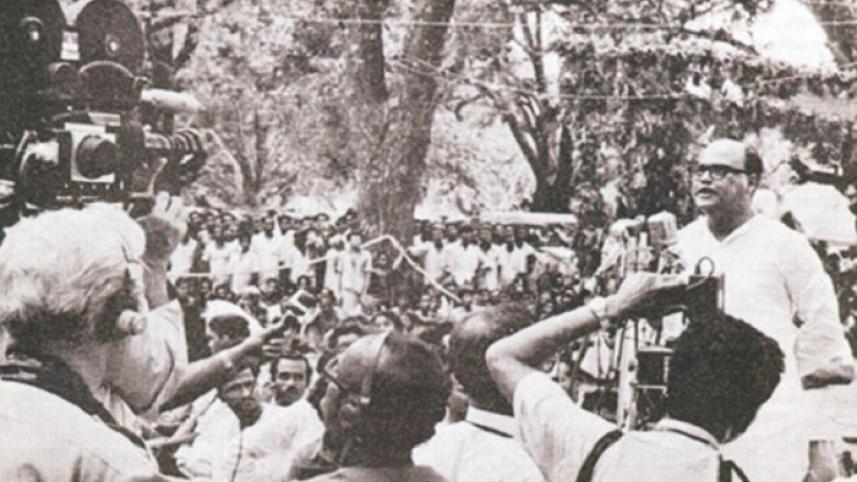
A short while later, the top leadership of the Awami League, led by Tajuddin Ahmed and Syed Nazrul Islam, ascended a slightly higher stage. After that, the matter became clear. This was the formal oath-taking ceremony of the Mujibnagar government. Then, Member of National Assembly (MNA) from Dinajpur, Professor Yusuf Ali, read out the Proclamation of Independence of Bangladesh in front of foreign journalists. Bangladesh was declared an independent, sovereign republic. He administered the oath to the interim President Syed Nazrul Islam. The national anthem was sung. Then Syed Nazrul Islam, Tajuddin Ahmed and five ministers stood on the slightly elevated stage. The journalists took the historical picture of the Mujibnagar government. Then, Tajuddin Ahmed, the Prime Minister of the Mujibnagar government, spoke to the journalists.
Thus, the Mujibnagar government was successfully sworn in, affirming that Bangladesh’s independence struggle was not a separatist movement like the Biafra War, but a just and legitimate liberation struggle led by a government elected through a legal mandate.
Rahat Minhaz is an assistant professor in Mass Communication and Journalism at Jagannath University, Dhaka. He can be reached at minhaz_uddin_du@yahoo.com
Sources:
The Indira-Taj meeting (Page: 104-112), Bangladesh War: Report from ground zero, New Delhi.
Ghosh, Manash (2021) Bangladesh War: Report from ground zero, New Delhi: Niyogi Books.
Send your articles for Slow Reads to slowreads@thedailystar.net. Check out our submission guidelines for details.
25th Death Anniversary / A life so full: Remembering Ahmed Sofa
Bengal's forgotten slave trade: Portuguese, Arakanese and Dutch trafficking networks
Mufazzal Haider Chaudhury and the idea of Bangladesh
The Tagore paradox: Why critique strengthens his legacy
What Sufism can teach us about the modern world
The journey of Qawwali across South Asia: Music, mysticism, and cultural exchange
Thinking with Partha Chatterjee
Why secularism is losing ground in South Asia

Interview / Modern Islam has always been a 'secular' entity