Reshoring critical supply chains and the new political economy of post-globalization

Over the past decade, the language of economic policy in the United States has shifted markedly. Where earlier debates centred on efficiency, liberalisation, and the expansion of global markets, the current conversation increasingly invokes resilience, national security, and control over supply chains. At the centre of this shift lies the renewed emphasis on reshoring critical production—a policy orientation strongly associated with Donald Trump, but now debated across the American political spectrum.
As noted by Investopedia, reshoring—also called inshoring or backshoring—refers to bringing manufacturing and production activities back to a company’s country of origin, reversing the long era of offshoring that relocated industrial capacity abroad in pursuit of lower costs. In policy debates, the concept typically refers to efforts to relocate the production of strategically important goods from overseas manufacturing hubs back to the United States.
The idea gained prominence and traction during the disruptions of the COVID-19 pandemic, when shortages of medical equipment, semiconductors, and pharmaceutical ingredients exposed the vulnerabilities of highly globalised supply chains. For many policymakers, these disruptions highlighted a deeper structural concern: the dependence of the US economy on production networks heavily concentrated in countries such as China.
The rationale behind reshoring rests on three interrelated concerns: national security, industrial capacity, and trade imbalance. For decades, global production networks were organised primarily around cost efficiency. Companies located factories wherever labour, regulation, and logistics offered the lowest cost structure. While this model lowered consumer prices and expanded global trade, it also accelerated the relocation of manufacturing from advanced economies to emerging industrial centres.
In the United States, this transformation contributed to a steady decline in manufacturing employment beginning in the late twentieth century. Entire industrial regions—particularly in the Midwest—experienced factory closures, wage stagnation, and long-term economic restructuring. Political discontent surrounding these changes provided fertile ground for arguments that globalisation had hollowed out the American industrial base.
Yet reshoring does not necessarily imply a large revival of manufacturing employment. Modern industrial facilities rely heavily on automation, robotics, and advanced digital systems. Production has become increasingly capital-intensive rather than labour-intensive. As a result, reshored factories may employ far fewer workers than the large manufacturing complexes of earlier decades.
Reshoring therefore seeks to restore domestic manufacturing capacity, particularly in sectors considered strategically vital. These sectors include semiconductors, pharmaceuticals, medical supplies, critical minerals, defence technologies, and advanced electronics. Rather than relying on global production networks dominated by external suppliers, reshoring attempts to anchor production within national territory.
To pursue this objective, policymakers have deployed a range of economic instruments. Tariffs, tax incentives for domestic manufacturing, restrictions on foreign investment in sensitive sectors, and subsidies designed to attract industrial investment have become central tools of contemporary industrial policy. Tariffs imposed on imports from China during the Trump administration were among the most visible instruments of this strategy, signalling an effort to alter the structure of global trade rather than merely renegotiating individual agreements.
More broadly, the US policy environment has shifted towards active government support for strategic industries. Legislation such as the CHIPS and Science Act reflects a growing willingness in Washington to subsidise domestic production in sectors considered essential for technological and economic leadership. Although these policies extend beyond any single administration, they illustrate the gradual institutionalisation of reshoring as a long-term strategic objective.
This shift has also influenced trade enforcement policy. Around sixteen economies are currently under investigation by the Office of the United States Trade Representative after Washington argued that certain foreign government policies are contributing to structural industrial overcapacity that could weaken the US manufacturing base. The probe—launched under Section 301 of the Trade Act—targets economies including China, the European Union, Japan, India, and Vietnam.
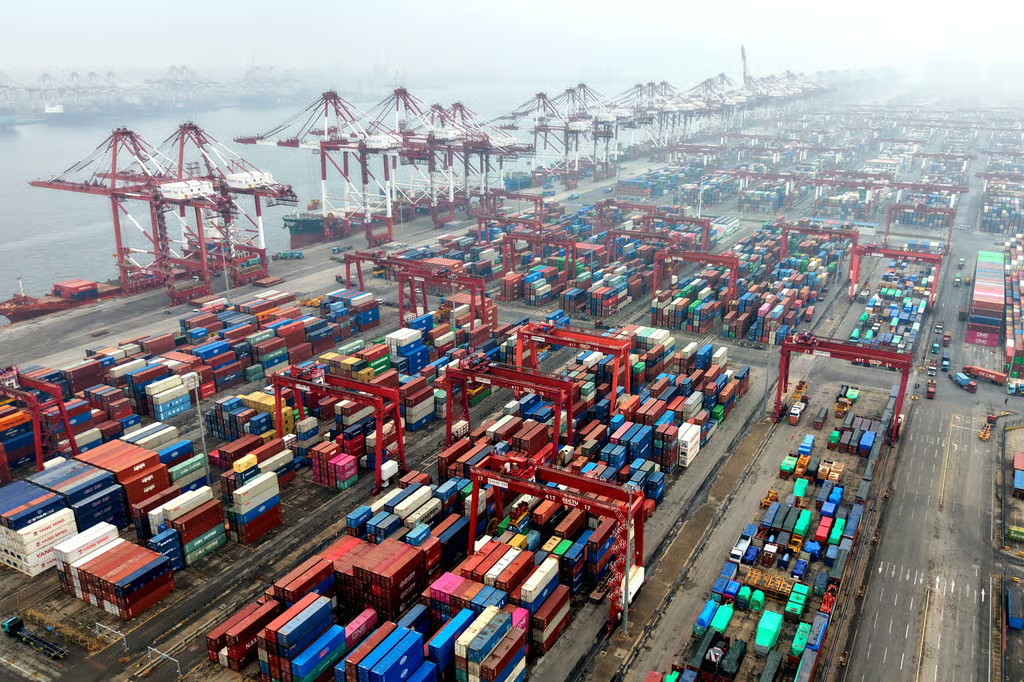
Overcapacity occurs when production expands well beyond global demand, often supported by state subsidies, tax incentives, preferential credit, or energy support. When excess output is pushed into export markets at very low prices, US officials argue, it can undercut domestic producers, depress global prices, and contribute to factory closures and job losses in American industry. Such investigations therefore complement domestic industrial policy by potentially justifying tariffs or other measures designed to shield US producers from what policymakers view as unfairly subsidised competition.
For the US domestic economy, however, the consequences of reshoring are complex. The policy may strengthen industrial capacity by encouraging the construction of new manufacturing facilities and technological infrastructure. Investments in semiconductor fabrication plants, battery manufacturing, and advanced electronics production illustrate how industrial ecosystems can be rebuilt when government incentives align with corporate strategy.
Yet reshoring does not necessarily imply a large revival of manufacturing employment. Modern industrial facilities rely heavily on automation, robotics, and advanced digital systems. Production has become increasingly capital-intensive rather than labour-intensive. As a result, reshored factories may employ far fewer workers than the large manufacturing complexes of earlier decades.
The employment effects are therefore likely to concentrate in highly skilled technical fields such as engineering, advanced manufacturing operations, and research and development. While these positions offer high wages and technological sophistication, they cannot replicate the scale of employment once associated with traditional manufacturing industries.
Production costs present another challenge. Manufacturing in the United States typically involves higher wages, stricter environmental regulations, and more extensive compliance requirements than in many developing economies. These factors can raise the cost of domestically produced goods, potentially contributing to higher consumer prices or reduced export competitiveness in certain sectors.
The reshoring agenda also carries significant implications for the structure of globalisation itself. For much of the late twentieth and early twenty-first centuries, global trade expanded under the assumption that production should be organised according to comparative advantage and cost efficiency. Companies designed supply chains that stretched across continents, integrating raw materials, intermediate components, and final assembly into complex global networks.
Reshoring challenges this model by prioritising resilience and geopolitical alignment over pure efficiency. Rather than relying on a single global supply chain optimised for cost, firms increasingly consider the strategic risks associated with concentrated production in particular countries. Political tensions, trade restrictions, and logistical disruptions have encouraged companies to rethink the geography of manufacturing.
In practice, this transformation does not necessarily imply a complete return of production to the United States. Instead, it has encouraged the emergence of a hybrid model often described as “friend-shoring”. Under this approach, companies relocate certain stages of production to countries that maintain stable political and economic relations with the United States. Manufacturing networks may therefore shift towards partners such as India, Vietnam, or Mexico while reducing dependence on strategic competitors.
The result is not the end of globalisation but its reconfiguration. Global trade continues, yet supply chains become more regionally clustered and politically structured. Economic integration increasingly reflects geopolitical alignments rather than purely market-driven calculations.
For the US domestic economy, however, the consequences of reshoring are complex. The policy may strengthen industrial capacity by encouraging the construction of new manufacturing facilities and technological infrastructure. Investments in semiconductor fabrication plants, battery manufacturing, and advanced electronics production illustrate how industrial ecosystems can be rebuilt when government incentives align with corporate strategy.
At a deeper level, this transformation reflects a broader shift in how economic policy is understood. For several decades, globalisation was framed primarily as a process of economic efficiency. Today, supply chains are increasingly viewed as instruments of geopolitical influence and national power. Control over semiconductor production, critical minerals, pharmaceutical supply, and advanced technologies now carries strategic implications comparable to traditional forms of military capability.
Reshoring therefore signals more than a change in trade policy. It represents a transformation in the political economy of globalisation itself.
Yet the strategic framework underlying reshoring—and the related concept of friend-shoring—may itself reflect an earlier moment in the international system. Much of the current policy debate assumes that the United States can reorganise global supply chains around its own strategic preferences. This assumption echoes the unipolar world that emerged after the Cold War, when American economic and institutional dominance allowed Washington to shape the rules and geography of globalisation.
Today, however, the global economy is increasingly multipolar. Manufacturing capacity, technological development, and financial influence are distributed across several major centres rather than concentrated within a single hegemonic order. In such a landscape, attempts to restructure global production around a US-centred framework may confront structural limits. The emerging world economy may prove less amenable to strategic reordering than reshoring advocates assume.
What is clear is that the era in which supply chains were treated purely as instruments of cost optimisation has come to an end. The geography of production is now shaped as much by security considerations and geopolitical rivalry as by market logic. Whether this new political economy ultimately produces greater resilience or deeper fragmentation will depend on how states and corporations navigate the transition from the globalisation of the past to the multipolar order already unfolding.
Dr. Faridul Alam is a former academic and he writes from New York City.
Send your articles for Slow Reads to slowreads@thedailystar.net. Check out our submission guidelines for details.

The politics of fear: From Gaza's paper kites to ‘unsafe’ on campuses

Shared rivers, shared responsibilities: The case for water treaties

Shanghai Cooperation Organisation at 25: Can China, India and Russia really speak with one voice?

Bihar wants Delhi to not renew Ganges treaty. What does it mean for Dhaka?
Bangladesh and the United States: Beyond the tariff bargain

From the Carter Doctrine to the Mecca Pact: A changing Gulf security order

More capability, less autonomy? Bangladesh’s emerging security dilemma

An anti-West network is emerging: How should Bangladesh respond?

The Mecca Pact: Deterrence, Israel, and the new Gulf security equation