The hunt for the Holy Grail: The repurposed US-Israeli casus belli for Iran’s uranium

Malory, Gawain, and the Labyrinthine Quest
In Malory’s 15th-century Arthurian prose romance, Le Morte d'Arthur, the Holy Grail is never merely an object but the force that reorganises the kingdom around its pursuit. In the adjacent Arthurian universe of Sir Gawain and the Green Knight, the quest becomes a test of endurance, cunning, and ethical resolve. The Grail and the quest alike are never static prizes; they shape the seeker, reconfigure the meaning of duty, and transform the journey into its own destination. The modern battlefield, in the US-Israeli confrontation with Iran, has now produced a Grail of its own: roughly 440 kilograms of uranium enriched to 60 percent purity, hidden within the fortified subterranean complexes of Isfahan, Fordow (sometimes spelled Fordo), and possibly Natanz. As in the Arthurian world, the Grail here is not a fixed prize but a dynamic object, one that repurposes the very war designed to capture it.
The pre-emptive expedition against Iran, launched with promises of decapitation, instantaneous regime change, and the creation of a pliant vassal state, quickly revealed itself to be no ordinary campaign. The expectation of immediate victory dissolved under the weight of practical failure. Conventional wisdom regarding asymmetric warfare proved insufficient against the ingenuity of Iranian defence and the intractable geography of its nuclear facilities. Each operational misstep, each intelligence gap, produced new contingencies, creating a labyrinthine conflict that recalls the recursive architectures of Jorge Luis Borges: each action folds back into unpredictable consequences, each tactical gain spawning fresh hazards.
From Decapitation to the Escalation Trap
From the outset, the mission required an endgame and a credible exit strategy. Instead, the original calculus of war rested on the fantasy of swift decapitation: remove Iran’s top religious, civil, and military leaders, and instantaneous compliance would follow, clearing the way for a strategically neutered, if not wholly vassalised, state. The logic was stark: disable the command structure, degrade the nuclear capability, and declare victory in time to convert military shock into political advantage.
Yet failure followed failure. Precision strikes occasionally hit tactical targets, but never the broader strategic aim. The promised regime change proved ephemeral; the envisioned capitulation remained impossible. This succession of setbacks produced what strategists call the escalation trap. As the political and military off-ramp steadily diminished, improvisation became compulsory. Each new strike demanded adjustment; each tactical success revealed strategic fragility.
The war had begun as a linear operation but evolved into a labyrinth: an intricate, recursive structure with no guaranteed exit. The elusive enriched uranium, originally a secondary target, now dictated the war’s terms, reshaping both operational and political imperatives. Yet the deeper irony is that this stockpile was not originally understood by US intelligence or the IAEA as evidence of an active weaponisation drive, but rather as a latent capability suspended between deterrence, bargaining leverage, and nuclear ambiguity. What the opening blows could not secure through decapitation, the campaign now sought to redeem through material seizure. In that sense, the uranium’s elevation into the war’s Holy Grail owed less to verified weaponisation than to the obsessive-compulsive strategic imagination of Benjamin Netanyahu, in which latent fissile matter was narratively transformed into imminent apocalypse. The object’s political value thus exceeded its technical intent: it became the retrospective alibi for a campaign whose original fantasies of instant capitulation had already collapsed.
The Precursor: Rescue as Prelude
Before the war fully pivoted towards the uranium, it staged an unlikely prelude: one of the most dramatic US combat search-and-rescue missions in recent memory. Deep inside Iranian territory, following the downing of an F-15E Strike Eagle, the US deployed roughly 176 aircraft and hundreds of personnel to recover the stranded airmen. One aviator was quickly recovered; the second, the F-15E’s wounded weapons systems officer, a colonel, remained concealed within the mountainous terrain for nearly forty-eight hours, surviving in a rock crevice while Iranian search units closed in. His eventual recovery required deception operations, special-forces insertion, an improvised airfield, and, most dramatically, the first operational use of the CIA’s top-secret “Ghost Murmur” technology, whose long-range quantum magnetometry reportedly tracked the unique electromagnetic murmur of his heartbeat across the silent mountain expanse.
Officially, this was a heroic, better still, daredevil personnel-recovery mission. Strategically, however, it may have constituted something far more consequential: a dress rehearsal for the repurposed hunt that was to follow. The geography of Isfahan, where the rescue unfolded, overlaps suggestively with the suspected burial sites of Iran’s enriched uranium. Deep-penetration air corridors, temporary territorial insertion, deception architectures, and intelligence networks tested during the rescue now furnish the operational grammar for a potential uranium-seizure mission. What appeared to be the urgent retrieval of imperilled airmen may, in retrospect, read as the normalisation of the very pathways through which the Holy Grail hunt could later proceed. If the rescue normalised penetration, the surviving uranium supplied the retrospective rationale for repeating it.
The Object That Repurposed the War
The surviving uranium has assumed the status of a geopolitical Holy Grail: elusive, materially consequential, and symbolically overburdened. The closer the seeker approaches, the more the object reshapes the seeker’s intent. What began as a campaign to degrade Iranian capabilities and induce regime compliance has now contracted into a concrete imperative: seize the uranium before Tehran can disperse, relocate, or re-enrich it.
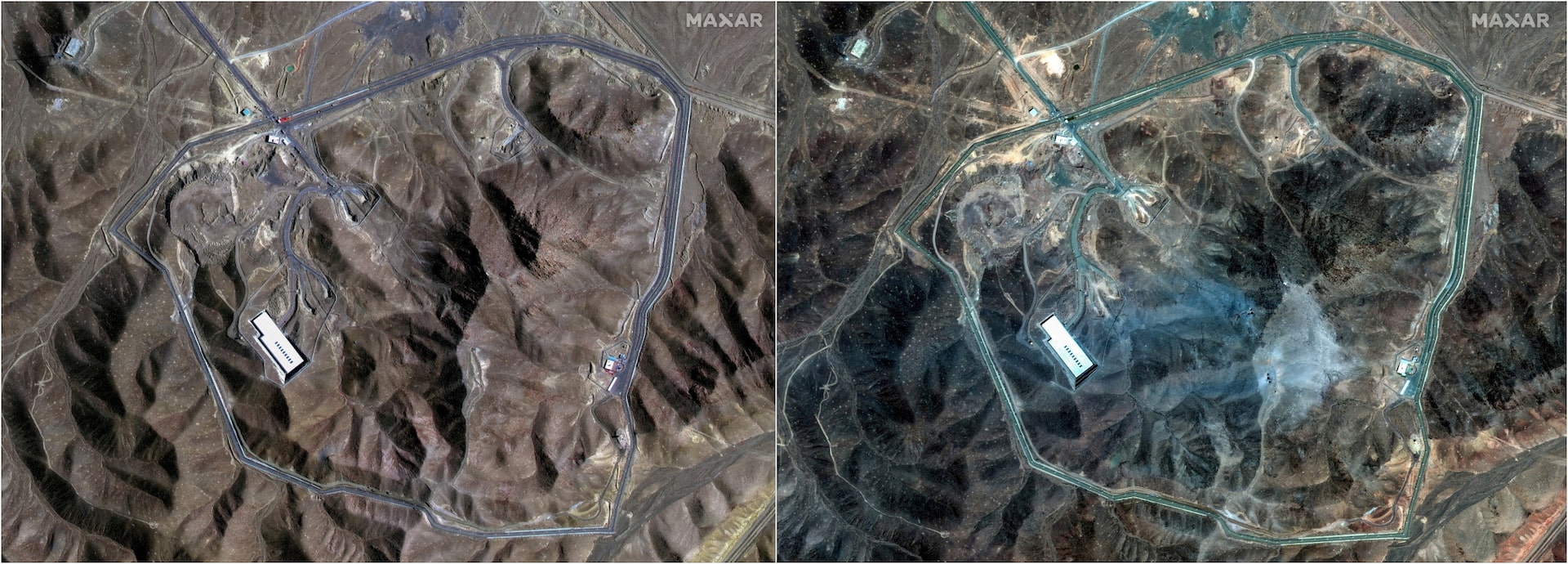
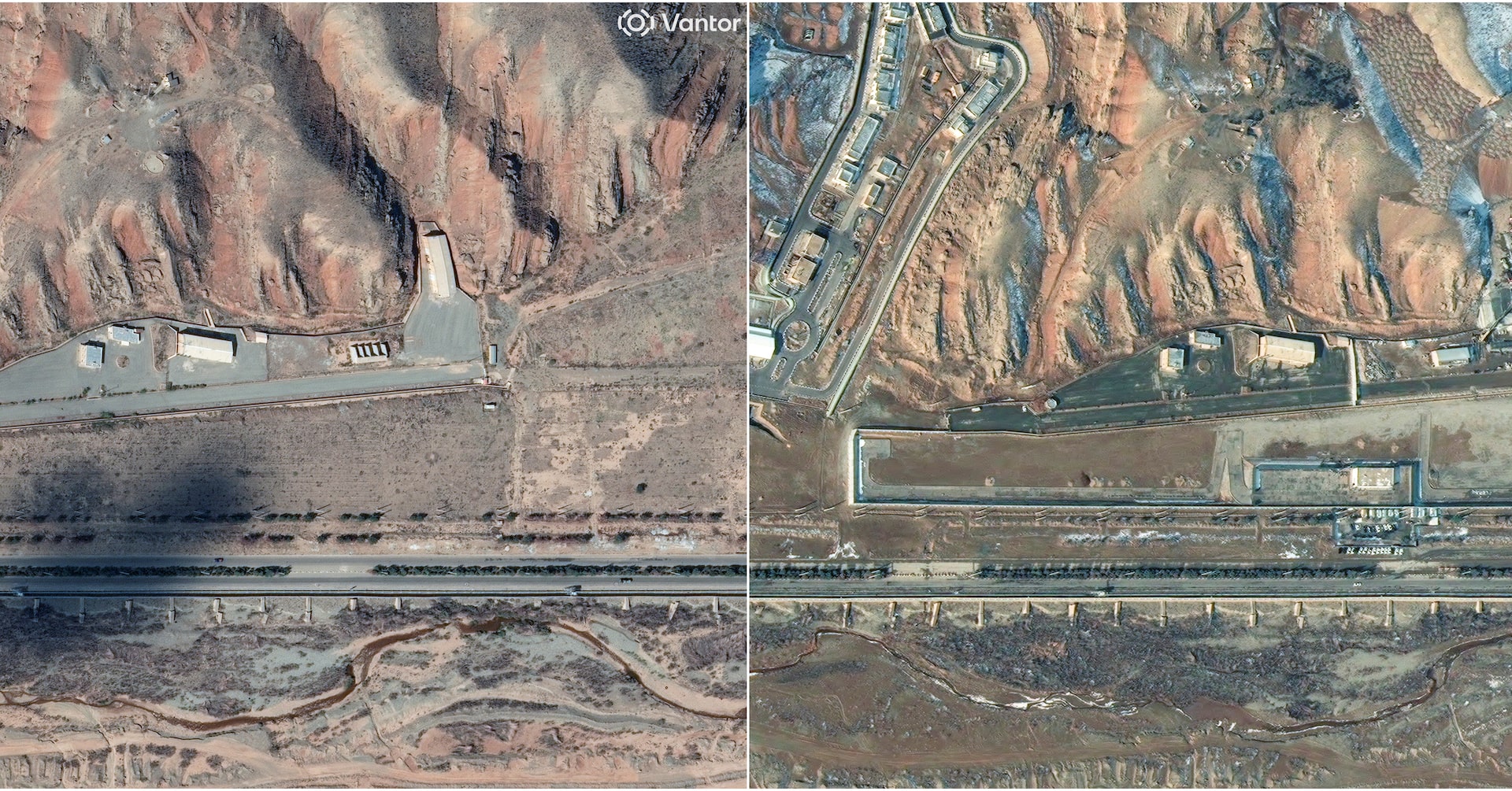
The war has not merely continued; it has been retrofitted by its surviving object. Shafts collapsed, centrifuge halls pulverised, and tunnel mouths transformed into geological tombs, yet the uranium endured. The battlefield now revolves not around air superiority or coercive leverage alone, but around the custody of matter itself. The Grail metaphor captures this transformation: the uranium matters less for its intrinsic materiality than for its capacity to justify, narratively and materially, a war that has otherwise produced escalating complications.
Optics, Performance, and the Post-Strategic Object
At this point, the uranium shifts registers, from material object to representational instrument.
Recent remarks by Donald Trump have inadvertently clarified this transformation. Speaking during an interview in China, he suggested that the pursuit of Iran’s enriched uranium was “more for optics than anything else”. The phrase is deceptively simple, but conceptually decisive.
It introduces a distinction that earlier strategic language suppresses: the difference between strategic necessity and political visibility.
In this framing, the uranium is no longer only what must be denied to Iran. It is also what must be seen to have been controlled. Its value becomes partly performative: it functions as evidence of agency in a system where outcomes are increasingly ambiguous and difficult to narrate as victory.
This stands in contrast to the Israeli articulation of the issue, in which uranium is embedded within an apocalyptic grammar of imminence. There, latent capacity collapses into existential threat. Trump’s “optics” formulation, by contrast, exposes a parallel but distinct logic: that the pursuit itself risks becoming self-referential, sustained by the need to demonstrate control rather than solely to achieve it.
The object thus acquires a dual ontology. It is simultaneously fissile material and narrative artefact. It is what must be controlled and what must be shown to have been controlled.
In this sense, optics does not replace strategy; it becomes part of it. The Holy Grail metaphor thus reaches its final mutation: the object is pursued not only for what it materially is, but for what its possession might allow history to say, retroactively, about the meaning of the war itself.
From Rescue Corridor to Uranium Corridor
The pilot rescue demonstrates the battlefield as a labyrinthine space of improvisation and emergent knowledge. The extraordinary coordination required—air cover, electronic deception, special operations, and sustained penetration—produced a logistical architecture that could be repurposed for a seizure mission.
Specifically, the operation validated ingress and egress routes through contested airspace, survivable helicopter approaches into mountainous enclaves, temporary forward arming and refuelling points, deception narratives capable of confusing Iranian pursuit units, and intelligence-fed misdirection designed to distort local search grids.
Every war eventually reveals what survives its declared purpose. In Iran, what endures is neither regime nor army, but enriched uranium: the Holy Grail of contemporary warfare, the residual object that has gradually reorganised the campaign around its own survival. The pre-emptive expedition, conceived in the fantasy of swift decapitation and instant regime change, instead entered a Borgesian labyrinth in which each strike, setback, and tactical improvisation recursively altered the meaning of the war itself.
These operational gains are not incidental. They represent the grammar of a uranium-seizure mission, a Borgesian labyrinth in which every corridor and misdirection is rehearsed in miniature, every pathway anticipates contingencies. What was narrated publicly as humanitarian necessity may be retrospectively interpreted as the operational cover for a deeper strategic purpose, or, more unsettlingly, as the revelation that no coherent strategic telos remained beyond the compulsion to keep the labyrinth in motion.
The Improvisational Presidency and Retroactive Victory
At the time of the rescue, the White House faced a symbolic rupture: the downing of an American fighter contradicted repeated claims of overwhelming dominance. Recovery of both aviators allowed a temporary reclamation of competence and control. Yet symbolic recovery is rarely sufficient. Escalation through repurposing often follows humiliation.
In this context, an increasingly improvisational presidency channels the war towards a tangible, narratively satisfying prize: the uranium stockpile. Recovering the Grail would enable the administration to reframe the campaign as a non-proliferation triumph rather than a spiralling regional conflict. The uranium, like the Grail in Arthurian legend, is both a tangible object and a narrative instrument through which retroactive legitimacy can be manufactured.
The Cursed Logic of the Grail
The medieval Grail was never merely a chalice; its meaning resided in the quest. Similarly, Iran’s buried uranium functions as the object that converts tactical destruction into strategic coherence. Success promises closure; failure transforms every destroyed bunker into a prelude to a future Iranian deterrent constructed from memory and survival.
The paradox is stark: the more valuable the object becomes, the more dangerous the pursuit. A mission to seize the uranium would require commandos, engineers, radiological specialists, excavation machinery, perimeter defences, airlift logistics, and temporary territorial control deep within Iranian territory. The rescue mission demonstrated feasibility; the uranium hunt would escalate this into a micro-occupation of a nuclear graveyard. The Grail is thus cursed: its capture promises closure but also risks transforming limited war into open-ended custodial warfare.
The war is therefore no longer about victory in the traditional sense. It is about what continues to reorganise purpose after declared aims have expired, and how ambition confronts the recursive architectures it has itself produced. Yet beyond the residue of uranium lies a more enduring remainder: guilt. It is human beings, not artificial intelligence, who must continue to bear responsibility for what increasingly resembles a crime against humanity.
The Tenuous Ceasefire and the Deferred Hunt
The failure of the 21-hour intensive US–Iran talks in Islamabad, mediated by Pakistan, to yield a negotiated settlement should therefore not be misconstrued as a simple return to square one. If anything, it marks the beginning of a longer and more labyrinthine road towards reinventing the hunt for the Holy Grail itself. The diplomatic impasse did not dissolve the object; it redistributed its strategic temporality. What could not be secured through maximalist war aims or compressed ceasefire diplomacy now re-enters history as a deferred yet mutating pursuit, where uranium, leverage, and narrative salvage continue to reorganise policy imagination beneath the surface of formal de-escalation. In this sense, Islamabad may come to signify less the failure of peace than the extension of quest logic by other means: the Grail survives the talks just as it survived the bombardment, ensuring that the war’s deepest telos remains suspended, reinvented, and ominously unfinished.
The War’s Afterlife and the Migratory Grail
Every war eventually reveals what survives its declared purpose. In Iran, what endures is neither regime nor army, but enriched uranium: the Holy Grail of contemporary warfare, the residual object that has gradually reorganised the campaign around its own survival. The pre-emptive expedition, conceived in the fantasy of swift decapitation and instant regime change, instead entered a Borgesian labyrinth in which each strike, setback, and tactical improvisation recursively altered the meaning of the war itself.
The opening shock has now given way to the quieter acoustics of strategic exhaustion. The frontier recedes into white noise; the earlier rescue corridor reads retrospectively as a rehearsal for deeper forms of penetration; and the ceasefire, rather than closing the episode, has shifted the object of pursuit into a different register. The failure of the 21-hour Islamabad talks did not restore the status quo ante. It transformed the search from an immediate military imperative into a more diffuse and enduring strategic grammar. The hunt is no longer simply deferred in time; it has become migratory in form, moving across diplomacy, intelligence, sanctions, covert access routes, regional alignments, and the politics of narrative salvage. What survives is not merely uranium, but the institutionalisation of its pursuit.
In the run-up to the prospective twilight of unipolarity, the conflict has thus been retrofitted by persistence rather than closure. Failure no longer appears as termination but as mutation: strategic disappointment generates new theatres of justification, new corridors of access, and new vocabularies of necessity. The deeper object may never have been fissile material alone, but the recurring fantasy of a final act, military, diplomatic, or symbolic, that can redeem an otherwise labyrinthine campaign by retrospectively imposing coherence upon it.
The war is therefore no longer about victory in the traditional sense. It is about what continues to reorganise purpose after declared aims have expired, and how ambition confronts the recursive architectures it has itself produced. Yet beyond the residue of uranium lies a more enduring remainder: guilt. It is human beings, not artificial intelligence, who must continue to bear responsibility for what increasingly resembles a crime against humanity. Technology in general, and AI in particular, cannot serve as the alibi that absolves the human capacity to subsume humanity itself beneath systems of domination, annihilation, and retrospective justification. The machine may optimise the corridor, map the tunnel, or track the heartbeat, but it cannot inherit the moral stain. That burden remains irreducibly human.
The larger question, how strategic fatigue, diplomatic failure, narrative salvage, and hegemonic decline will shape the wider afterlife of this conflict, now hangs over humanity like the Sword of Damocles, suspended not only above the region but above the very legitimacy of a world order still seeking moral authority through endlessly renewable justifications.
Dr. Faridul Alam, a former academic, writes from New York City.
Send your articles for Slow Reads to slowreads@thedailystar.net. Check out our submission guidelines for details.
The politics of fear: From Gaza's paper kites to ‘unsafe’ on campuses
Shared rivers, shared responsibilities: The case for water treaties
Shanghai Cooperation Organisation at 25: Can China, India and Russia really speak with one voice?
Bihar wants Delhi to not renew Ganges treaty. What does it mean for Dhaka?

Bangladesh and the United States: Beyond the tariff bargain

From the Carter Doctrine to the Mecca Pact: A changing Gulf security order
More capability, less autonomy? Bangladesh’s emerging security dilemma
An anti-West network is emerging: How should Bangladesh respond?
The Mecca Pact: Deterrence, Israel, and the new Gulf security equation