A 300-year-old shrine and the legend of Oggean Thakur

Nestled along the waterlogged margins of Kawadighi Haor in Moulvibazar Sadar Upazila, the temple of Oggean Thakur stands as one of the most intriguing spiritual sites in the Sylhet region. For nearly three centuries, it has drawn pilgrims, the afflicted, and the curious alike. People of different faiths arrive bearing vows, seeking solace, and hoping to hear the distant sound of drums drifting across the water after dark.
Known locally as Oggean Thakur-er Mandir, the shrine’s origins are inseparable from the extraordinary life of the man for whom it was built. Today, it remains an active place of devotion. Candles illuminate the shrine each evening, Paush Sankranti remains its most important annual observance, and stories of the saint continue to circulate among the villages surrounding the haor.
The story begins with a boy named Keshab. According to the account preserved in the Srihatta chronicle compiled by scholar Achyutcharan Chowdhury Tattvanidhi, Keshab was born in Burikona village in Moulvibazar. As a young man, he was regarded as simple-minded and easily deceived. Shepherd boys would often steal the rice and bananas he carried home from households he visited. His elder brother would scold him, yet Keshab never seemed troubled by the losses.
What appeared to be simplicity, however, may have concealed something deeper.
After one such incident, Keshab did not return home. Instead, he disappeared into the dense forest beyond the village, a wilderness known for its tigers and wild buffaloes. When he failed to return, his family searched for him and eventually assumed that he had died.
Three days later, he came back. Something about him had changed. He cooked his own food, spoke little, and spent much of his time near the household shrine. He addressed every man as Jetha and every woman as Jethi, extending familial respect to everyone he met. Villagers found the habit unusual but gradually accepted it. Yet traces of the old Keshab remained. He still spent time with the shepherd boys as before.
One evening, as the herdsmen worried about cattle that had wandered off, Keshab calmly told each of them exactly where their animals could be found. The boys returned home astonished, and news of the incident spread through neighbouring villages.
Soon people began arriving at his doorstep. The sick, the grieving, and those burdened by personal troubles sought his help. Many believed they found relief through his presence, words, or touch.
A story involving a villager named Binandaram Dhar further strengthened his reputation. Upon seeing him one day, Keshab remarked casually, “Jetha, the mangoes on your tree are ripe. Why haven’t you brought me any?”
It was not mango season. Perplexed, Binandaram returned home and reportedly found ripe mangoes hanging from his tree.
Around this period, a Pir named Qutub Shah arrived in the area. The meeting between the wandering mystic and the village ascetic would become central to local tradition. During what was described as a state of spiritual ecstasy, Keshab approached the Pir and picked up saliva that Qutub Shah had spat onto the ground.
Rather than expressing anger, the Pir addressed him affectionately as “Oggean”, a word that roughly means “unlearned” but is often understood to refer to someone whose wisdom transcends formal learning. From that moment, local tradition holds, Keshab became known as Oggean Thakur.
Among the many legends attached to him, none is more enduring than the story of his boat.
On a stretch of high, dry land, variously identified as the Adampur Hills, Barshijura, or even Kailasahar in present-day Tripura, Oggean Thakur had a boat named Banamali constructed.
The boat was then launched. According to local belief, it sailed not across water but across nearly four miles of dry ground.
The route became known as Oggeaner Kara, while the surrounding area came to be called Oggean Jangal. A verse commemorating the event survives in local memory:
“Sabe Bol Hari Hari. /Oggean Sawari Nao Jaito Antehari.”
(All together, say Hari Hari. /Oggean’s passenger boat goes to Antehari.)
For devotees, the story reflects a belief found across Bengali devotional traditions: that spiritually awakened figures exist in a relationship with the world that transcends ordinary limits.
Another interesting legend concerns sounds heard across the haor after nightfall.
Villagers, including Abdus Salam, Basit Mia, and Malik Mia of Birimabad, recount hearing drums and cymbals drifting over the waters of Kawadighi Haor. Devotees believe the sounds come from Oggean Thakur and his companions, still rowing across the haor as they once did in life. Those fortunate enough to be listening, they say, can still hear them.
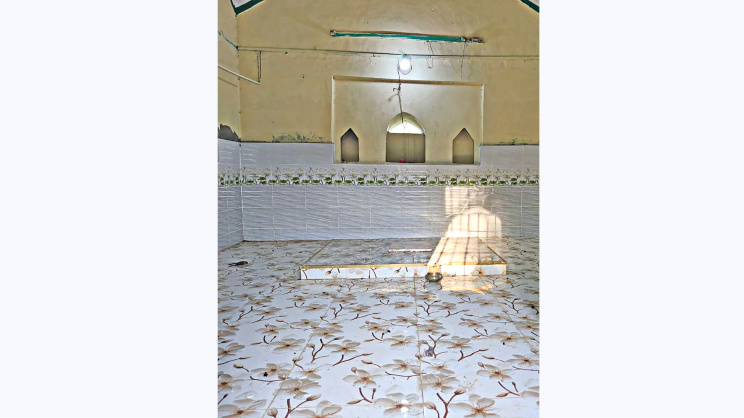
In his later years, Oggean Thakur embraced a more ascetic life. He took up residence at the temple and devoted himself to constant devotional chanting. Visitors continued to arrive from early morning seeking blessings, guidance, and healing.
Then, one morning, he did not emerge.
The day passed. Then another. Soon a week had gone by.
On the eighth day, villagers forced open the temple door. Inside, they found no trace of him. Instead, there was only a hole in the ground.
The prevailing belief is that he departed this world through this opening rather than dying in any ordinary sense. Local tradition further holds that offerings of milk and bananas placed inside the hole later appeared floating in a nearby pond.
The opening has since been sealed with stones, but belief in the miracle endures.
The temple stands in Birimabad village in Ekatuna Union, on the edge of Kawadighi Haor. Older residents recall a time when four ponds surrounded the shrine. According to local accounts, Oggean Thakur could dive into one pond and emerge from another. Today, only the eastern pond remains, while much of the surrounding precinct has become open land.
Despite the passage of centuries, the shrine continues to function as a centre of worship and community life. Candles are lit each evening, and Paush Sankranti attracts devotees from across the region.
One of the most striking features of the site is its appeal across religious boundaries. Hindus, Muslims, and people of other faiths continue to visit, fulfil vows, and seek blessings associated with Oggean Thakur.
A seasonal fair known as Baruni was once held here over several days. Although the fair has faded in recent years, the tradition of gathering around the shrine remains alive.
Babul Sutradhar, general secretary of the Sri Sri Oggean Thakur Temple Management Committee, said the number of regular devotees continues to grow. However, the shrine faces practical challenges. The access road remains in poor condition, and water and sanitation facilities are inadequate for the number of visitors it receives.
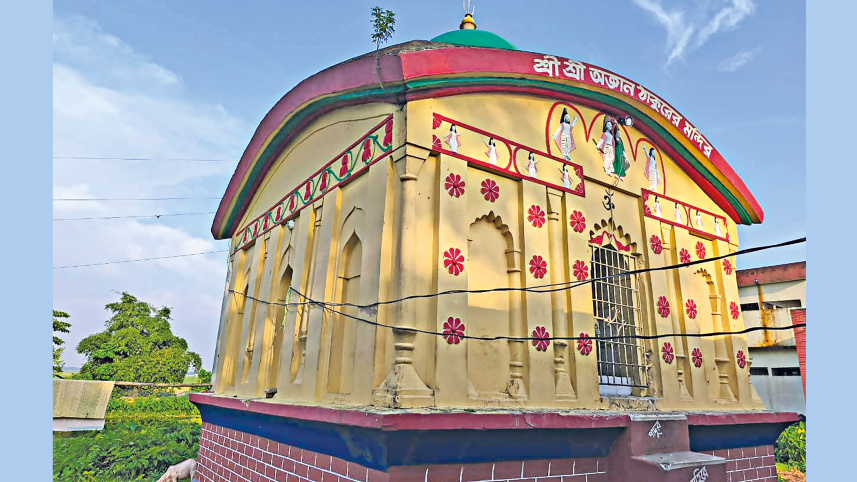
Local tradition holds that the temple was established after Oggean Thakur attained spiritual realisation and that it is around three hundred years old. Whether or not its precise age can be established, the shrine conveys a striking sense of continuity. Its moss-covered stones, surviving pond, and candles glowing at dusk evoke an endurance that transcends chronology.
The shrine occupies a distinctive place in the cultural landscape of Sylhet. It is at once a Hindu temple, a sacred site shaped by the memory of Pir Qutub Shah, and a gathering place that welcomes people across religious boundaries.
Members of the temple management committee have suggested developing the area as a heritage and cultural tourism destination. The history of the haor, the life of an extraordinary spiritual figure, and the living traditions of a multi-faith community could together create a destination of considerable cultural significance.
Mintu Deshwara is a journalist at The Daily Star.
Send your articles for Slow Reads to slowreads@thedailystar.net. Check out our submission guidelines for details

More than refugees: How Rohingya youth are reclaiming their story
Behind every cup / The mental toll on women tea workers
From Shyamnagar to Kurigram: Women work, but where is the income?

Waiting for April: The other side of migration in the Sundarbans

Where have Bangladesh’s hilsa gone?

Lead poisoning in Bangladesh: A crisis ignored for too long

Who recycles Bangladesh’s garment waste?

Bangladesh running out of options on Rohingya crisis: Is there a way out?

Construction of the Sugandha-Kalatoli beach road / A grave threat to Cox’s Bazar’s sand dunes