


Rana Plaza, 13 years on: No justice, no memory

Thirteen years after the Rana Plaza building collapse, any mention of the disaster is often treated as an inconvenience.
Some argue that Bangladesh has come a long way since, and that is all we should talk about. It now has the highest number of LEED-certified “green” factories in the world, and there is no need for “negative press” when so many other problems demand attention.
There has definitely been notable progress within the RMG industry regarding improvements in fire, electrical, and structural safety. But the fact remains that, after 13 years, there has been little movement on accountability – not a single court has yet delivered a final judgment. While humanitarian aid was provided, no compensation has been paid for the most devastating catastrophe in the history of the global fashion industry.
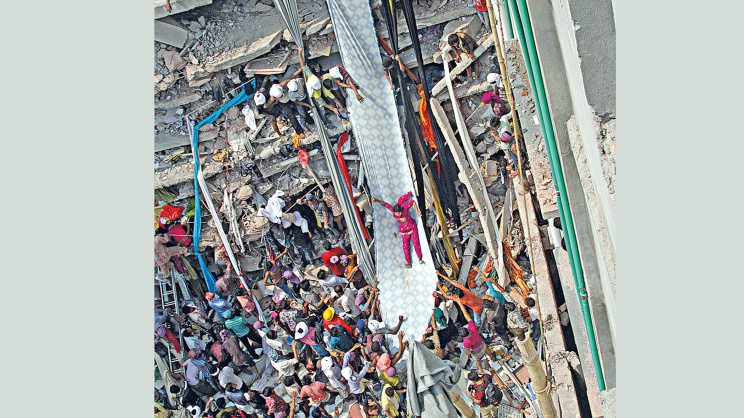
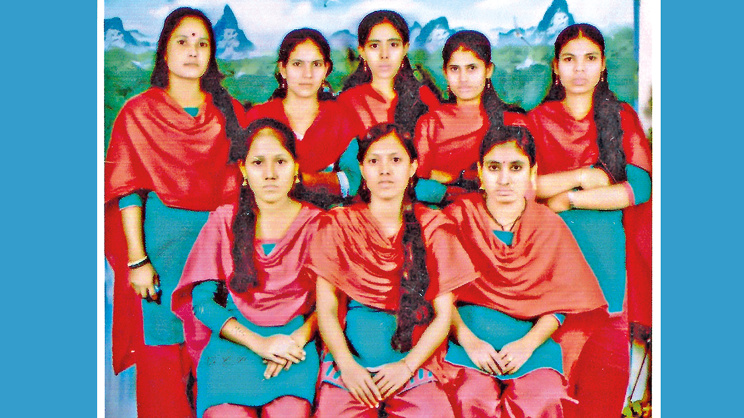
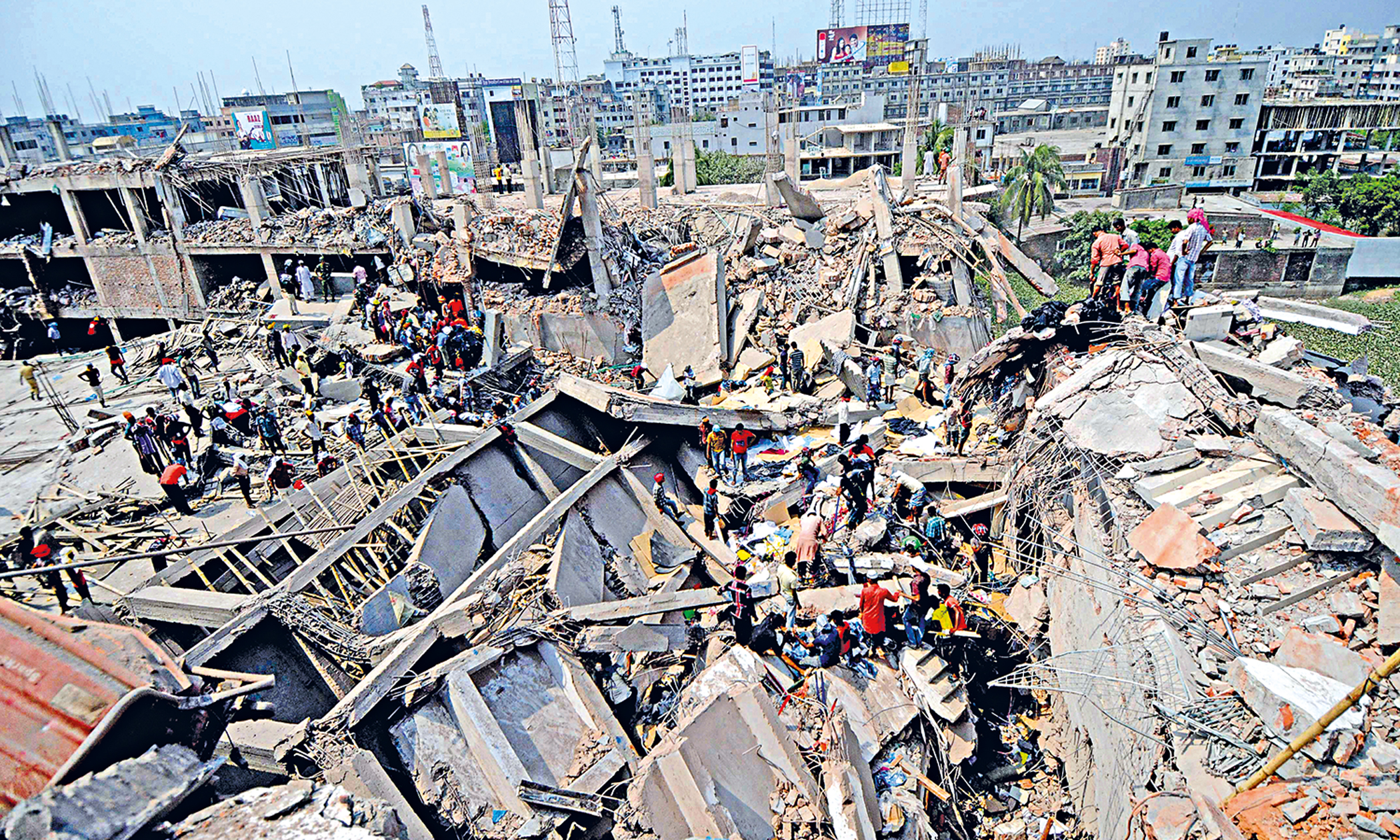
This was a preventable disaster. It occurred because of the failures of different individuals and entities. Their actions and inaction killed 1,136 people—workers like Akhi Akhter and her friends—inflicted life-long injuries on 2,438 more, and left lasting trauma on families, communities, and rescue workers.
Beyond the denial of justice, Bangladesh still lacks adequate laws to ensure reparations for victims of work-related accidents and deaths, including justified compensation for those injured or bereaved families of those killed, long-term rehabilitation support for severely injured survivors, a well-resourced industrial safety governance system that extends beyond fire and building safety in export garment factories, and meaningful ways to remember and heal from this national tragedy.
Justice denied
Today, a total of 14 cases filed in relation to the Rana Plaza disaster remain in limbo.
The Department of Inspections for Factories and Establishments (DIFE) had filed 11 of these cases in the Labour Court against 14 individuals, including the building and factory owners, for failure to give notice of accidents and contravention of the law with dangerous results. Among them, 11 of the accused are absconding, while three others have been discharged.
There are three (03) criminal cases filed on the Rana Plaza incident in 2013, all pending trial. Rajdhani Unnayan Kartripakkha (RAJUK) had filed one case under the Bangladesh Building Construction Act, 1952, which has been transferred to the Court of the Additional Chief Judicial Magistrate, Dhaka, for trial.
Two cases were filed under the Penal Code, 1860—one by the Sub-Inspector (SI) of Police, Mr Wali Ashraf of Savar Police Station, and another by Ms Sheuly Akter, whose husband Jahangir Alam was among the deceased. Although charge sheets have been filed in the cases, each case is currently pending, awaiting the next date of proceedings.
Under the last Interim Government, renewed emphasis has been placed on concluding the long-stalled trials. The Additional Public Prosecutor, Advocate Faisal Mahmud, noted that collecting the testimony of 594 witnesses, many of whom reside outside Dhaka, remains a key obstacle in an already complex process. The Court has since taken a step to prioritise essential witnesses only, in an effort to accelerate proceedings.
In addition to the 14 cases, five writ petitions are also pending for hearing before the High Court Division of the Supreme Court of Bangladesh. These include a petition by BLAST and Ain O Shalish Kendra (ASK) seeking an investigation into the reasons for the collapse, action against those responsible, and compensation for those affected.
When asked about the impact of the pending cases on the industry’s image, Sadaf Siddiqi, a long-time industry actor and a member of the BGMEA Standing Committee on the Ready-Made Garment Sustainability Council (RSC), acknowledged that “Bangladesh cannot fully heal and move on from the Rana Plaza tragedy unless we are able to achieve some kind of closure for those who lost their loved ones. Those who violated the law need to be held accountable. The justice system needs to ensure a fair and just completion of the pending cases.”
The prolonged trial processes have left victims’ families and the injured wondering whether justice will come in their lifetimes. For some, like Nasima Begum, who survived Rana Plaza only to lose her life in the Daulatia bus accident, there has been no respite from disasters caused by negligence within a single lifetime.
Safety for export only
Rana Plaza propelled workplace safety onto the compliance agenda of the global fashion industry.
It gave rise to national initiatives like the Sustainability Compact, which sought to strengthen labour legislation and increase DIFE’s inspection capacity.
Prominent international initiatives included the Accord on Fire and Building Safety, which in Bangladesh has now transitioned into the tripartite Ready-Made Garment Sustainability Council (RSC); this international model is now being replicated in countries like Pakistan. The Alliance for Bangladesh Worker Safety was another initiative that subsequently evolved into the Nirapon Safety Management Programme.
While these models of industrial safety governance, trialled and tested in Bangladesh, have spilled over to other countries, within Bangladesh they unfortunately remain confined to exporting garment factories, as noted by Syed Sultan Uddin Ahmmed, Executive Director of the Bangladesh Institute for Labour Studies (BILS). He also highlighted persistent weaknesses in factory building approval processes and the supervisory capacity of local administration.
These concerns are echoed by the Joint Inspector General of DIFE, Md Mahfuzur Rahman Bhuiyan, who pointed out that DIFE still cannot verify whether buildings are constructed to proper standards because it has not been included in RAJUK’s (Rajdhani Unnayan Kartripakkha) building approval committee, as was also the case during Rana Plaza.
Expanding DIFE’s monitoring capacity has been slow, though some progress has been made. The department now has 554 inspectors, with 122 more expected to join soon, to monitor the 83,591 establishments listed in the public database. It remains to be seen whether it can sufficiently cover the agency’s broad mandate, which includes overseeing safety standards of “all factories, shops, industrial and commercial establishments, tea gardens, inland water transport, road transport, etc.” across the country, along with filing complaints in the labour court, investigating worker complaints, and issuing licences.
If Bangladesh is to create “10 million jobs in 18 months”, governing institutions must urgently address these gaps to establish safer workplaces and ensure the state can effectively enforce the law.
Moreover, as Syed Sultan Ahmmed emphasised: “Sustainable workplace safety depends on more than just physical infrastructure. It requires the active participation of both owners and workers, supported by a robust system of legal rights and protections to ensure lasting remediation.”
The unfinished struggle for worker compensation
Part of this wider system of protection includes the contested topic of compensation. In the immediate aftermath of Rana Plaza, approximately BDT 127 crore (approximately USD 15.9 million) was donated to the Prime Minister’s Relief Fund, of which 15% was directly disbursed and another BDT 23 crore (approximately USD 3 million) was distributed through the Rana Plaza Arrangement. The remaining BDT 85 crore (approximately USD 10.6 million) is still unaccounted for. A Probe Committee was formed under the IG to investigate this, but its findings have not yet been made public.
The Rana Plaza Arrangement was the largest single disbursement of funds to survivors and families of the deceased. Workers and their representatives campaigned to engage international brands, which donated a total of USD 30 million. Under ILO supervision, funds were disbursed to 5,109 beneficiaries, but as a one-time donation, not legal compensation.
Taslima Akhter, President of Bangladesh Garments Sramik Samhati (BGWS), was clear on the distinction: the Arrangement was voluntary humanitarian aid, not based on an adequate compensation law and framework, which is essential to ensure proper support and corporate accountability.
That framework is long overdue. Sections 150 and 151 of the Bangladesh Labour Act 2006 still set arbitrary limits of BDT 2 lakh for deaths and BDT 2.5 lakh for permanent disablement, which are critically low. There is an urgent need to reform these limits in alignment with international standards and High Court precedents that emphasise ‘loss of lifetime earnings’ rather than arbitrary lump sums.
Demands for such a compensation framework remain unaddressed, despite repeated efforts by workers’ organisations and platforms like BGWS, the Sramik Nirapotta Forum, Sramik Karmachari Oikya Parishad (SKOP), and most recently the Labour Reform Commission under the IG.
The consequences of failing to learn from Rana Plaza are still being felt across other industries. Syed Sultan Uddin Ahmmed noted that families of the 55 children killed in the Hashem Food factory fire received only BDT 2 lakh in compensation. Without a national disability assessment system, many injured workers across sectors still cannot access rehabilitation, long-term treatment, or psychological support. Integrating these services into a national policy framework is not a one-time relief measure but a pathway back to dignity.
One notable initiative is the Employment Injury Scheme (EIS), which has been piloted primarily in exporting RMG factories to provide social insurance coverage against work-related accidents and occupational diseases. The pilot has shown both that the model works and where it needs strengthening before it can be scaled.
Ensuring a mandatory national framework that covers all workers, not only those in exporting garment factories, requires a policy decision and budget commitments that the current government has yet to make. This can certainly help realise its ambitions to build a “safe and humane” Bangladesh.
No grave, no plaque, no memorial
Court judgments, law, and compensation frameworks matter enormously and must be urgently addressed. But they are not enough for what is needed in response to such a national tragedy.
The experience of Rana Plaza must also be preserved as part of the people’s history — to learn from the past and ensure such a disaster is never repeated.
Remembering is also a way to honour the courage and humanity of people from all walks of life – rickshaw pullers, students, rescue workers, trade unionists, NGO staff, employer organisations, and people from across Bangladesh and beyond – who rushed to the site or contributed through various means. They included young volunteer rescuers like Nowshad Hasan Himu, whose astounding bravery ultimately cost him his life.
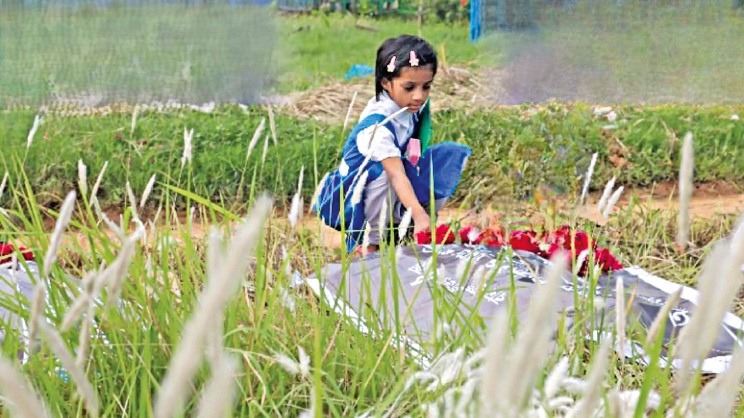
Online archives such as Outcries of a Thousand Souls by BGWS and After Rana Plaza by Ismail Ferdous have been crucial for preservation and remembrance. But the Rana Plaza site itself remains littered with garbage, where the remains of people like seventeen-year-old Shanta Akhter, whose body was never recovered, have long since been absorbed into the earth.
Syed Sultan Uddin Ahmmed contends that burying Rana Plaza victims in the Jurain graveyard, rather than in Savar, was a “deliberate attempt to erase their memory”, as authorities have ignored or failed to act on the demands by Sromik Nirapotta Forum and others for a memorial and plaque at either site.
Sadaf Siddiqi believes the industry could play a role in “remembering and honouring the victims, the amazing potential that was in all of those who lost their lives. Perhaps a landmark memorial, which also symbolises the resilience of an industry that has changed Bangladesh, with workers as its backbone”.
Setting aside differences to co-create a space for remembrance could set a meaningful precedent. Rather than an admission of weakness, it would demonstrate that the industry has the maturity to acknowledge the past and the resolve to build a more just and sustainable future.
In a few days, 24th April will mark the passage of yet another year without justice or accountability since Rana Plaza. Beyond the commemorations on this single day, we hope there will be justice for the survivors and the families who lost their loved ones, and systemic change to ensure protection for all workers, not just in garments, but across the country.
Adiba Afros is a doctoral researcher at the Research Centre for Human Rights in Erlangen-Nuremberg (CHREN) and an independent consultant.
Advocate Sifat E Nur Khanam is a Legal Specialist at the Bangladesh Legal Aid and Services Trust (BLAST) and an Advocate of the Supreme Court of Bangladesh.
Send your articles for Slow Reads to slowreads@thedailystar.net. Check out our submission guidelines for details.