Unseen struggles of ATM security guards in Bangladesh

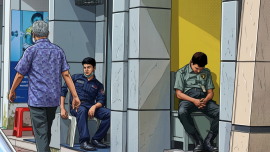
It was around 9:00 pm when I first approached Delwar Hossain, an ATM booth security guard in Karwan Bazar, as he sat outside his post with one of his colleagues. When I asked to discuss his working conditions and life on the job, his colleague laughed, having seen such inquiries before, and preemptively remarked, “Nothing will happen!”
Delwar agreed to talk regardless. He has worked in the security sector for 14 years.
“We have to work 16 hours a day in total, 7 days a week. There is no weekend for us. We have to work 30 days a month,” Delwar said. “We have to do both day and night shifts. After a week we rotate our shift. Morning shift starts from 6 am and lasts until 2 pm and we move to a different booth for the next shift which starts from 2 pm to 10 pm in the night.”

He noted that guards receive 29 days of leave per year, but even then, not everyone is granted time off during Eid or other festivals.
“My monthly salary is 17.5 thousand Tk. I was promoted to a supervisor role but I had to demote myself after a while to the guard duty. Although the pay was a little better but there was immense pressure in that role so I had to downgrade my role,” he said.
While there is no insurance, Delwar explained that guards receive a lump sum upon retirement, which functions as a pension. Before starting, employees undergo one week of training focused on conduct and assisting customers less on guard duty.
We have to work 16 hours a day in total, 7 days a week. There is no weekend for us. We have to work 30 days a month,” Delwar said. “We have to do both day and night shifts. After a week we rotate our shift. Morning shift starts from 6 am and lasts until 2 pm and we move to a different booth for the next shift which starts from 2 pm to 10 pm in the night.
However, the reality of the job is grueling.“As for lunch and breaks, I get 10 minutes for my lunch, during which I have to leave the booth without anyone watching over it,” he added.
Another ATM guard, who works in Puran Dhaka and requested anonymity, is employed by a different security firm. He began his duties six months ago.
“We have to work a total 12 hours a day, 7 days a week. We also rotate day and night shifts after a week,” he said. “My monthly salary is 16 thousand Tk. And for overtime we get 3 thousand more.”

His shifts run from 8:00am to 8:00pm and night shifts from 8:00pm to 8:00am. He noted that his company provides 10 days of holiday and 24 “rest” days annually. If they forgo these rest days, they are paid 350 Tk for every two days.
The training, which lasted 14 days, focused on behavior rather than security. “We don’t have firearms; in case of an emergency, they just let us carry a baton for protection. In emergencies, we have to inform managers and police,” he said.
Because they are third-party employees, the bank does not communicate with them directly. “We have heard that the bank pays Tk 25,000 for each guard, but even after overtime, we receive Tk 19,000,” he said. One benefit is that the company provides shared housing in a mess where 20 to 24 guards reside.
They fine us if they saw us without wearing our boots. In a 12 hour shift our feet gets sore so it’s quite painful,” he said. “I saw someone taking a long medical leave and after they return, they are transferred to different location or dismissed altogether.
The job comes with strict oversight. Guards are checked by company officials once or twice a week, often in the middle of the night. “Sometimes it is very cruel. They fine us if they saw us without wearing our boots. In a 12 hour shift our feet gets sore so it’s quite painful,” he said.
He also described a lack of job security. “I saw someone take a long medical leave, and after they returned, they were transferred to a different location or dismissed altogether. The festival bonus is comically low. I got Tk 1,900 as an Eid bonus. I have heard that after two or three years we get a pair of new boots and a new uniform, and that’s it.”
For these workers, the path forward is clear. “What I want is for us to be employed directly by the bank. We do not like being third-party workers. We want insurance—if something happens to us while working, my family should at least receive something.”
We cross paths with these workers every day, yet their struggles remain largely unseen. Despite the strain of long hours, low pay, and little security, they continue to treat others with patience and respect. There is no shortage of discussion around labour rights, but in cases like theirs, it rarely leads to meaningful change.
Ystiaque Ahmed is a journalist at The Daily Star.
Send your articles for Slow Reads to slowreads@thedailystar.net. Check out our submission guidelines for details.
Why Rana Plaza survivors are still protesting
Unseen struggles of ATM security guards in Bangladesh

The app treats me like a number: The uncertain lives of Dhaka’s ride-hailing drivers