Learning to love the hyphen: Bangladeshi-American

At the beginning of class four, after moving to a new school, a white kid named Taylor looked at me during roll call and said, “Istiaq? What kind of a name is…Istiaq?” His tone suggested it was ridiculous that such a name could exist.
I sank further into my seat. I wanted to disappear like Batman, but I had nowhere to go. I was in a classroom of twenty other white kids in Oshkosh, Wisconsin. I wished my name were something like Matt, so I could blend in, but my brown skin identified me as being from somewhere else.
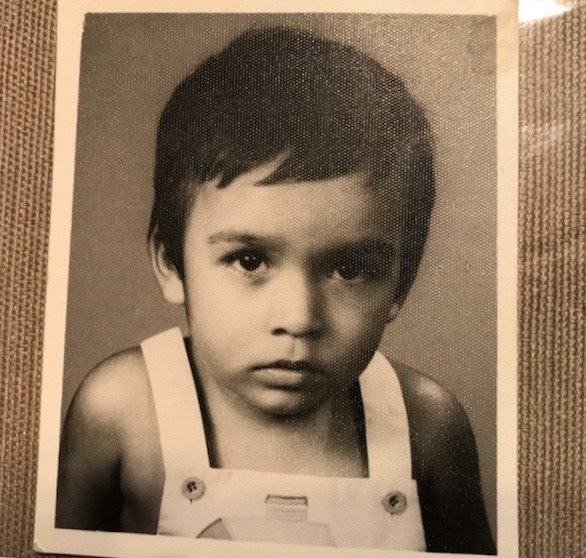
My family had moved from Dhaka, Bangladesh, to Wisconsin in 1990 when I was three years old. I thought we had taken a spaceship to arrive at our new destination. No one had explained to me why we left home and moved to this strange planet, where the skin tone was lighter, people wore mundane clothes, and everyone generally was friendly (except Taylor).
I noticed more differences between me and my new culture. At home, I ate rice, creamy dal, and fried fish, but I craved what everyone else ate at the school cafeteria: burgers, pizza, and French fries. When my parents went to the local grocery store, I saw people staring at us. My mum covered her hair with a hijab, and my dad exposed his by maintaining a long dark beard.
Eventually, I stopped going to the grocery store. When I wore traditional clothing like a panjabi, I did not feel comfortable. The other kids at school were not wearing shirts that went down to their knees. I wanted to wear the American clothes we could afford from K-Mart.
While my parents spoke Bangla to me, my focus shifted to learning English because I needed it to advance in school. Since English was everywhere, I forgot how to speak Bangla. I tried leaning into my American identity as I moved through public school, but at one point, I became frustrated with my inability to speak Bangla. While visiting my older cousins in New York during college, I met one of their friends, and the moment he learned that I could not speak Bangla, he immediately left our conversation, discarding me like a piece of trash. I called my mum and expressed frustration at not being able to talk with people who looked like me. She told me in Bangla that she was sorry I was not raised bilingual, as the focus had been on doing well in school. I understood that it was not anyone’s fault—it was just the way things were.
I thought about that three-year-old boy who boarded an aeroplane to travel halfway across the world. He had always thought something was missing. He lacked the full picture of what his culture was about.
During grade school, my father never told me explicitly, but it was implied that I had to get top scores—there was no other option. This mentality was helpful, as it pushed me. In college at the University of Minnesota, I frequently studied on Friday and Saturday nights consecutively. My roommates became angry when they would walk in and find me hunched over my laptop and textbooks, but I ignored them because I had one goal in mind: medical school. I was accepted to study medicine at the University of Wisconsin, where I met an American woman during my psychiatry rotation. Despite being from different worlds, I fell in love with Jillian because we looked at the world similarly. We got married at the end of medical school.
Jillian loved to travel, and during residency, we secured a rotation to work at a hospital in Parbatipur, Bangladesh. I had never been able to return before because the cost was prohibitive for my parents, who had four children. After leaving Bangladesh, I would be returning there 26 years later.
In Parbatipur, I worked alongside people of different faiths—Hindus, Christians, and other Muslims—at a rural hospital. In the hospital courtyard, colourful sarees dangled on clotheslines. Families washed patients’ clothes and hung their garments to dry in the Bangladeshi heat. Every patient had a family member, called a “chaperone”, at their bedside, who fed them and eagerly awaited the doctors each day. While it was common to see patients alone in their rooms in America, every patient had a chaperone in Bangladesh.
After we finished work in Parbatipur, Jillian and I went to Dhaka to meet my parents, who had flown in from the US. We travelled to Chandpur, where my father grew up.
We stepped off the ferry and took an auto-rickshaw to the countryside, to my aunt’s house. Outside her home, I took my sandals off and felt the mud on my feet—it felt as good as the cool side of the pillow. A separate structure next to my aunt’s home had a tiny clay pit inside, where my cousins cooked food over a fire.
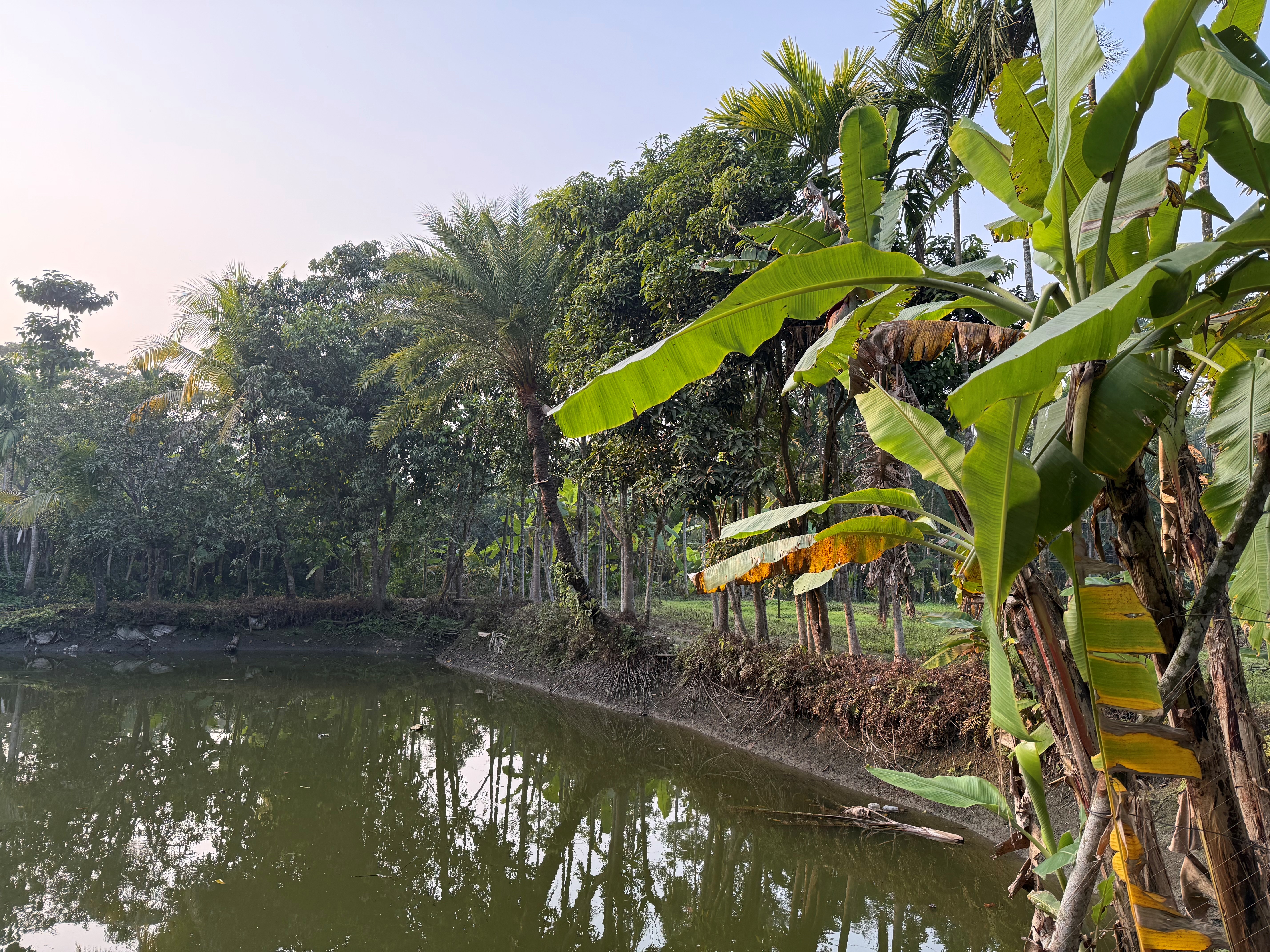
My aunt’s family served us chicken curry, fragrant polao, and river prawns that were as big as lobsters. When I finished my meal, my cousin approached me with a bowl, a pitcher of water, and a bottle. He ejected two gobs of pink soap onto my palms, then poured water through my fingers over the bowl. I had never had my hands washed tableside before. After the meal, I walked around my aunt’s backyard and noted the rich forest green that surrounded her property. Coconut trees towered over me next to smaller banana trees.
After I returned to America from my first trip to Bangladesh, I felt more confident. I wore a golden panjabi during Eid. I appreciated my mother’s cooking more deeply. I felt pride standing next to my parents in public.
At night, I had difficulty falling asleep because of the humidity and lack of air conditioning. My father swung a paper fan back and forth to cool me. From my bed, I looked up at the stars and felt guilty. I watched the same little white diamonds in the sky when I lived in America, but I had not been fully aware of how hard my aunts and cousins were working in the village. They had taken such great care of me. What had I done to deserve such royal treatment?
I thought about that three-year-old boy who boarded an aeroplane to travel halfway across the world. He had always thought something was missing. He lacked the full picture of what his culture was about. While in Bangladesh, I learned that it is about feeding your guests and making them feel respected. It is about being at the bedside when your family is sick and working towards a common goal with people different from you. It is about wearing colourful clothes to be festive.
Growing up, I felt I could not lean into either of my identities. After spending time in Bangladesh, I realised I could develop the best qualities from each of my cultures and become the best version of myself. I wished somebody had told me that when I was younger—that I could accept and love my duality and that it could be a superpower. As I fell asleep, I acknowledged that I was still a work in progress.
My American side loves how, in childhood, I heard my friends’ parents tell their kids, “I love you.” I had personally never heard that phrase because my mum explained she had never heard her mum say it, so she never felt comfortable saying it to me. One of the best parts of American culture is how it values openly talking about one’s feelings.
Respecting cultural norms does require nuance. In Bangladeshi culture, I was taught from an early age that elders always deserve respect, but it is not taught what you should do if an elder treats you poorly. After college, when speaking to one of my dad’s friends, he asked me what my grades were in school. I reluctantly told him my results. He responded, “You should look into medical school overseas,” as if I had no chance of getting accepted into an American school. I let his comment slide because of the hierarchy, but I now know that in future encounters, I can stand up for myself.
Cultural norms are not written in stone, and they do not always need to be followed.
After I returned to America from my first trip to Bangladesh, I felt more confident. I wore a golden panjabi during Eid. I appreciated my mother’s cooking more deeply. I felt pride standing next to my parents in public. I still watch American football and enjoy fried cheese curds occasionally. Whenever someone stops by my home, I try to help them feel a fraction of what I felt in my relatives’ home in Bangladesh.
If someone asks me now, “What kind of a name is Istiaq?” I would say, “I’m Bangladeshi and American, and the name is Arabic.” In Arabic, it translates to the feeling of “longing” for something. For decades, I had longed to return to my birthplace, and I was worried it would not be fruitful, but going back and finding myself there showed me that it is never too late to return home.
Istiaq Mian is a physician whose work has appeared in The New York Times and he writes on Substack.
Send your articles for Slow Reads to slowreads@thedailystar.net. Check out our submission guidelines for details.
What can a teacher give that AI cannot?
What phuchka and jhalmuri can teach us about the science of taste

Remembering Yayoi Kusama: My encounters with the master of infinity

Dress and morality : The politics of what women wear
Is being single at 35 a failure?
Travelling through books / One more page please, Mama
BTV does not need a new look to have a new future
Why is there so much anxiety about women’s bodies?
Buddhadeva Bose: As I knew him