Tracing the roots behind World Cup badge
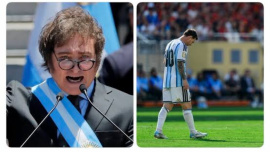
Angelo and his wife Rosa arrived in Argentina in 1883, swept up in a mass migration from Italy. The couple left their homeland fleeing poverty, political unrest and overpopulation. They settled in Rosario and never looked back. Four generations later, their family would produce Lionel Andres Messi -- one of the greatest footballers the world has ever seen.
Messi is not alone. Five other players in Argentina's squad trace their roots to Italy. Three of them -- Julian Alvarez, Rodrigo De Paul and Giovani Lo Celso -- even hold Italian passports.

Argentina's story is far from unusual. Nearly 23 percent of players at this World Cup carry foreign heritage. That means 277 players have ancestry linking them to at least one country other than the one they now represent, according to the Institute for Economics and Peace, a Sydney-based think tank.
Many players carry roots across multiple borders.
Countries shaped by large-scale immigration and colonial history dominate the list. France leads with 21 foreign-heritage players, followed by Canada (20), England (17), Australia (17), Switzerland (16), the Netherlands (15), Germany (15), the United States (13), New Zealand (12) and Belgium (10).
Two patterns emerge from this list. The first involves former colonial powers -- France, England, the Netherlands -- who recruited labour from their colonies to rebuild postwar Europe. Decades later, the children and grandchildren of those migrants are now representing the countries their families helped reconstruct.
Kylian Mbappe, born in Paris to a father with roots in Cameroon and a French-born mother of Algerian Kabyle descent, is a product of this history. So is Marcus Rashford of England, whose paternal grandparents came from the Caribbean as part of the Windrush generation in the 1950s, answering Britain's call for postwar labour.
Seven players from the Netherlands trace their heritage to Suriname, which the Dutch ruled from 1667 to 1975.
Germany's postwar economic boom relied on millions of foreign workers, particularly from Turkiye, Morocco and Yugoslavia. That history is visible in their squad today. Deniz Undav, who scored the winner against Ivory Coast on June 21, has roots in both Turkey and Syria.
The second pattern belongs to nations built on successive waves of immigration. Australia, New Zealand and the United States each have at least 12 foreign-heritage players in their squad. Multi-cultural Canada’s 20 players trace their heritage to at least 14 countries, including Ghana, Ireland, Jamaica and Haiti.
Switzerland, despite its modest size, named 16 foreign-heritage players. Captain Granit Xhaka was born into an ethnic Albanian family from Kosovo. Breel Embolo, who scored in their opener against Qatar, is of Cameroonian origin. The squad mirrors the country itself: roughly 30 percent of Switzerland's population is foreign-born.
Foreign-heritage players also carry stories of displacement. Alphonso Davies was born in a Ghanaian refugee camp to parents who had fled civil war in Liberia; he was five when his family resettled in Edmonton, Canada. Australia's Awer Mabil was born in a Kenyan refugee camp in 1995 to parents who escaped political violence in Sudan.
The global diaspora has reshaped not just wealthy footballing nations. Comparatively smaller teams are now fielding sides built on players raised and developed in Europe. Almost half of Morocco's players were born in Spain and France, the two powers that colonised Morocco in the first half of the 20th century.
Morocco's story is not an anomaly. Nearly one in four players at this tournament -- 292 of the 1,248 -- were born outside the country they represent.
A significant number of these players were born, trained, and developed in Europe before beginning their professional careers.
Notably, 124 players at this World Cup began their youth-level international career with one nation before eventually representing another. For many, the decision reflected a return to their family roots.
For example, much like his younger brother Nico Williams, Iñaki Williams began his international career representing Spain. He featured prominently for Spain’s Under-21s until 2022, netting three goals, and even earned a senior cap for La Roja. However, the forward later chose to represent Ghana, the homeland of his parents.
Other prominent players who represented one country at the youth level before making a senior switch include Aaron Wan-Bissaka (England & DR Congo), Ferdi Kadioglu (the Netherlands & Turkiye), Rayan Ait-Nouri (France & Algeria) and Seko Fofana (France & Ivory Coast).
Foreign-born players have, in fact, always featured at World Cups. From the earliest editions through 2018, tournaments averaged around 47 such players. Between 1994 and 2018, that average rose to nearly 72. At the 2022 World Cup, 137 foreign-born players made up nearly 17 percent of all players -- a record at the time. This edition has since surpassed it.
Much of that increase was driven by a change in FIFA's eligibility rules, which made it easier for players to switch national teams. Previously, even a single youth appearance could tie a player to one country for life.
 For all latest news, follow The Daily Star's Google News channel.
 Under the revised rules, players can switch allegiances if they have made no more than three senior appearances before the age of 21, have never featured in a competitive final of a major international tournament, and at least three years have passed since their last cap for another country.
Brahim Diaz’s switch to Morocco from Spain was made possible because of this revision.
In modern era, the beautiful game illustrates that regardless of where a family’s journey began, the language of the football pitch remains entirely universal.

Reaction / Be like Doku and kill with kindness
Oscar-winning actor Brad Pitt offers to ‘show Neymar how to sell the scene’
‘Terrible mistake’ if FIFA even considered replacing Infantino, risking World Cup profits, says Trump
South Korea FA apologises after sex scandal adds to controversies
US World Cup cities seek millions of dollars promised by FIFA
Tapia hails current Argentina side as country's greatest ever

Can football stay the people’s game?
'Messi behaved in a sportsmanlike manner': World Cup final referee Vincic
FIFA opens disciplinary case over Argentina Falklands banner