


Quirky Science
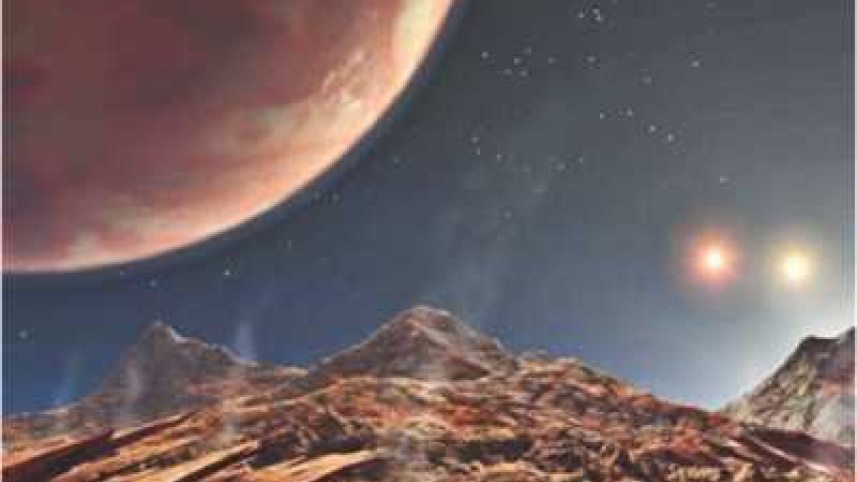
A HOT JUPITER
Crisp, clear images of a "hot Jupiter" system captured by a University of Notre Dame physicist were vital in determining that a newly found planet inhabits a three-star system, a phenomenon documented only a few times before.

Justin R. Crepp, Freimann Assistant Professor of Physics, was part of the team that discovered KELT-4Ab, a so-called "hot Jupiter" because it is a gas giant that orbits extremely close to one of the stars in its solar system. The discovery was published in The Astronomical Journal.
While the KELT, or Kilodegree Extremely Little Telescope, detected the likely presence of the planet now called KELT-4Ab about 685 light years from Earth, Crepp was able to capture crisp, clear images of the system, discovering that the planet was in fact a member of a triple star system – one of only a few found to date.
The KELT monitors bright stars in large sections of the sky, searching for planets that orbit extremely closely. When the star KELT-A dimmed every few days, scientists believed they were witnessing an orbiting planet. Crepp was then asked to use the Keck Telescope to investigate and capture photos, and he wound up finding two additional stars in the process.
THE MISSING PIECE OF THE ORIGIN OF LIFE
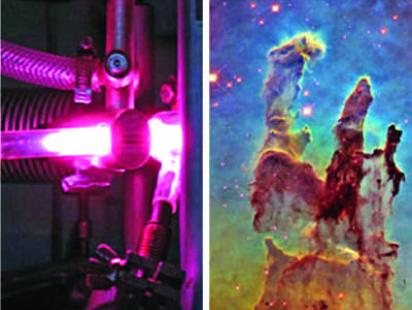
Researchers have for the first time shown that ribose, a sugar that is one of the building blocks of genetic material in living organisms, may have formed in cometary ices. To obtain this result, scientists at the Institut de Chimie de Nice (CNRS/Université Nice Sophia Antipolis) carried out a highly detailed analysis of an artificial comet created by their colleagues at the Institutd'AstrophysiqueSpatiale (CNRS/Université Paris-Sud). Along with other teams[1], including one at the SOLEIL synchrotron, they propose the first realistic scenario for the formation of this key compound, which had never been detected in meteorites or cometary ices until now. Their findings, which shed new light on the emergence of life on Earth, are published in the journal Science dated 8 April 2016.
The genetic material of all living organisms on Earth, as well as of viruses, is made up of nucleic acids, DNA and RNA[2]. RNA, which is considered more primitive, is thought to have been one of the first molecules characteristic of life to appear on Earth. Scientists have long wondered about the origin of these biological compounds. Some of them believe that the Earth was seeded by comets or asteroids that contained the basic building blocks needed to form such molecules. And indeed several amino acids (the components of proteins) and nitrogenous bases (one of the components of nucleic acids) have already been found in meteorites, as well as in artificial comets produced in the laboratory. However, ribose, the other key component of RNA, had never yet been detected in extraterrestrial material or created in the laboratory under 'astrophysical' conditions. Now, by simulating the evolution of the interstellar ice making up comets, French research teams have successfully obtained ribose, a key step in understanding the origin of RNA – and therefore of life.
 For all latest news, follow The Daily Star's Google News channel.
Comments