


QUIRKY SCIENCE
FIVE-DIMENSIONAL BLACK HOLE COULD 'BREAK' GENERAL RELATIVITY
Researchers have shown how a bizarrely shaped black hole could cause Einstein's general theory of relativity, a foundation of modern physics, to break down. However, such an object could only exist in a universe with five or more dimensions.

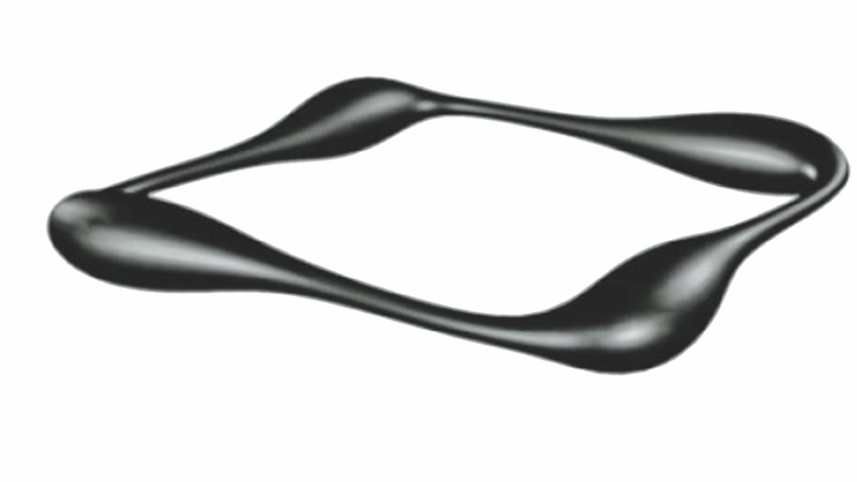
The researchers, from the University of Cambridge and Queen Mary University of London, have successfully simulated a black hole shaped like a very thin ring, which gives rise to a series of 'bulges' connected by strings that become thinner over time. These strings eventually become so thin that they pinch off into a series of miniature black holes, similar to how a thin stream of water from a tap breaks up into droplets.
Ring-shaped black holes were 'discovered' by theoretical physicists in 2002, but this is the first time that their dynamics have been successfully simulated using supercomputers. Should this type of black hole form, it would lead to the appearance of a 'naked singularity', which would cause the equations behind general relativity to break down. The results are published in the journal Physical Review Letters.
General relativity underpins our current understanding of gravity: everything from the estimation of the age of the stars in the universe, to the GPS signals we rely on to help us navigate, is based on Einstein's equations. In part, the theory tells us that matter warps its surrounding spacetime, and what we call gravity is the effect of that warp. In the 100 years since it was published, general relativity has passed every test that has been thrown at it, but one of its limitations is the existence of singularities.
POSSIBLE ANCIENT OCEAN ON PLUTO'S MOON
Pluto's largest moon may have gotten too big for its own skin.
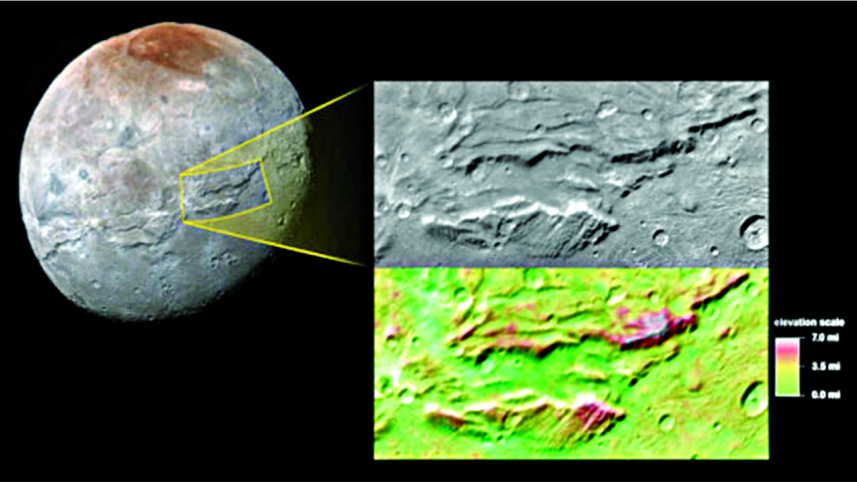
Images from NASA's New Horizons mission suggest that Pluto's moon Charon once had a subsurface ocean that has long since frozen and expanded, pushing outward and causing the moon's surface to stretch and fracture on a massive scale.
The side of Pluto's largest moon viewed by NASA's passing New Horizons spacecraft in July 2015 is characterized by a system of "pull apart" tectonic faults, which are expressed as ridges, scarps and valleys – the latter sometimes reaching more than 4 miles (6.5 kilometers) deep. Charon's tectonic landscape shows that, somehow, the moon expanded in its past, and – like Bruce Banner tearing his shirt as he becomes the Incredible Hulk – Charon's surface fractured as it stretched.
The outer layer of Charon is primarily water ice. This layer was kept warm when Charon was young by heat provided by the decay of radioactive elements, as well as Charon's own internal heat of formation. Scientists say Charon could have been warm enough to cause the water ice to melt deep down, creating a subsurface ocean. But as Charon cooled over time, this ocean would have frozen and expanded (as happens when water freezes), lifting the outermost layers of the moon and producing the massive chasms we see today.
 For all latest news, follow The Daily Star's Google News channel.
Comments