


From Waste Dump to Landmark


For most Dhaka residents, a garbage dump is something to avoid: a place that smells and disappears into the background noise of urban life. But for architect Sharif Uddin Ahammed, such a site became the canvas for one of the most celebrated architectural transformations in recent years. He received the prestigious ARCASIA Awards 2025 in a special category called “Socially Responsible Architecture” for converting a derelict waste-filled tract of land into a lush, living public park, an achievement that speaks not only to design skill but to an entirely different philosophy of what architecture should do for a city.
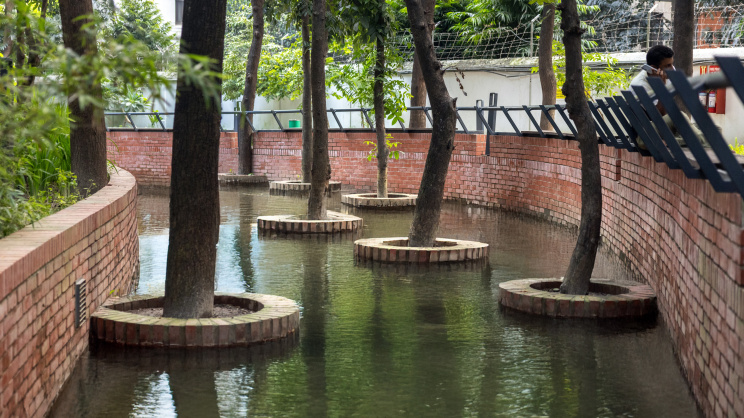
A neglected site reimagined
The story begins behind an abandoned factory of the British American Tobacco company, where for years a stretch of land had served as an informal dumping ground. No one went there unless they had to. It was a forgotten place. When the owners of the adjacent property sought to redevelop the grounds, the earliest proposals were conventional: build a road, construct a checkpoint, add infrastructure for car parking.

Born and educated in Bangladesh, Sharif Uddin Ahammed completed his Bachelor of Architecture at Khulna University. He founded Sthapotik in 2007 with a simple but uncompromising belief: architecture is not an act of domination over land; it is a negotiation with the natural environment. Any project, in his view, should emerge from the terrain’s social and environmental reality, rather than overwrite it.
A modest and ambitious vision
When he first visited the site behind Mohakhali SKS Tower, he imagined a public space where animals, birds, trees, butterflies, and people all live together. But instead of envisioning expensive structures or ornamental landscaping, he proposed something more modest and more ambitious at the same time: a park shaped from the land itself.
The design took shape around the natural contours of the dump. A stagnant waterhole became a restored pond that now helps manage monsoon runoff. Footpaths were carved out, trees were planted to revive biodiversity, and leftover materials from the old factory were reused in retaining walls, seating, and circulation structures.
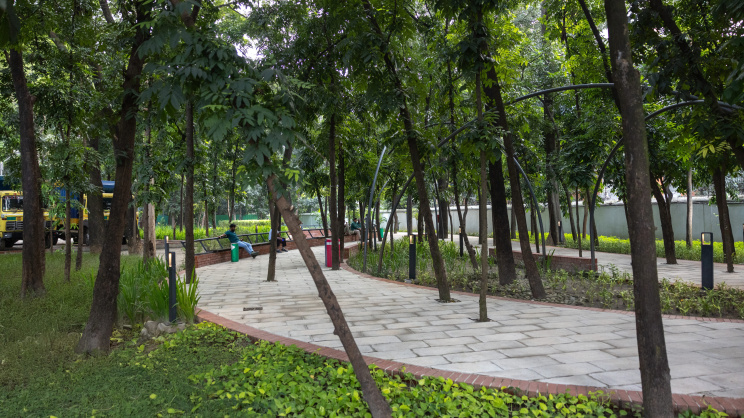
What could easily have been a multibillion-taka project was completed for just 1.72 crore taka, largely because the design embraced the site’s resources instead of importing flashy and unnecessary new elements.
Parks as public equalisers
To understand why the project resonates so widely, one must place it in the broader context of Dhaka’s evolution. The capital grows denser every year, swallowing wetlands, raising high-rises at dizzying speed, and leaving behind pockets of unusable land, spaces that sit idle because they are too difficult or too costly to rehabilitate. What Sharif has demonstrated is that the “difficult” land is often where the most innovative solutions can emerge. It does not require massive budgets or foreign consultants; it requires imagination and an ecological mindset. There is also a deeper cultural significance. Public parks are more than greenery; they are shared equalisers in a class-stratified city. The park built by Sharif was not behind walls or security gates. The modest design elements were deliberate: the landscape itself was the architecture.
Recognition and policy implications
For Bangladesh’s architectural community, Sharif’s award serves as both recognition and a challenge. It affirms that local architects are capable of producing globally acclaimed work grounded in local realities. At the same time, it urges institutions and policymakers to rethink how they approach land, development, and public space.
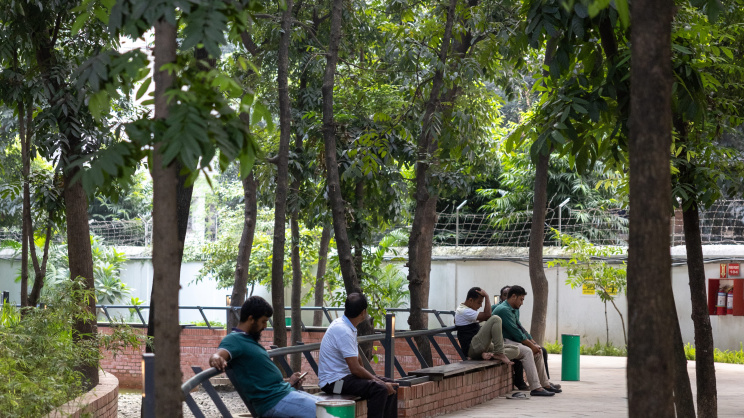
If a garbage dump can become a park, then perhaps other neglected places like old factories, low-lying waterlogged zones, and unused government plots can be reimagined in similarly transformative ways.
 For all latest news, follow The Daily Star's Google News channel.
Comments