


An election born of blood and tears

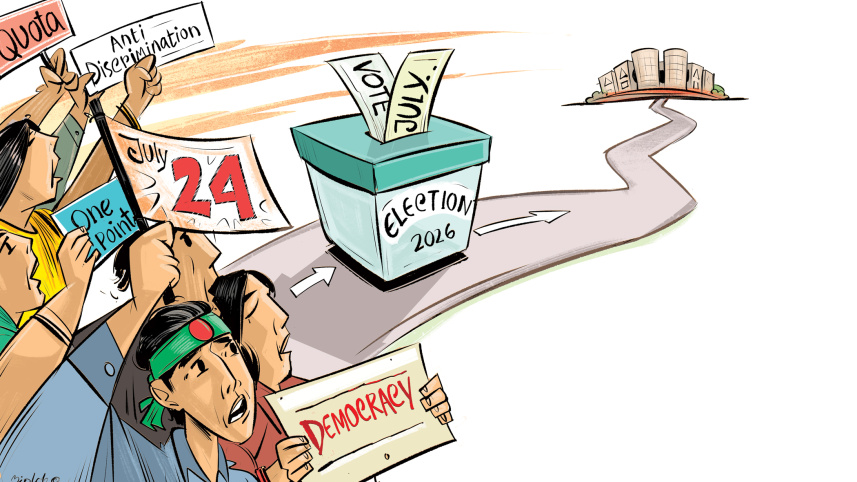
When Winston Churchill rose at the House of Commons in October 1944, he reminded the world that democracy rests on something really important: “At the bottom of all tribute paid to democracy is the little man and woman, walking into a little booth, with a little pencil making a little cross on paper.”
Tomorrow, citizens of Bangladesh, those little men and woman, as Churchill had mentioned, will walk into those little booths, with little seals to mark their ballots and choose representatives in a competitive election, after 17 years.

The nation is witnessing such a contest following the ouster of Sheikh Hasina’s autocratic government in the wake of a mass uprising. Anticipation is high, nerves are taut as voters, parties, and observers wait to see the winner. For the first time in years, a glorious uncertainty hangs over who will assume power.
Although elections are constitutionally held every five years, this 13th national poll comes after just about two years (26 months) because a people’s uprising ousted the previous regime in August 2024.
The spark came on July 1, 2024, when students began protesting against government job quotas only to be met with harsh and brutal response. In response, the fledgling movement transformed into an all‑out anti‑government campaign demanding Hasina’s resignation. She fled to India on August 5, when hundreds of thousands of people began marching towards Dhaka.
The UN reported that around 1,400 people were killed during those few weeks of July and August.
Professor Muhammad Yunus assumed leadership of the interim government three days later on August 8, pledging reforms, justice for the July killings, and a credible election. Since then, the government has repeatedly emphasised that reforms, trials, and an election are its priorities.
BNP and its allies initially demanded that the election be held by December 2025, seemingly unhappy at the government’s indication that the polls may be delayed till as late as June.
Amid strong criticism for delayed polls, the chief adviser said on June 13, 2025 that polls could be held the week before Ramadan in 2026 if preparations were complete. The announcement came after a meeting with BNP chief Tarique Rahman in London.
But the much-promised reforms still remained elusive until mid-October when 25 parties signed the July charter after months-long negotiations among 30 parties at the National Consensus Commission. Five parties still refused to sign, including the National Citizen Party, which was the natural heir to the July uprising.
The government on November 13 announced that the national election and the referendum would be held on the same day, and that an upper house would be introduced based on proportional representation of the votes cast.
On December 11, the Election Commission confirmed February 12 as polling day and campaigns began in earnest. Adversarial rhetoric filled the airwaves, but the process remained comparatively peaceful compared to past elections.
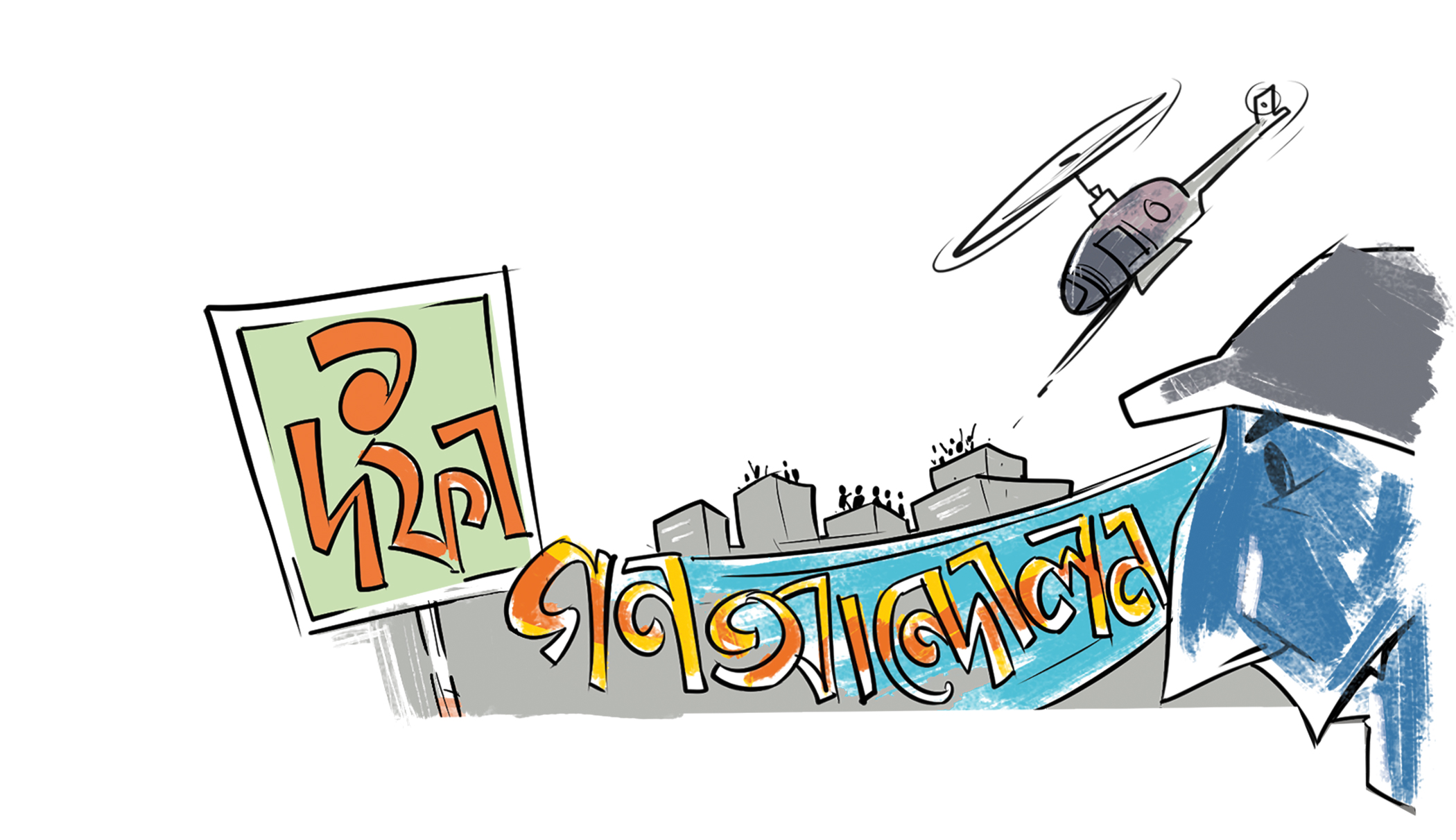
The fall of the Awami League reshaped Bangladesh’s political landscape. While its leaders fled the country, the party was banned for alleged killings and crimes against humanity during the uprising, and its registration was suspended, disqualifying it from the polls.
This opened space for the BNP and Jamaat‑e‑Islami‑led alliances to contest constituencies long dominated by the AL. For decades, BNP and AL had defended their bases, alternating power since 1991. But the balance broke during the last three controversial elections, when the AL secured a super majority.
The 2014 and 2024 polls were mostly uncontested, boycotted by the opposition, while the 2018 election was marred by allegations of ballot‑stuffing on the eve of the polling day.
Prof Al Masud Hasanuzzaman of Jahangirnagar University observed that BNP’s main rival now appears to be the Jamaat‑led 11‑party alliance. He noted that BNP has a scope to win beyond its traditional bastions, but success depends on strategy, candidates, and their conduct. Young voters are expected to play a decisive role.
BNP, founded by Ziaur Rahman in 1978, has been out of power for 17 years -- its longest stretch.
Jamaat, banned after independence for collaborating with Pakistan, revived in 1976 and later joined BNP in a four‑party alliance in 1999. Together they won in 2001, with two Jamaat leaders becoming cabinet members, but were defeated in 2008.
Since then both the parties faced persecution at the hands of the Awami League government. The four-party alliance, became a 20-party combine as several other parties joined in 2012.
The next year, the HC cancelled Jamaat’s registration on the grounds that some provisions of the Jamaat charter went against the country’s constitution and election laws.
 For all latest news, follow The Daily Star's Google News channel.
 In the face of widespread criticism for its ties with Jamaat, which opposed the Liberation War and had sided with Pakistan, the BNP remained distant from the largest Islamist party.
The 20-party alliance dissolved in December 2022 after the BNP asked its allies not to use the name of the alliance.
Since independence, Bangladesh has gone to the polls twelve times and another one is knocking at the door. Yet across this long journey, one fact stands out. No ruling party ever lost an election held under it.
The Awami League first tasted victory while in office in 1973. Decades later, it regained power in 1996, 2008 and in three consecutive elections -- 2014, 2018, and 2024.
The 2014 and 2024 contests were condemned as “one-sided”, boycotted by the opposition. The 2018 election carried even darker allegations: ballot boxes stuffed the night before voting. Critics branded all three as “sham polls”. The 1973 election was also equally one-sided.
The Bangladesh Nationalist Party (BNP) had its moments too, winning in 1979 and again in 1991, the short-lived February 1996 election as well as in 2001. The Jatiya Party, under military ruler HM Ershad, claimed back-to-back victories in 1986 and 1988 -- both boycotted, both one-sided.
The other fact that also stands out in Bangladesh’s electoral journey is that every single election considered fair was conducted under an interim or caretaker government. Four elections -- 1991, June 1996, 2001, and 2008 -- were held under caretaker or interim governments. Each time, the previous incumbent lost, proving that free and fair elections could indeed change power and further that none of the parties had been able to overcome the anti-incumbency factor with dedicated groundwork.
But the broader record tells another story. Bangladesh has endured five one-sided polls -- 1986, 1988, February 1996, 2014, and 2024 -- each marked by opposition boycotts.
The Awami League secured a two-thirds majority five times, the BNP secured it twice by itself, and once with allies, and the Jatiya Party once. Strikingly, both AL and BNP achieved two-thirds majorities in elections where the opposition was absent.
Beginning with a parliamentary system Bangladesh regressed to a presidential system that also coincided with military rule between 1975 and 1990. Parliamentary system was restored in 1991 following the fall of HM Ershad.
Now, as the country prepares to vote on February 12, the nation appears to be waiting for the election result with baited breath as a genuine uncertainty engulfs every tea stall and drawing room. The kind of uncertainty that makes democracy real.
Comments