


China urges talks
China yesterday called for extra efforts to resolve the North Korean nuclear crisis through talks after US President Donald Trump re-branded Pyongyang as a state sponsor of terrorism.
Beijing has repeatedly pushed for negotiations to end the standoff. Some analysts warned that the terror designation could further inflame tensions.

"We still hope all relevant parties can contribute to easing tensions, that the relevant parties can resume talks and (adopt) the correct track to resolving the Korean peninsula issue through dialogue and consultation," said foreign ministry spokesman Lu Kang.
China has pushed for a "dual track approach" which would require the United States to freeze its military drills in South Korea while North Korea would halt its weapons programmes, but the proposal has not gained traction.
Trump on Monday promised a rapid escalation of US Treasury sanctions against the North after adding its name to a terror blacklist previously led by Iran and Syria.
"Should have happened a long time ago. Should have happened years ago," Trump said.
However, Secretary of State Rex Tillerson said sanctions and diplomacy could still pressure North Korean leader Kim Jong-Un into talks on nuclear disarmament.
There was no immediate reaction from North Korea. Japan and South Korea praised the US move but some analysts warned of a possible backlash.
"North Korea will consider it as a thing next to a declaration of war," Professor Yang Moo-Jin of the University for North Korean Studies in Seoul told AFP. "There is a possibility that it may retaliate by test-launching an ICBM in the near future."
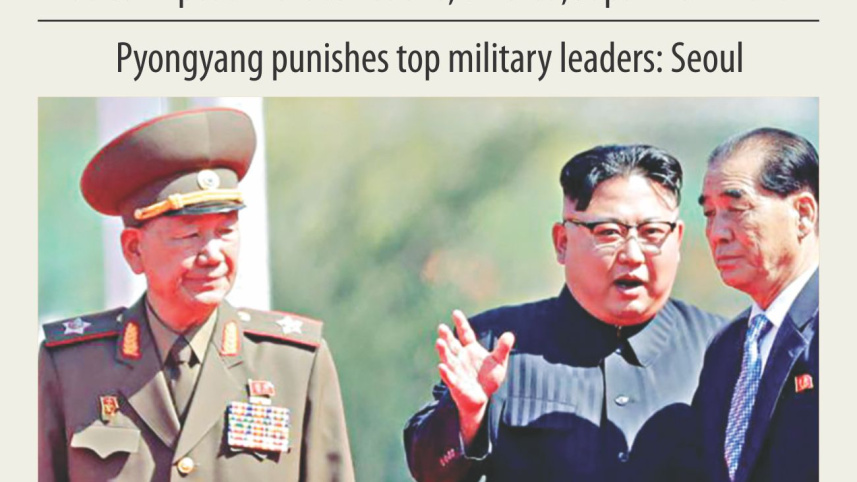
Meanwhile, two key figures in the North Korean military have been punished for "impure behavior," according to a South Korean lawmaker, a move analysts say is likely intended to help leader Kim Jong Un tighten his grip on power.
A closed-door briefing by South Korea's National Intelligence Service (NIS) identified the two officials as Hwang Pyong So, the director of North Korea's General Political Bureau (GPB), and his deputy Kim Won Hong, said South Korean Rep. Kim Byung-kee after the meeting.
It's unclear how exactly how Hwang and his deputy were disciplined, but one analyst told CNN they could have been required to undergo re-education, which is likely to include a period of re-indoctrination of North Korean ideology.
"He's playing musical chairs with key positions," said Andrei Lankov, a professor at Kookmin University in Seoul and the director of NKNews.org. "Kim Jong Un doesn't want anybody in the military to stay in charge for too long ... He's brilliant, cynical, brutal and efficient."
 For all latest news, follow The Daily Star's Google News channel.
Comments