


Military drills ratchet up tensions
♦ Trump warns Pyongyang over nuclear test; praises China's role
♦ US security adviser reaffirms US will pay for THAAD
South Korea and the United States wrapped up their annual large-scale military drills yesterday, but continued a separate joint naval exercise that has triggered dire threats from nuclear-armed North Korea.

Tensions on the Korean peninsula have been running sky-high for weeks, with signs that the North might be preparing a long-range missile launch or a sixth nuclear test -- and with Washington refusing to rule out a military strike in response.
The massive "Foal Eagle" drill, which the defence ministry in Seoul said was ending as scheduled yesterday, involved around 20,000 South Korean and 10,000 US troops.
Another annual joint exercise known as "Key Resolve" ended last month.
Both play out scenarios for a conflict with North Korea, but Seoul and Washington insist they are purely defensive in nature, despite Pyongyang's claims that they are provocative rehearsals for invasion.
Their conclusion normally signals a period of relative calm in North-South tensions, but this year the situation looks set to remain highly volatile.
US President Donald Trump has warned of a possible "major conflict" while Pyongyang has carried out a series of failed missile tests, including one on Saturday, and a massive live-fire military exercise.
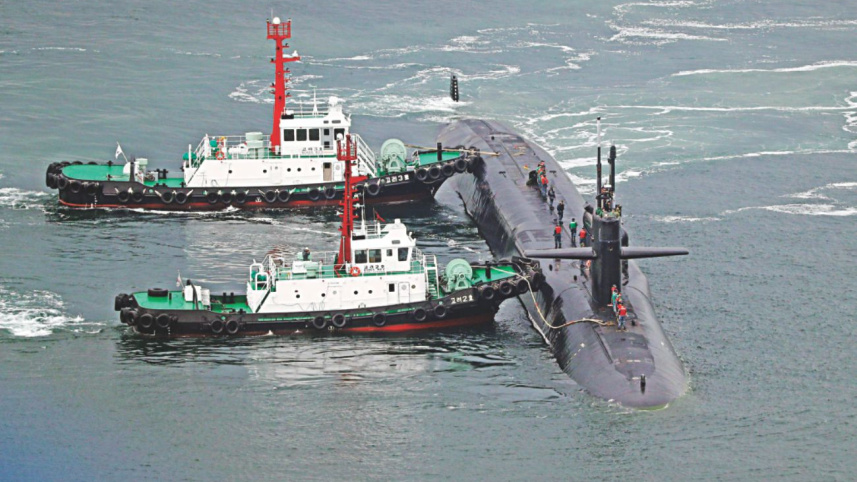
Through state media, North Korea has threatened to attack the Carl Vinson aircraft carrier group, and a state-sponsored website yesterday also warned of a possible strike against a US nuclear-powered submarine despatched to the area.
"The moment the USS Michigan tries to budge even a little, it will be doomed to face the miserable fate of becoming an underwater ghost without being able to come to the surface," the North's propaganda website Urminzokkiri said.
In excerpts of an interview with CBS News released on Saturday, Trump said the United States and China would "not be happy" with a nuclear test but gave no other details. The Chinese leadership will not be happy either, he added.
Asked if "not happy" signified "military action," Trump answered: "I don't know. I mean, we'll see."
Pyongyang's show of defiance included a failed missile test on Saturday that came just hours after US Secretary of State Rex Tillerson warned the UN Security Council of "catastrophic consequences" if the international community -- most notably China -- failed to pressure the North into abandoning its weapons programme.
Military options for dealing with the North were still "on the table", Tillerson said.
The tensions have also triggered some friction between Seoul and Washington, with Trump suggesting in a recent interview that the South should pay for the $1.0-billion dollar THAAD anti-missile system that the US is deploying on its ally's territory.
But on Sunday South Korea said US National Security Adviser HR McMaster had spoken by phone with his counterpart in Seoul and both sides had reaffirmed that Washington would bear the cost of the THAAD deployment, as initially agreed.
Beijing has been infuriated by the THAAD deployment, which it says upsets the regional security balance.
 For all latest news, follow The Daily Star's Google News channel.
Comments