


What is Xi's thinking?
WHAT DOES IT MEAN?
China has a state constitution, which governs how the country is run, but the Communist Party that has ruled the world's most populous nation since 1949 has its own charter for its 89 million members. With Xi's name newly inked in the party constitution, disputes can be crushed and rivals can be parried with a swift look at the rulebook. "It means his authority has been recognised by the entire party," said Chinese political scholar Hu Xingdou. Not only that, but the way Xi thinks will seep through the collective political conscious -- all the way down to the youngest members of society. Officials have plans to cement Xi Thought into hearts and minds across China.

WHAT THOUGHTS, EXACTLY?
Xi sketched the outlines of his philosophy in a mammoth opening address spanning three and a half hours last Wednesday, although he has been incorporating his principles into CCP rhetoric for years.
Broad brushstrokes include banner notions such as a "moderately prosperous society" and the "great rejuvenation of the Chinese nation." "The principal contradiction facing Chinese society in the new era," Xi said in his speech, "is that between unbalanced and inadequate development and the people's ever-growing needs for a better life." Now that dream has been defined as one for the "new era" -- an era with Xi at its helm.
HOW DID IT GO DOWN?
In the highly-choreographed world of Communist Party Congress, Xi's wisdom was tremendously well received. Mentions of "Xi Thought" (the philosophy's state-approved shorthand) echoed through Beijing's Great Hall of the People during the week-long congress. "We have entered the new era of socialism with Chinese characteristics with General Secretary Xi Jinping as the core," Yang Baofeng, a delegate from northeast Heilongjiang province, told AFP yesterday. Li Hualiang, a village party branch secretary in northeast Jilin province, called the ideology a "very great formulation and innovation." "There were absolutely no dissenting opinions. This is normal," he said. "Now our country is unified, cohesive and moving up in the world."
HOW DOES IT STACK UP AGAINST OTHERS?
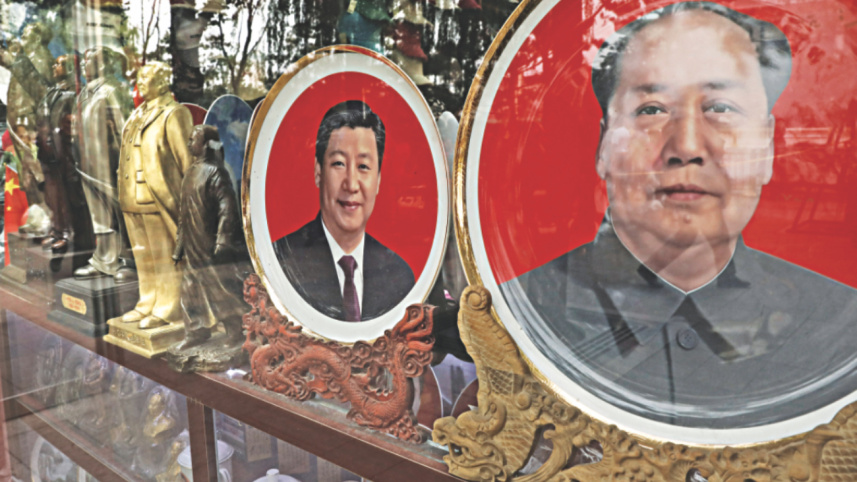
With a title more than double the length of the other constitutionally-approved philosophies -- Marxism-Leninism, Mao Zedong Thought, Deng Xiaoping Theory -- the addition of Xi to the charter solidifies his place as a Chinese leader that history will reckon with. Mao is the only other figure in Chinese history to have been honoured in this way while he was still alive, triggering speculation that Xi will hang onto power well beyond the standard two terms after his second mandate ends in 2022. Xi's predecessors, Jiang Zemin and Hu Jintao, had concepts included in the constitution but without their names, and then only when they shuffled off into retirement -- the Communist Party equivalent of a testimonial football match.
 For all latest news, follow The Daily Star's Google News channel.
Comments