


A warning signal to West?
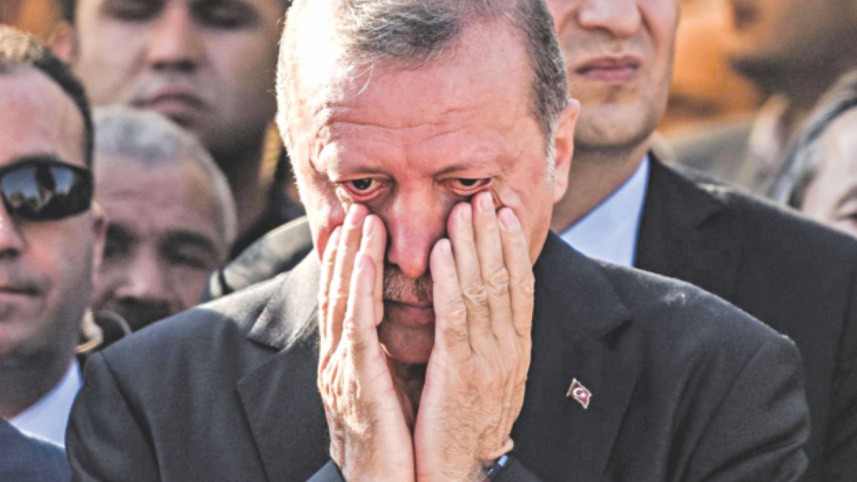
As Turkey's relations with Europe and the United States are strained by the fallout from its failed coup, President Tayyip Erdogan travels to Russia on Tuesday to meet Vladimir Putin in a trip he may hope will give the West pause for thought.
Turkish officials insist Erdogan's visit to St Petersburg is no sign that the Nato member and European Union membership candidate is turning its back on the West.

But the thaw with Moscow, which imposed trade sanctions nine months ago after Turkey downed a Russian fighter jet near the Syrian border, comes as Ankara's relationship with the West could scarcely be more fractious.
Erdogan and many Turks have been incensed by what they see as Western concern over a post-coup crackdown but indifference to the bloody events themselves, in which more than 230 people were killed as rogue soldiers bombed parliament and seized bridges with tanks and helicopters.
The Turkish government has blamed the coup on followers of a cleric in self-imposed exile in the United States, and purged tens of thousands of his suspected followers from positions as teachers, police, judges, soldiers and even the ruling party members. Western countries say the purge has been too fast and indiscriminate.
So damaged are relations that Germany's foreign minister said this week there was no basis for discussions and that "we are talking with each other like emissaries from two different planets."
"For Erdogan, this meeting with Putin is certainly an opportunity to signal to Turkey's partners in the West that it could have other strategic options," said Sinan Ulgen, a former Turkish diplomat and analyst at the Carnegie Europe think tank.
"There is this perception game that Turkey could strategically gravitate towards Russia if the relationship with the West cannot be maintained. There is also an incentive on the side of Russia to use the crisis between Turkey and the West to undermine Nato's cohesiveness," Ulgen said.
But Russia and Turkey are not on the same page on world affairs.
"The meeting between Putin and Erdogan ... will show how far both sides are willing to compromise. The question is whether the current tactical de-escalation can translate into a deeper strategic partnership," he added said.
Closer ties between Ankara and Moscow could be more troublesome for Europe, which sees a plan for a gas pipeline from Russia to Turkey, a project known as TurkStream, as a complication in its efforts to cut dependence on Russian energy.
"Gas cooperation between Russia and Turkey could be scary for the European Union," said Akin Unver, assistant professor of international relations at Kadir Has university in Istanbul and an expert in regional energy.
"The EU wants to diversify suppliers and link eastern Mediterranean gas to Europe in the long run ... if Russia bypasses all that with TurkStream that would not help. But the EU is in no position to bargain. Politically, it is very weak."
 For all latest news, follow The Daily Star's Google News channel.
Comments