


US special forces to target ISIS leaders
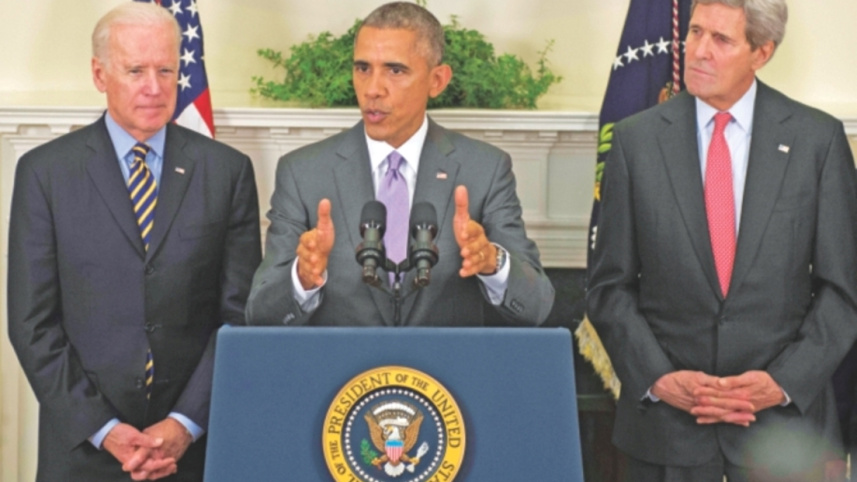
President Barack Obama said he would not flinch from sending US special forces to kill Islamic State leaders, as he called for Congress to authorize military operations that stop short of a full-scale invasion.
Tantamount to a declaration of war, Obama on Wednesday asked lawmakers for formal authority to take the fight to the Islamic State group, beyond their current footholds in Syria and Iraq if necessary.

"Our coalition is on the offensive," Obama said, adding Islamic State is "on the defensive" and is "going to lose."
Since August 2014, the US military -- along with allies -- has been conducting a campaign of air strikes against Islamic State in Iraq and Syria.
Obama has promised to back up the strikes with targeted covert ground-based attacks if necessary.
"If we had actionable intelligence about a gathering of ISIL (Islamic State) leaders, and our partners didn't have the capacity to get them, I would be prepared to order our special forces to take action," Obama said.
"I will not allow these terrorists to have a safe haven."
The request signals a ramping up of pressure on Islamic State as the Iraqi government prepares for a major ground offensive, expected within months.
Obama, however, placed limits on his power to deploy the military in both form and scope.
The proposed legislation does not authorize "enduring offensive ground combat operations," according to a draft sent to Congress.
The authorization would also "terminate three years after the date of the enactment of this joint resolution, unless reauthorized."
Obama will also have to report to Congress every six months.
With bitter arguments over previous wars still seared in US political memory, Obama was quick to make clear this would not be a sequel to Iraq or Afghanistan.
Obama said he had no intention to see the United States getting "dragged back into another prolonged ground war in the Middle East."
Meanwhile, the UN Security Council was to adopt a resolution yesterday aimed at choking off millions of dollars in earnings from oil sales, antiquities trafficking and ransom payments to the terrorist group.
The resolution calls for sanctions against individuals and entities that trade in oil with ISIS and al-Qaeda affiliates such as the Al-Nusra Front in Syria.
The measure urges all 193 countries of UN to take "appropriate steps" to prevent the trade in cultural property from Iraq and Syria and directs the UN cultural agency UNESCO to help put in place a ban.
It also reminds governments worldwide that they must "prevent terrorists from benefiting directly or indirectly from ransom payments or political concessions" to secure the release of hostages.
Drafted under chapter seven of the UN charter, the resolution can be enforced through sanctions or use of force, even though it does not authorize military force.
 For all latest news, follow The Daily Star's Google News channel.
 Meanwhile, Congress scored its most significant legislative achievement of 2015 Wednesday, approving the controversial Keystone XL pipeline to transport Canadian oil to US refineries, though President Barack Obama plans to veto it citing environmental issues.
Comments