


Benjamin Wood From early writing days to ‘Seascraper’ success
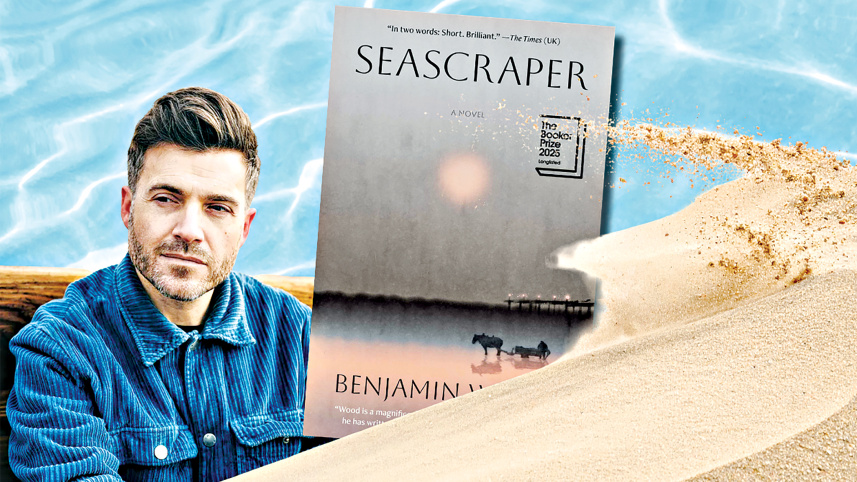
Benjamin Wood’s latest novel Seascraper (Scribner, 2025), longlisted for the Booker Prize in 2025, is a tale of a young shrimp fisher Tom Flett who has an extraordinary expertise about sea and beaches. With a dependent grandmother, he ekes out his living from fishing the shrimps, growing sullen of his difficult life. Apart from Flett, there are more dexterously drawn characters in the novel that organically take place in the story as it unfolds further. However, the most extraordinary feature of Benjamin’s writing is his exquisite Dickensian prose that makes the novel a feast for the readers. Here we speak to Benjamin about his writing and Seascraper.
How did it strike you to write about sea and beaches as a backdrop of your novel? Do you have some personal liking or fascination for the sea and beaches?

I grew up in Southport, a coastal town on the northwest coast of England. Longferry in Seascraper is a fictionalised version of that place, scaled down to suit my authorial purposes, amplified and stylised here and there. But I built it from my personal experiences and memories of the beach and the dismal weather conditions which usually prevail there. The scenes on the beach were, in some ways, the easiest—or perhaps just the most instinctive—aspects of the book to write, because I felt I understood what it felt like to stand there in Thomas’s place. I can conjure up Southport beach in my mind in a blink.
The novel seems to be set in older times, somewhere in the 1950s rural side. What was your deliberation on this?
The novel is actually set in the early 1960s—and there are plenty of factual indicators scattered throughout the book which reveal exactly which year, if the reader wishes to notice them and Google them for clarity. But I didn’t want to date-stamp the story, because I hoped to give the reader the impression that Thomas is stuck in time—i.e. he is still practicing traditional methods of shrimping in an age of mechanisation, and he can see the world moving on around him while he is still rooted to the same old customs and expectations. I wanted the reader to enter the novel’s world uncertain about which period the book’s action is unfolding in, for them to think or assume it is earlier in history than it is, and then for it to pull them into ‘modernity’ along with Thomas.
The idea of separation is enormously intriguing in the novel as it’s been depicted through all major characters; Flett’s mother is long separated from her husband, Flett has to bid adieu to his new friend Edgar, and Edgar is also somewhat in separation from his wife and daughter. How do you look at the idea of such instances of separation and ensuing grief in the novel?
Without going too deeply into the subject here, I have quite a bit of personal experience of parental separation, and of estrangement from parents, to draw from as a writer. With Seascraper, I made a conscious decision to use those experiences to shape the characters’ situations and perspectives as much as possible. It’s probably my most personal novel, in that respect, even though the characters’ life stories are a long throw from my own.
Which character did you find the most difficult to carve out while writing the novel?
Every character in a novel is difficult to carve out, or, at least, to render with sufficient authenticity of voice and experience. I’d say that, in Seascraper, the side characters were the toughest to render–for example, John Rigby the seafood merchant Thomas sells his shrimp to, or the sparky fella who’s a porter at the hotel where Edgar stays–because they don’t have a lot of space to declare their personalities to the reader. And even minor or incidental characters in a novel should make some impression while the spotlight is upon them, or they might as well not be there at all.
It’s a densely written novel in Dickensian style with detailed impeccable prose. How much do you find that this craft is important for fiction writing?
Well, ‘Dickensian’ and ‘impeccable’ are words every writer wants to hear in relation to their work, so thank you very much for saying that. I’ll have to get it printed on a t-shirt! Honestly, I try to make every sentence in a novel as fresh and interesting, as rhythmic and fluent, as concise and particular as I can make it. The music of a writer’s prose is the first thing I care about as a reader, so I try to make mine as tuneful to the ear as possible.
This is an excerpt from the interview. Read the full conversation on The Daily Star and Star Books and Literature’s websites.
Dr Mohammed Farhan teaches English at Jamia Millia Islamia, New Delhi. He often writes on books, and interviews authors for various reputed English dailies including The Hindu, Hindustan Times, and Hindu Business Line, among others.
 For all latest news, follow The Daily Star's Google News channel.
Comments