


Homage to Rani-ma on her centenary year
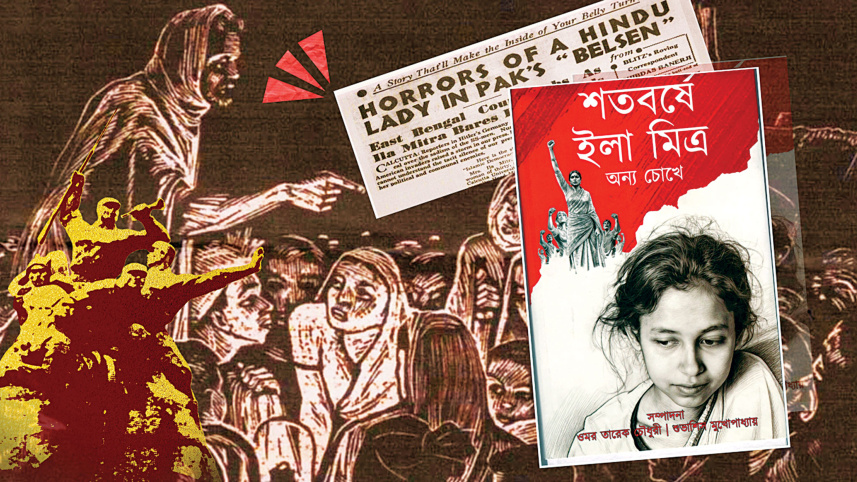
TW: Mention of sexual abuse, rape
Some names act as a spark—for example, Ila Mitra—along with those of Rosa Luxemburg, Pritilata Wadedder, and Matangini Hazra—who is much better known and acclaimed as ‘Nachole-er Rani-ma’ (Queen Mother of Nachole). Inspired by her indomitable communist husband, Romen Mitra, who had been the zamindar of Ramchandrapur in Rajshahi district in East Bengal, Ila Mitra also declassed herself and fought like a tigress leading the impoverished peasants against the landlords and their henchmen. Though the sobriquet ‘Rani-ma’ clung to her, she, in the words of co-editor Subhasis Mukhopadhyay, “could speak Santhali with admirable fluency [...] she simply merged with the landless peasants, Hindus and Muslims, and challenged the landowners as well as the repressive East Pakistani regime armed to the teeth.”
 For all latest news, follow The Daily Star's Google News channel.
 Indeed, the glorious Tebhaga movement, which began in 1946-47 and continued even after Partition, is crystallised in the valour and defiance of Rani-ma. Not a single book nor an essay on the topic forgets to mention her name. Perhaps, the best chronicler of this movement, the leftist icon of East Bengal, Badruddin Umar, emphasised in particular that even after the movement had ebbed somewhat in other districts of East and West Bengal, it continued to glow in Rajshahi, especially in Nachole. In his remarkable essay, “Peasant Uprising Nachole”, which forms the second essay of the book, this indefatigable Leftist wrote, “Tebhaga came to an end in entire Bengal in 1947, but Nachole remained the only exception. Indeed, the region which came under Nachole Police station bristled with persecuted Santhal peasants and they persisted doggedly with their struggle from 1948 to 1950; that was the new phase.” And who led the uprising? Of course Rani-ma and her husband, along with others like Azhar Hosain, Shuku Koramudi, and Brindaban Saha.
What is so exemplary about this book is its meticulous documentation. In the fourth chapter, for instance, co-editor Omar Tareq Chaudhuri has compiled newspaper reports on this subject which were published from 1950 to 1955 in the two Bengals and even beyond. In 28 pages, he has provided the complete history based on news coverage, and, as we read, our eyes remain fixated on the report filed by Shibdas Bannerji, the roving correspondent of Blitz, which carried the heading “East Bengal Court sobs as Ila Mitra bares her wounds”. Bannerji wrote, “When Ms. Ila Mitra was asked by the Court to give her statement, she narrated a story which made the aged pleaders, Muslims and Hindus, weep. They hung their heads down in shame and heard Ila in rapt and sorrowful silence”.
Though those present in the courtroom sobbed, Ila Mitra, herself, when she recalled her revolt after many years, said “I, in my humble way, tried to play my part, for which I have nothing unusual to speak of. Time generally helps a person to take up a role. For me, the time that I passed through has left its indelible marks, may be majestic, or heroic, or cowardly. For peace in this country, I look for a signal from my star.”. I wonder how she could attain this amazing grace after the horrendous torture inflicted on her at Nachole Police Station when she was arrested, which included multiple rapes and finally pushing up four redhot boiled eggs through her vaginal passage.
As a student of literature, who had delved into the subject of gender and Partition in the East, I emphasise: the creative articulation of Tebhaga is, by no means, insignificant. I recall Manik Bandyopadhyay’s incredible short story “Haraner Natjamai” that had been converted into a gripping play by one of our great thespians, Arun Mukhopadhyay; Selina Hossain’s dedicated political novel Kantatare Projapati as well as Maleka Begum’s excellent biography; Saukat Ali’s novel Narail, which ended with a Muslim and Hindu peasant joining hands and advancing to fight for Tebhaga; and, above all, Akhtaruzzaman Elias’s masterpiece Khwabnama, which posited Tebhaga as the redemptive counterpart or utopia to the disjunctive dystopia of the Partition. These texts, literally, incited me like the poem on Rani-ma by the famous communist poet, Gholam Quddus, who hailed her as ‘Stalin-nandini’ and also the intense though raw and rough sketches of Somnath Hore which were included in his Tebhaga Diary.
In fact, I was waiting for the documentation to serve as a basis for the creative expression I have outlined above, and that is what I have acquired in this book. It includes almost everything—questions and answers on Ila Mitra as well as discussions held in the Indian parliament; statements which Ila Mitra made in the West Bengal Assembly as an MLA of the Communist Party of India; fervent recollections penned by Pravash Chaudhuri Lahiri, Anisuzzaman, Mahbubul Alam Chaudhury, and Satyen Sen. Equally moving are the memories of her son Mohan Mitra in two separate chapters, one titled “Amar Ma” and the other recalling the indispensable connection between her mother and the peasant uprising in Nachole, in an intimate interview. The last lines of this dialogue are memorable, even educative: “She didn’t indulge in intricate theorising on whether the revolution should be ‘national democratic’ or ‘people’s democratic.’ Nonetheless, she was a brilliant orator.”
Somehow, I feel that Bangladesh, where she fought, remembers her more vividly than West Bengal. In 2005, the well-known Bangladeshi, director, Syed Ahiduzzaman Diamond, made a film on her titled Nachole Rani and in as late as 2025, Zakir Hossain paid homage to her in his short story titled “Akhono Ila Mitre-r Naame Choto Golpo”. A museum dedicated to her was inaugurated on February 17, 2024, in Nachole itself.
Subhoranjan Dasgupta is an academic and author of several books in English and Bengali, based in Kolkata.
Comments