


Little Grey

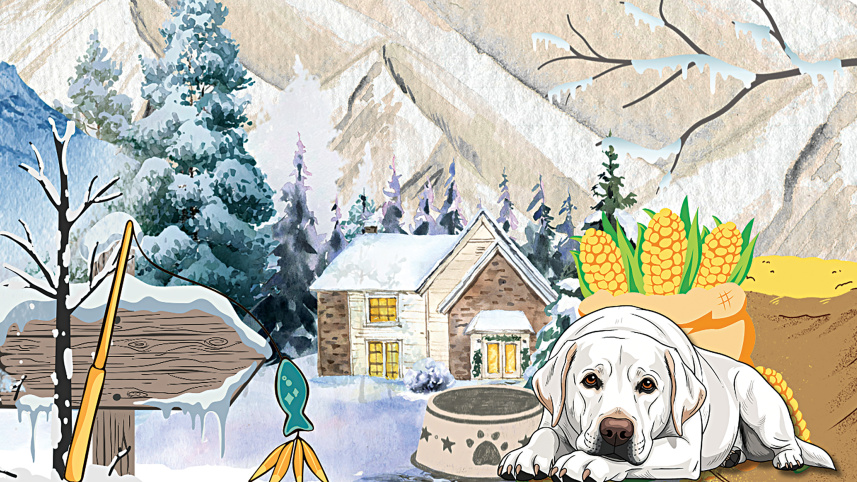
It is a winter day in a small town at the far eastern edge of the Himalaya, in the Chinese province of Yunnan. The province is known for its mild climate. Though snowy days are not uncommon, especially in January, if they do occur they are few. Some years go by without any snow reaching the ground at all. On this January day, temperatures are low, but not low enough for snow. It is cold, if one asks the people living here, or cool, if one were to ask people accustomed to harsher climates.
Xiaohui is in his usual place: the corner of the inner courtyard of a walled compound that includes a three-story house and a few sheds. To his left, there is the big gate that separates the courtyard from a small alley. The alley leads to the main road, where buses on their way to Qujing pass a few times a day. Qujing is home to more people than dozens of countries, and yet in China it is not a very big city. The most imposing part of the whole compound is the gate through which one enters. Its sheer size alone makes it an impressive structure. It is covered in gold-coloured ornaments in the forms of dragons, large Chinese letters, and elaborate patterns. The pillars that carry the gate are red and golden and have wishes for prosperity and wealth written on them in red letters. No practical purpose is served by a gate this large and extravagant. If one was a burglar, one would simply climb one of the walls that extend from its sides and are noticeably lower. The gate was not chosen for reasons of security. It is the most visible feature from the vantage point of passersby, and what others think is important. After all, this small town is not so much a town as it is a village, and certain village norms are universal.

To Xiaohui’s right, there is an open shed with a corrugated metal roof. The shed stores corn. Some of the corn is packed in red mesh bags, the rest is piled up loosely, waiting to be bagged, or fed to the animals of the household. Across the courtyard, a lone water buffalo rests on dried corn stalks and husks in an enclosure behind yet another wall. Entertainment is provided by geese and chicken who share the same space. The far end of the enclosure is formed by the wall of another shed, which houses two or three pigs. From time to time, their snouts can be seen peeking through the shed’s little windows. Carefully laid out to dry on the concrete floor of the courtyard, there are different kinds of chilli peppers. One batch is green, two dark red, two earthy yellow, and several batches are red. While food in Yunnan may not match the fiery intensity of the famed Sichuan cuisine, spice is a vital element of the local culinary identity.
Xiaohui is sitting on the concrete floor. He has been in this corner for as long as he can remember clearly. For some time, he had memories of another place, and of playing with his siblings, chasing them around tea bushes with their distinct sweet aroma that was most prominent in the early morning. These memories have since dissolved into a distant blur. It has been eight years perhaps, more likely 10. His fur is grey in colour, and it is rugged and unkempt, like an old hairy carpet. The elements have done quite a bit of damage over the years. The colour, however, is neither a sign of time, nor of exposure to the forces of nature. Xiaohui has always been grey. In fact, that is how he got his name. In Chinese characters, the first character of his name means “little” and the second “grey” words that describe Xiaohui rather bluntly. Xiaohui himself prefers to think of his name as “little wisdom”, in Pinyin the transliteration of the characters becomes “Xiaohui,” and he carries it with a certain sense of pride. Though he has not seen much of the village, let alone the world, every day he watches the people passing through the gate and coming in and out of the house, and he rightly believes that this has allowed him to achieve some degree of wisdom. Observing people’s actions tells you more about humans, and humanity, than listening to their words. It does not matter much that Xiaohui only understands fragments of their language.
At this moment, Xiaohui is watching a small boy in a winter jacket. The boy is holding a toy truck in his hands. He seems excited. He just got the truck from the oldest daughter of the house, his mother’s cousin. She is visiting from Kunming, the capital and only “big city” of Yunnan. Kunming has a population larger than Sydney’s, yet–like many big cities in China, and unlike Sydney–it is mostly unheard of in other parts of the world. The boy is inspecting his new acquisition. He has figured out some of its functions already. Others are still a mystery. How can he extend the truck’s loading ramp so that he can drive one of his other toy cars onto it? He has curated quite a collection, by specifically asking for a different kind of car whenever a relative comes to visit. The boy is one of rural China’s tens of millions of “left-behind children,” as they are called in Chinese. His parents have gone to a faraway city to work in a factory, leaving him in the care of his grandmother and extended family who remain in the village. It is one of the costs of the country’s rapid economic rise.
The boy’s grandmother is somewhere around the compound as well, busy like everyone in the village at this time of the year. A flurry of preparations has been underway for days now. The household is preparing for the upcoming Spring Festival, which marks the beginning of a new year on the traditional Chinese calendar and is China’s most important holiday. It is tradition that families come together during this time. Hundreds of millions of people travel to their hometowns to celebrate, making this the largest annual human migration in the world. The Spring Festival is still a few weeks away, but the elder daughter and her sister, the only other sibling, have come home early to help with the preparations. Custom demands that the house be cleaned thoroughly, to clear away any bad luck and make room for the good things the New Year may bring. Xiaohui is amused to see the sister cleaning the window bars on the ground floor with much fervour. The courtyard is his territory and he knows it better than anybody else. He knows that the bars will again be covered by the dust that lies in a thin layer on top of the concrete before the Year of the Dragon comes to an end. All it takes is a small gust of wind. Two red lanterns are installed on each side of the main door, as is custom too. Below the lanterns, banners are being affixed to the wall with red tape. They contain wishes for the New Year, the Year of the Snake, similar to the ones on the pillars of the gate. People here want what all people want: health, money, and generally a good life.
Xiaohui watches the cheerful bustle. His role in the household is simple: make noise if a stranger approaches the gate. He is getting old and cannot see very well anymore, but he can still count on his nose to distinguish between people he knows and strangers. The day before, an unfamiliar smell had alerted him to a newcomer who arrived with the two sisters. He did his duty. It should have become obvious quickly that the newcomer was a guest rather than a threat, but he kept making noise, as if to convince himself and the universe that he is still useful. The guest was brought to the kitchen across the courtyard. Food was served: rice, tofu, vegetables. Xiaohui watched the guest through the open door of the kitchen and noticed the focused strain on his face as he used chopsticks to clumsily navigate pieces of tofu and vegetable from the bowl to his mouth. He must have come from far.
When Xiaohui first got here, he would have tried to walk over to have a closer look at the newcomer, but now he just sits and observes from a distance. He understands the restrictions imposed by the chain connecting his collar to a short metal pole set into the ground. It allows him to make it about halfway across the courtyard. These days, he rarely leaves his corner. Looking at Xiaohui from the outside, one may be tempted to think of him as having resigned to his fate. He himself likes to think that he has merely gotten used to his circumstances. The chain has become his companion, in fact, and he can no longer imagine life without its faithful presence. The same holds true for the gate, the corn, the concrete floor. Calling Xiaohui happy would go too far, but for the most part, he is content.
This is the first of two parts of the short story “Little Grey.”
Dr Rainer Ebert holds a PhD in philosophy from Rice University in Texas and is a research fellow in the Department of Philosophy, Practical and Systematic Theology at the University of South Africa. He has been visiting Bangladesh regularly for years. Reach him at rainerebert.com and on X @rainer_ebert.
 For all latest news, follow The Daily Star's Google News channel.
Comments