


‘No Eid at home’: Farmers lament low paddy prices in Rangpur

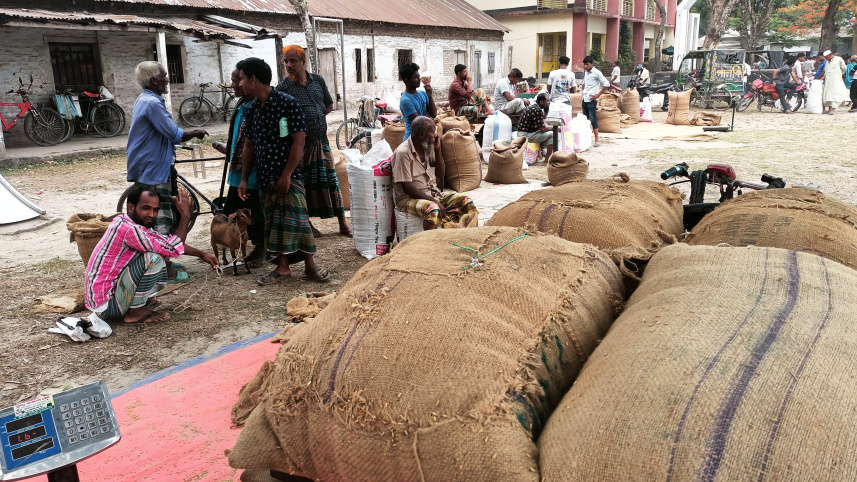
Farmer Monsur Ali, 65, became deeply frustrated after waiting for hours to sell his paddy at Durakuti Haat in Lalmonirhat.
He brought eight maunds of paddy to the market, hoping to sell it at Tk 1,000 to Tk 1,050 per maund. However, after waiting nearly two hours, he had to sell it at only Tk 810 per maund as buyers were unwilling to pay his expected price.

Monsur said he cultivated Boro paddy on 10 bighas of land this year. He has already harvested paddy from seven bighas and achieved a yield of 22 maunds per bigha.
“This year I got nearly one maund more paddy per bigha. My heart fills with happiness seeing the crop in the field, but in the market there is only disappointment because of low prices,” he said.
At the same time last year, he sold paddy at Tk 1,050 per maund.
A similar situation was described by farmer Nabin Chandra Barman, 60, from Shalmara village in Aditmari upazila. He said he had to sell paddy at only Tk 800 to Tk 850 per maund.
“Last year I sold paddy at Tk 1,050 per maund. This year production costs have increased, yet prices have fallen. Had I known this earlier, I would not have brought my paddy to the market,” he said.
Nabin Chandra cultivated Boro paddy on 16 bighas of land this year. According to his calculations, the production cost per maund was around Tk 950. But the current market price is only Tk 800 to Tk 850, meaning even labour costs are not being recovered.
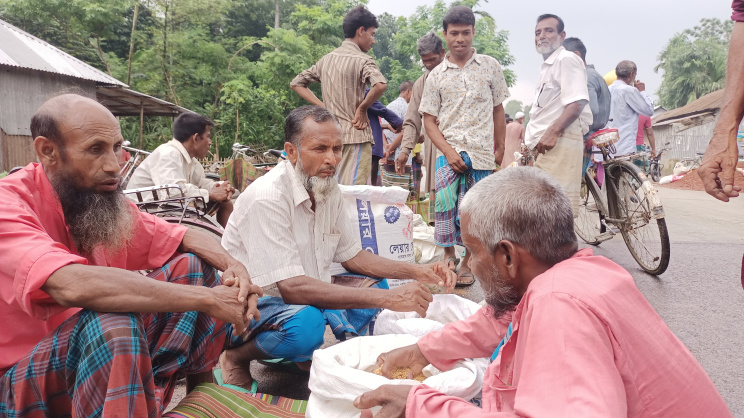
Farmer Atoar Rahman, 55, from Gopinathpur village in Rangpur Sadar, said he cultivated paddy on 20 bighas of land and has already harvested paddy from 15 bighas, while five bighas still remain in the field. He achieved a yield of 20 maunds per bigha. Due to urgent family expenses, he sold 30 maunds of paddy at Tk 800 per maund.
“Seeing the crop in the field gives us hope, but that hope breaks apart once we reach the market. It cost Tk 920 to produce one maund of paddy, but it is selling for only Tk 800. If this continues, cultivating paddy in the future will become extremely difficult,” he said.
Kabir Mahmud, 70, from Singardabari area of Rajarhat upazila in Kurigram, said, “Although the harvest is good, we become disappointed in the market. Production cost is nearly Tk 950, yet we are forced to sell at Tk 800. Our situation now is ‘happiness in the field, disappointment in the market’.”
Mizanur Rahman, 55, from Naodanga village in Phulbari upazila of Kurigram, said selling one maund of paddy was not enough even to buy one kilogramme of meat.
“I am losing interest in cultivating paddy in the future,” he said.
Akkel Ali, 65, from Chowdhurani village in Pirgachha upazila of Rangpur, said he incurred losses from paddy cultivation this year.
“There is no Eid in our homes this year. We are not getting fair prices for our crops, and because of that we are all deeply upset.”
According to the Department of Agricultural Extension (DAE), Boro paddy has been cultivated on 683,795 hectares of land across Rangpur division’s eight districts -- Lalmonirhat, Kurigram, Rangpur, Gaibandha, Dinajpur, Panchagarh, Nilphamari and Thakurgaon -- this season.
The production target has been set at 41 lakh tonnes of paddy.
Rangpur Divisional Food Department said the government plans to procure 71,483 tonnes of Boro paddy directly from farmers and 246,246 tonnes of rice from millers this year.
Paddy wholesaler Soleman Ali from Lalmonirhat said, “There is still old stock in our warehouses. We are buying paddy from local markets, but in smaller quantities. Once the old stock finishes, I will start purchasing paddy fully. However, other wholesalers are still buying paddy.”
Another wholesaler, Sunil Chandra Sen from Rangpur said he was also a farmer and deeply disappointed by the low price of paddy.
 For all latest news, follow The Daily Star's Google News channel.
“Our warehouses still have old stock. Until those stocks are cleared, storing new paddy is difficult. That is why we are buying at lower prices,” he said.
Javed Hossain, a mill owner in Rangpur said, “We have received rice allocation, but the government has not yet started purchasing rice from us. Once procurement begins, we will start buying paddy from the market, and prices will rise.”
“At the moment I am buying only limited quantities because there is still old stock in the warehouse. This year the maximum market price of paddy may reach Tk 950, whereas last year it was Tk 1,050,” he said.
Additional Director of Rangpur Regional Agricultural Extension Department Sirajul Islam said there had been bumper paddy production this year.
“The government is purchasing paddy directly from farmers, but the volume is very limited. As a result, individual farmers cannot sell as much paddy as they want directly to government warehouses,” he said.
He said around 65 percent of paddy in the Rangpur region has already been harvested and all harvesting will likely be completed within the next two weeks.
“Farmers who urgently need cash are being forced to sell paddy at lower prices. Since prices are lower this year compared to last year, many farmers may lose interest in cultivating paddy in the future. Production costs have also increased compared to last year,” he added.
Rangpur Divisional Food Controller Zahirul Islam said the government procurement price for paddy has been fixed at Tk 36 per kilogramme this year.
Government procurement is currently ongoing based on lists prepared by agricultural offices, he said.
“However, the government is accepting drier paddy than what is available in the open market. Rice procurement from millers will begin within a short time. There is no opportunity to procure paddy from anyone outside the list provided by agricultural offices. I am properly monitoring paddy procurement from farmers at government warehouses,” he said.
Comments