


Rain-fuelled fruit fly attacks devastate Fazli mango harvest in Chapainawabganj

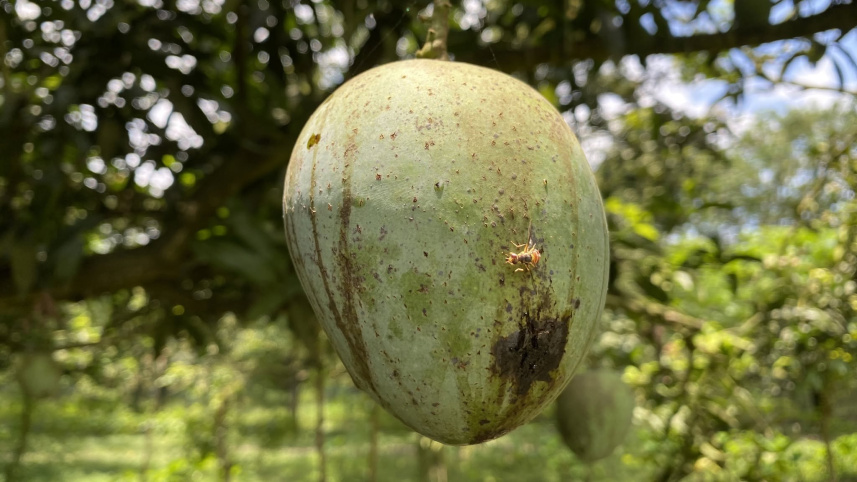
As the harvest of Chapainawabganj’s iconic Fazli mango reaches its peak, growers are facing an unexpected setback. Prolonged rainfall in recent days has led to a sharp rise in fruit fly infestations, causing large quantities of mangoes to rot on the trees and fall across orchards, resulting in significant financial losses for farmers.
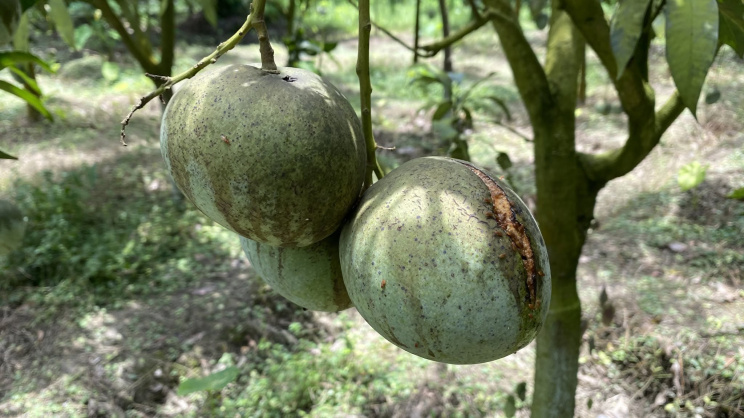
At a sprawling 100-bigha Fazli orchard near Ghorastand in Chapainawabganj Sadar, workers were busy harvesting mangoes. Beneath the trees, however, hundreds of damaged mangoes lay rotting on the ground. Most of the harvested fruits also bore dark blemishes, making the mangoes unfit for the market.

Abdul Awal, who leased the orchard, said the marks were caused by fruit flies that had multiplied rapidly following continuous rainfall.
“The flies sit on the mangoes and puncture the skin. Rot develops in those spots, and eventually the fruits become unsellable,” he said, adding that most of the mangoes in the orchard had been affected.
Awal had expected to harvest around 40,000 kg Fazli mangoes from the orchard. Instead, he managed to collect only about 8,000 kg of good-quality fruit.
“Fazli is now selling for Tk 2,500 to Tk 3,000 per 40 kg. I leased this orchard for two years at Tk 16.5 lakh. After deducting all expenses, I may earn only around Tk 4 lakh this year. That’s a huge loss for us,” he said. The orchard has around 150 mango trees.
Md Shofikul, a mango farmer from Ramchandrapur area of Chapainawabganj Sadar, said this was his first year leasing an orchard.
“I never imagined I would face such losses. The fruit flies appeared after the rains and damaged a large number of mangoes,” he said.
The problem, however, is not limited to Fazli mangoes.
Ahsan Habib, an orchard owner from Kalipur area under Shibganj municipality, said fruit fly infestation affects almost all late-season mango varieties after June.
“It is not just Fazli. All varieties that mature after June are vulnerable once the rains begin,” he said.
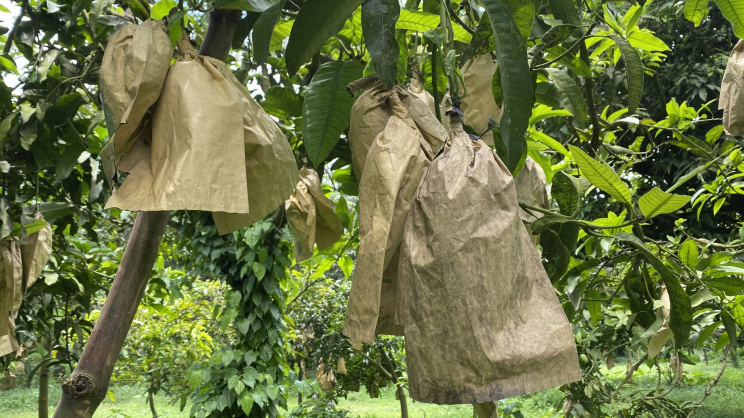
Habib had expected around 20,000 kg mangoes from his orchard. Although bagging helped save many fruits, he still lost about 15 percent of his production to fruit fly attacks.
“These damaged mangoes cannot be taken to the market,” he said.
The impact of the infestation is also visible at Kansat Mango Market, one of the country’s largest mango trading hubs, where different grades of Fazli mangoes are currently selling for Tk 2,500 to Tk 4,000 per 40 kg.
Mohammad Monsur, another mango farmer, said late-season varieties suffer the most every year.
“Fazli, Ashwina and Bari-4 mangoes are among the varieties that are heavily damaged by fruit flies during this period,” he said.
He added that bagged mangoes remain comparatively safer from insect attacks, look more attractive and fetch higher prices in the market.
Md Abdul Halim, additional deputy director (Crops) of the Department of Agricultural Extension (DAE) in Chapainawabganj, said fruit fly attacks occur every year during this period, although the department has not received many complaints this season.
According to him, expanding bagging practices is the most effective long-term solution.
 For all latest news, follow The Daily Star's Google News channel.
 “Bagging is the future. Gradually, more growers will have to adopt it. It protects mangoes from insect attacks and also improves their appearance,” he said.
He also recommended the use of pheromone traps, which attract and trap male fruit flies, reducing their breeding and ultimately lowering infestation.
According to the DAE, mangoes have been cultivated on 37,487 hectares of land in Chapainawabganj this year. The district has set a production target of 458,000 tonnes, with an estimated market value of around Tk 5,000 crore.
Comments