


Budget reflects BNP’s key election promises


In its first budget in two decades, the BNP government yesterday boosted allocations for education and health and significantly expanded social safety programmes, reflecting its key electoral pledges.
However, its pledges to prioritise other sectors and issues such as agriculture, wealth tax, solar energy, and a bullet rail network were not reflected in the budget.
 For all latest news, follow The Daily Star's Google News channel.
 In yesterday’s proposed budget, Finance Minister Amir Khasru Mahmud Chowdhury raised the education allocation from 1.39 percent of the GDP to 2 percent.
The party had pledged to modernise the country’s education and gradually increase public spending in the sector to 5 percent of the GDP.
While the 0.61 percentage point raise is a step forward, it remains a modest gain, signalling that the ruling party will need to make significantly larger annual strides to fulfil its election pledge.
However, its pledge to modernise education was reflected in the budget through plans to launch free school uniforms, shoes and bags for underprivileged students; specialised learning materials for children with special needs; a nationwide school mid-day meal programme; free Wi-Fi to support AI- and technology-driven education; and a “One Teacher, One Tab” programme to facilitate digital integration in classrooms.
It also rolled out a plan to involve highly educated non-resident Bangladeshis in the local education and research ecosystem to turn “Brain Drain” into “Brain Circulation”
Similarly, BNP also promised voters that they would raise health spending to at least 5 percent of GDP.
Health spending currently hovers at 0.58 percent of the GDP, and the budget yesterday doubled it to 1.01 percent, leaving huge grounds to cover during the remainder of the government’s 4-year-term.
The extra cash will be spent on establishing universal healthcare, with every citizen getting a “Health Card”, linked to a centralised patient management system accessible to all healthcare facilities. In addition, the budget reflects the electoral pledges to establish a primary healthcare unit in every union, turn district hospitals into specialised hospitals, ensure full maternal and neonatal care at the upazila level, and create a national ambulance pool and emergency service network.
Left out of the budget are pledges for public-private partnerships to ensure affordable treatment for costly and life-threatening conditions, and commitments to revamp the vaccine supply network.
BNP had pledged to give special attention to the agriculture sector, but it did not appear on the finance minister’s list of priority areas.
Agriculture’s share of the budget has fallen to 5 percent, the lowest in at least a decade. The proposed allocation for the sector stands at Tk 46,821 crore, up Tk 1,032 crore from FY26. However, as the national budget expands 19 percent to Tk 9.38 lakh crore, agriculture’s share has declined.
A review of the proposed initiatives suggests that, rather than targeted industry growth, farmers and fishers will largely be supported through social safety nets, including farmer cards and the inclusion of 15 lakh fisher households in the Vulnerable Group Feeding programme.
For farmer cards and a wider farmer protection system, the proposed budget has initially allocated Tk 1,062.50 crore. A total of Tk 1,567 crore has been allocated to waive loans of up to Tk 10,000 in the crop, fisheries, and livestock sectors.
BNP has also overlooked its election promise of establishing Agricultural Product Production, Preservation and Export Zones in the northern region.
In line with its flagship campaign promises on social welfare, the government increased social security spending by 14 percent. This expansion increases most existing allowances while introducing several new support schemes.
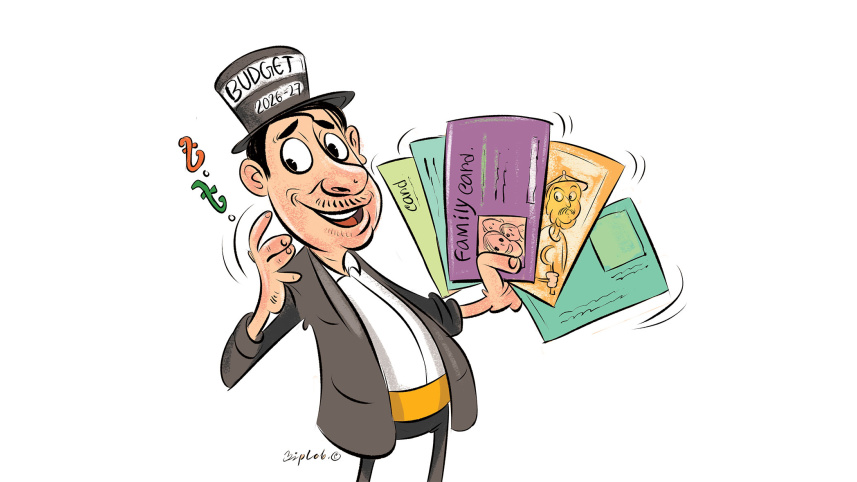
This includes family cards for 41 lakh families costing the government Tk 14,500 crore this fiscal year. This ambitious and costly welfare scheme still represents only a fraction of the 19.2 percent of the population living below the poverty line, leaving the government with large gaps to fill to fulfil its 2030 pledge.
While social safety spending ballooned, the newly announced tax regime does not introduce any measures to uphold its electoral pledge to “tax the wealthy and feed the poor”. No wealth tax was introduced, and the wealth surcharge rates remained the same.
While the party pledged ambitious solar energy goals by 2030, the budget did not set any production targets for the grid. Instead, it focused on enhancement of existing programmes and exploratory assessments for future ones.
BNP’s election manifesto also promised a high-speed bullet rail network that will connect Dhaka with major regional cities within one hour. The budget proposed a more realistic plan of constructing a chord line on the Dhaka-Cumilla section of the Dhaka-Chattogram railway corridor, reducing travel time between Dhaka and the port city to three hours.
The budget also reflected its pledge to facilitate micro-entrepreneurship and promote the creative economy. An initial allocation of Tk 300 crore has been proposed for the development of the creative economy sector, and another Tk 500 crore fund will be collected from Bangladesh Bank’s CSR sector. In ICT, BNP allocated Tk 500 crore for 200,000 IT jobs in IT-related areas and another 800,000 through freelancing and content creation.
Comments