


Relief for low-income groups, businesses

The proposed budget offers modest relief to low-income groups, while businesses and domestic industries can breathe easier as they have been spared major tax hikes.
Although high-income individuals are not facing any immediate rise in personal income tax, the middle-income segment is likely to bear a greater share of the fiscal burden.

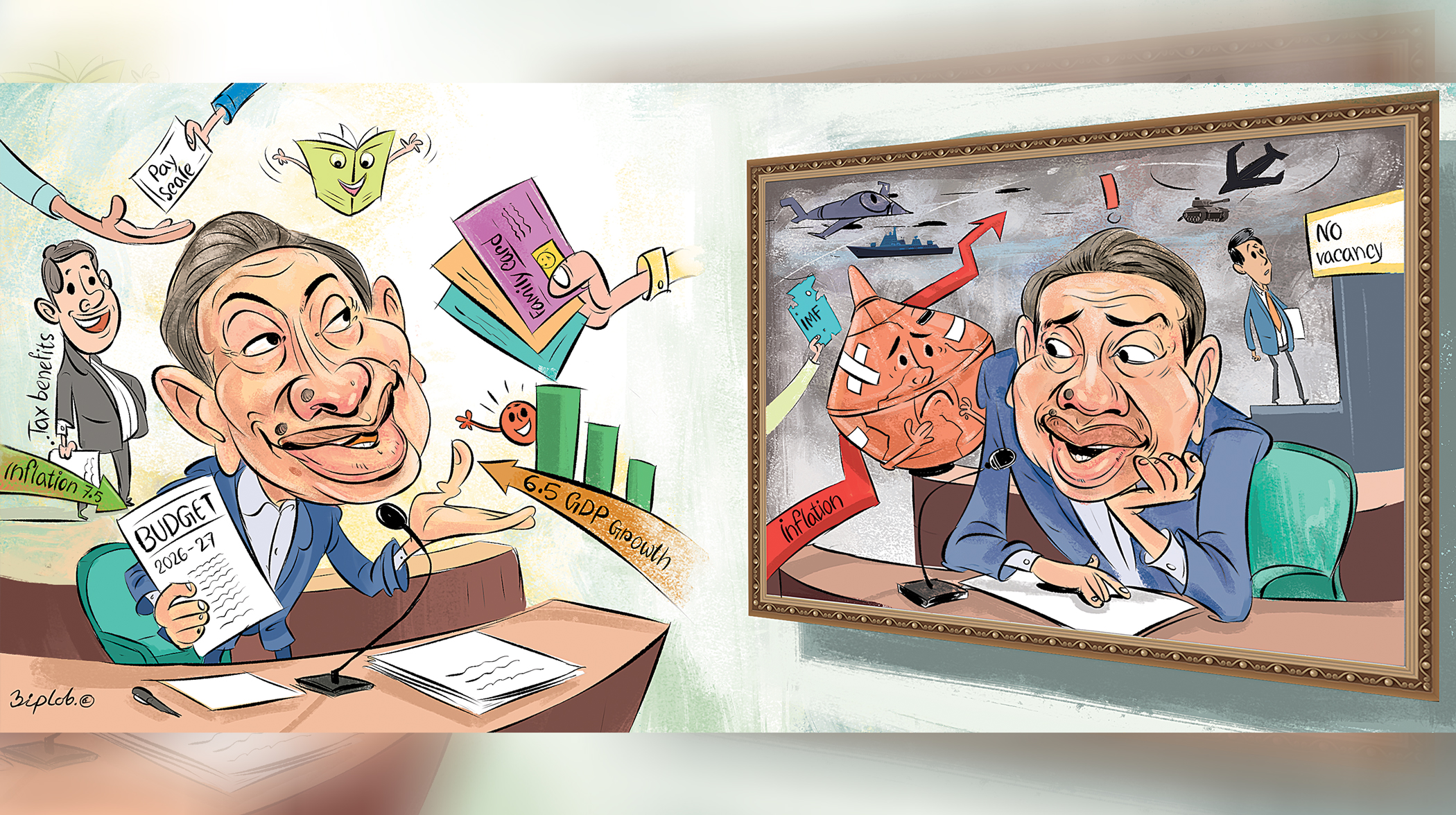
Meanwhile, holders of black money have been given an opportunity to legalise undisclosed income through property transactions without scrutiny of the funds’ origin.
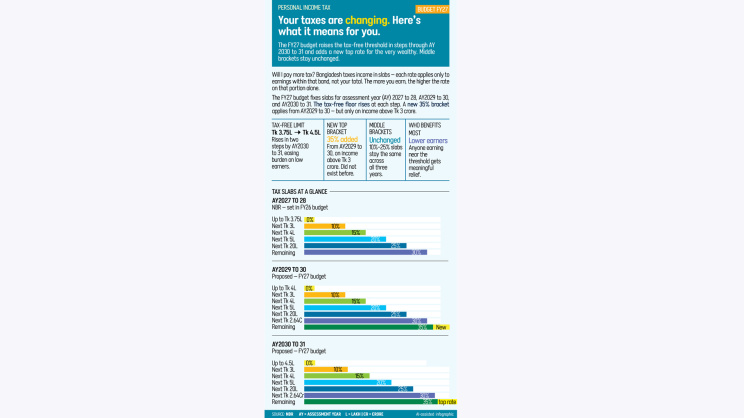
The tax-free income threshold has been raised to Tk 3.75 lakh in line with the previous interim administration’s prospective tax regime.
At the same time, the tax rate on the first taxable slab has been doubled to 10 percent from 5 percent. However, the minimum tax of Tk 3,000-5,000 remains unchanged.
In effect, the higher threshold offers relief to lower-income taxpayers, but the steeper entry-level rate shifts part of the burden onto middle-income earners, particularly those whose incomes are marginally above the exemption threshold.
WIDENING THE TAX NET
The government has announced several compulsory compliance measures to widen the tax net, with a particular focus on salaried individuals and small traders.
From the next fiscal year, a Taxpayer Identification Number (TIN) certificate will be mandatory for opening a bank account, while VAT registration and possession of a Business Identification Number will be mandatory for opening a business account at any bank.
The NBR’s database will be linked with the National Identity Card database, banks, utility service providers, and sub-registry offices. A new Withholder’s Identification Number has been introduced to strengthen the withholding tax system (tax deducted at source). TIN will also be mandatory for registering motorcycles with engine capacities of 150cc and above.
To bring small retailers under the formal tax net, the budget proposes Advance Income Tax at 0.20 percent on goods supplied to retailers, equivalent to Tk 2 per Tk 1,000 of goods.
Economists and business leaders warn that many small retailers may be unable or unwilling to claim tax adjustments, and could instead pass the additional cost on to consumers.
The budget also proposes changes to the taxation of savings certificate income.
Currently, tax deducted at source on savings certificate profits is treated as the final liability. But under the proposed system, the deduction will be treated as advance tax, and the interest income will be added to the taxpayer’s total income and taxed at the applicable slab rate.
Holders of savings certificates worth up to Tk 10 lakh currently pay 5 percent withholding tax, which may increase to 10 percent or above.
BOOST FOR DIGITAL ECONOMY, GREEN SECTOR
Income of freelancers and content creators across all categories will be fully exempt from tax.
Start-ups and tech-driven businesses will benefit from a zero percent turnover tax, while SME entrepreneurs will enjoy tax-free turnover thresholds of Tk 50 lakh, rising to Tk 70 lakh for women and persons with disabilities.
Importers of renewable energy equipment appear to be one of the biggest beneficiaries in the proposed budget.
 For all latest news, follow The Daily Star's Google News channel.
 Import duty and other taxes could be waived or reduced on solar inverters, lithium-ion batteries, battery pack housing, solar photovoltaic modules, and steel and aluminium mounting structures.
Corporate tax rates will be frozen to provide “policy continuity and certainty to investors.”
Moreover, withholding tax rates on 60 essential commodities, including rice, wheat, potato, edible oil, and sugar, have been reduced to a uniform 0.5 percent from rates of up to 5 percent.
BLACK MONEY
A provision has been proposed for allowing taxpayers to legalise undisclosed income through property transactions.
The measure will enable buyers and sellers of land, buildings, and apartments to declare previously undisclosed funds. This will apply where the actual purchase or sale prices of land, buildings, or apartments exceed the value declared in official documents -- a common practice in Bangladesh’s real estate market.
Individuals will be able to regularise the undisclosed portion of a property transaction by paying income tax at the applicable rate for individual taxpayers.
As per the proposal, no authority will be allowed to question or initiate proceedings on such income if the taxpayer voluntarily discloses it and pays the required tax, notwithstanding any provisions of the Income Tax Act or other applicable laws.
However, if tax authorities have already initiated proceedings over such transactions, the taxpayer will have to pay an additional 20 percent on top of the applicable tax on the excess amount, officials said.
The facility will not be available to individuals already convicted by a court over such matters.
REVENUE SOURCES
The NBR’s revenue target for fiscal 2026-27 has been set at Tk 6.04 lakh crore, against a revised target of Tk 5.54 lakh crore for fiscal 2025-26, which is likely to be missed.
NBR officials said capital gains tax, increased collection from land developers and the scope to legalise undeclared incomes will generate significant revenue.
“There are very few significant tax measures that would substantially increase revenue collection in the coming fiscal year,” said Snehasish Barua, managing director of SMAC Advisory Services.
“The source of the projected additional revenue remains unclear,” he noted.
Barua warned that the compliance push may put pressure on small and marginal taxpayers if wealthier individuals and businesses outside the tax net are not brought under the system.
“The government will not be able to generate substantial revenue unless it can bring individuals with undisclosed income and assets into the tax net,” he said, adding that personal tax slabs should be adjusted for inflation to prevent undue pressure on taxpayers.
Md Deen Islam, a professor of economics at Dhaka University, said the government appears to have deliberately avoided measures that could provoke public backlash.
“The strategy seems to centre on widening the tax base rather than imposing additional tax burdens,” he said.
Bangladesh’s overall revenue-to-GDP ratio stands at around 8 percent against a target of more than 10 percent for fiscal 2026-27. “The key question is how the government intends to achieve such a significant increase without introducing major new taxes or raising existing rates.”
He argued that selective incentives for productive sectors, combined with stronger compliance, could raise revenue collection.
“The real challenge is implementation. The scope for raising revenue exists, but whether the government can effectively bring eligible taxpayers into the system remains the biggest question,” he added.
Comments