


A desperate bid to offset losses

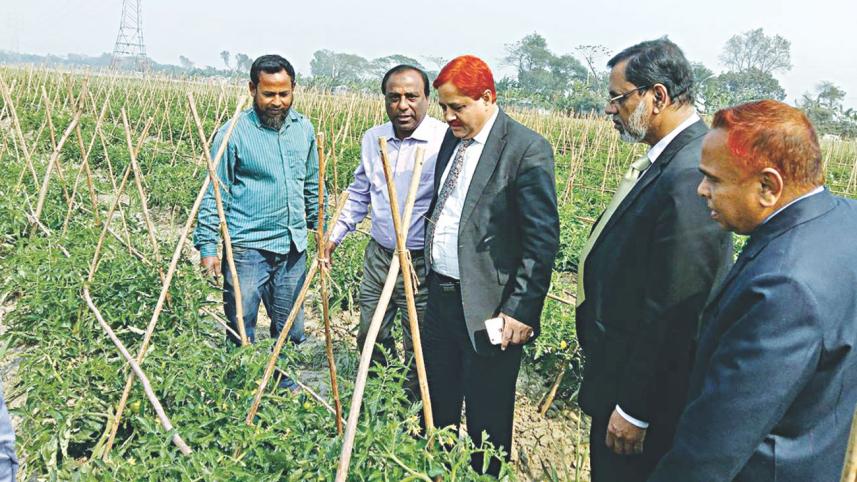
The Bangladesh Sugar and Food Industries Corporation (BSFIC) has taken up cultivating organic and pesticide-free vegetables, pulses and fruits on fallow land along with fish farming to reduce its annual losses to some extent.
As part of efforts to ensure supply of quality sugar at affordable prices in the country, the BSFIC cultivates sugarcane on some 15,000 acres of land to produce sugar alongside molasses, bagasse and press mud.
 For all latest news, follow The Daily Star's Google News channel.
 As per BSFIC Chairman AKM Delwer Hussain, sugar was sold at lower-than-market prices. As a result, production costs cannot be recovered, leading to recurring losses.
Bangladesh Economic Review 2018 showed that the loss was Tk 403.65 crore in fiscal 2017-18 (till April 30) whereas it was Tk 630.22 crore and Tk 516.52 crore in the preceding fiscal years.
The BSFIC already took up several initiatives, including increasing the production of sugar along with spirit, which is made by fermenting the molasses, to reduce the margin of the loss.
Its sugar production rose to 1.25 lakh tonnes till April 30 whereas it was 0.6 lakh tonnes and 0.58 lakh tonnes in 2016-17 and 2015-16 respectively.
Similarly, spirit production soared to 50 lakh litres whereas it was 47.32 lakh litres and 42.08 lakh litres earlier.
The current effort aims to use some 5,000 acres of land that remains unused at any given time.
The planting-to-harvesting period of sugarcane is around 14 to 15 months. Six to seven months have to be given to use the same land for the second time and a year for the third time.
During these “unused” periods, dhaincha (Sesbania sesban) is usually planted on the land to aid nitrogen fixation and improve soil health and fertility.
Now vegetables, some of which help soil regain its nutrition, pulses and fruits are being cultivated and fish farmed in ponds on these types of land.
Moreover, bagasse, the dry pulpy residue left after juice was extracted from sugarcane, and press mud, the residue from sugarcane juice filtration, were being turned to compost and used for the cultivation.
The use of the organic compost was what made people prefer their products, said Aminul Haque, chief of planning and development division of the BSFIC.
The BSFIC chairman said they started selling the crops at its Dhaka head office from last month where daily sales were reaching Tk 1.5-2 lakh though efforts of officials of different divisions taking up the responsibility by rotation.
“We want to ensure the best use of our land while keeping sugar production unhampered so that the loss of our corporation declines,” said Hussain.
“We are getting huge response in our vegetables and fruits cultivation though it is now being done on a test basis only,” he said, informing that the fish would be made available next month.
To meet the demand, the BSFIC is building another sales point at the Dhaka office so that vegetables and fish are made available in one while those with a longer shelf life such as pulses are sold in the other.
The BSFIC plans to set up more selling points and aims to annually earn Tk 50 crore from this sector in the coming years.


Comments